What does terrain bring to your gaming experience? Here’s a fresh take on how it can enhance your hobby, and help you remember your games years later.
Via Edward WinterRose at White Metal Games
“So where’s the building, then?” I asked.
 My GM, who had planned this out grabbed a dry erase marker and moved around the table and considered. On the tabletop was a larger rolled-out, tan hex map with printed hexes on it. It was blank in an unrolled parchment kind of way for fantasy gaming, except for the regular pattern of hexagons, convenient for the moving and facing of gaming miniatures. The innovation here was a large coffee-table sized pane of thick glass; suitable for drawing on with dry-erase markers.
There was a road, some bushes, and carts. My GM reached down and drew in a large couple of rectangles for the buildings, then thoughtfully added a few other shapes for obstacles and the like. It was innovative to me. But visually, I wasn’t entirely IN the scene, ya know? My imagination was doing the lion’s share of the heavy lifting. And that’s okay. I’m not shaming my old DM’s game. He made that story sing and dance. And even if the map and terrain I was seeing were more akin to concept doodles on a napkin, I still remember them.
We were playing in service of not getting bogged down in the details. That was cool too. It was the equivalent of setting your videogame’s graphics settings to lower detail for faster performance. We had foes to slay, and at least 6 players with two characters each. We didn’t need to make this skirmish stretch into 3 sessions rendering the scenery as works of fine art. Especially if we meant to just erase them later. It was quick and dirty and it was still fun.
But years later… I couldn’t tell you the details of that fight. Or what we were trying to accomplish at the time. This is no bad reflection on my GM. I tell ya sorry, gentle reader… But in my memory, it was ‘just another battle’.
Now contrast that with a time that I was with other pals of mine, and we were visiting a Games Workshop store here in Raleigh. My pal was checking up on minis he’d painted and put into a display case there as part of a competitive painting contest. My memory of the day is dominated by the large tabletops I saw there. Being a GW store, they had tables set up with countryside with hills and valleys and whole phalanxes of Lord of the Rings armies set to launch into one another. There was a blasted kind of cityscape, complete with ruined buildings and 40K minis jockeying for position on their Necron foes. There was a dark stone temple or dungeon setup with pillars and alters and a sense of claustrophobic cobbled depths and torchlight. I’d no idea what was being fought or what factions were gaming for victory. But I remember the scenes vividly.
I remember that.
Ultimately, I’m thinking this is the most valuable contribution your terrain is contributing to your wargaming experience. The memory anchored with the feeling of fun you were having at the time. You’re not merely flocking the grass and planting shrubs or bits of tree. You’re making a world your players are going to remember. I remembered the world I saw at the GW shop vividly enough that the next time I went back, I asked them if they’d let me photograph some of my minis on their terrain. They were very nice about it and patient. Remember that, if nothing else. You’re making memories.
However, you’re making some practical decisions too. I mean let’s get down to brass studs here.
Setting the Tone
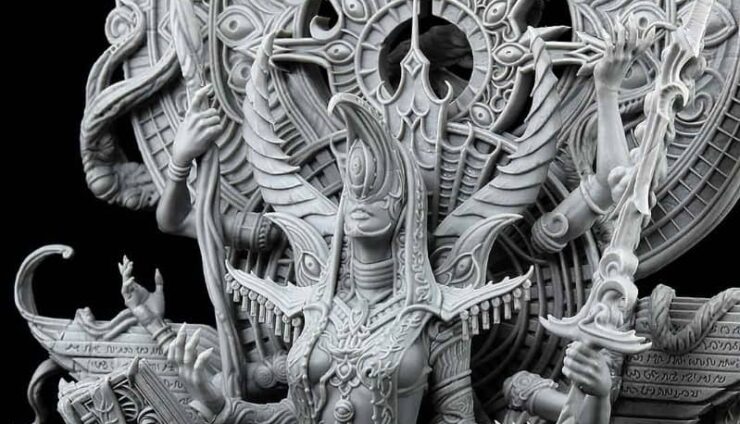
 I saw an article recently where someone was confronting the idea of terrain not being important in a video game situation. And maybe that was true to some degree in the nineties… maybe even the early aughts. Back when the rendering power of your machine was likely not up to something you’d see in a modern game. Terrain detail was the first thing you’d sacrifice to get the action running faster. But even then, there were standouts where the scenery was likely THE visual point of the game. ‘Darkseed’ in particular was one, featuring the organic machine surrealist worlds of H.R. Giger. The alien menace of those worlds set the tone of the horror adventure. Again, it was almost a throwaway nineties game, but the visuals were astonishing.
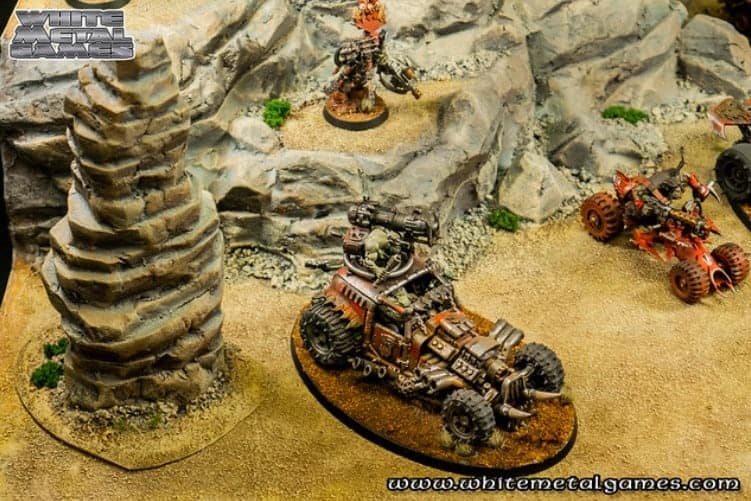
The menacing tone of the unfamiliar or alien. The oppressiveness of a desert. The lush difficulty of a jungle hell. The burnt and blackened scorch of an entrenched battlezone. The world around you determines the emotion of the situation you’re conveying. And the more detailed that is, the more memorable the experience. It is literally the difference between night and day for some. Especially if your game has vampires.
Setting the Action
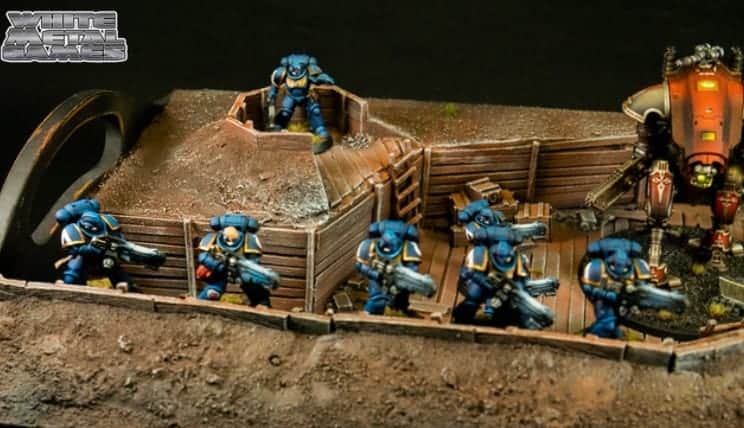 And then there’s the effect all this terrain’s going to have on your players psychologically. You can tell them that they’re in a dense forest, or a vast desert plain, or in a claustrophobic dungeon or space hulk all you like. There will still be something lost without that visual representation of how people are oriented. What they can see and what they can’t depends on where their character on the board is facing. What might be obscuring their line of sight? What they can realistically climb or jump up on or across? The suspense of a whole tabletop full of places their foes may be taking advantage of to ambush you.
There are assumptions your players might make as to what they can and can’t do, and therefore how they might behave in a given situation. Might this unit take the shot if they can pretty much eyeball that they really don’t have the best position for it? Might they instead try to get a better position instead? Might they resort to a spotter and use an indirect method of fire once they have a solution on their target? If they see that river of lava over there, maybe they’re not just going to rely on the stats of their equipment, which tells them they can probably jump that. Seeing it there, they may think twice. They may take on the feel that there’s more of a challenge here. Especially since the person running the game has chosen the battleground. There’s that feeling for your players that they’re not on their home turf. How can they strategically turn that terrain to their advantage?
Confronted visually with a dense jungle where guerillas might have set any number of ambushes or traps, where they can barely see one another, are they going to stick together so as not to get separated, or do they spread out so a munition doesn’t take out everyone at once? Are they going to try and snipe or get a single burst off at that guy they may only see partially through the foliage, or are they going to ‘spray and pray’? But they’re already making decisions based on what they’re SEEING. Not just what the rules tell them they can and can’t do. That’s going to lead to a lot less assumption and/or disagreements that can slow or bring a game to a tooth or tusk-grinding halt. Which brings me to…
Removing the Guesswork

“I waste him with my crossbow!”
“Dude, you can’t even SEE him.”
Ever launched into a ten-minute debate with a player over whether they had that shot or not? We had a ruler for that back on the hexmap and glass arrangement I used to RP over. But, like the man said, it showed ‘Two-dimensional thinking’. “I can see over that rock/wall, can’t I? How tall is it?” Blah Blah woof woof. In the case of your actual terrain, you’ve got that third dimension to work with and the measuring sticks to show whether or not your player’s got the shot or not. Can they be seen around or through that obscuring piece of scenery?
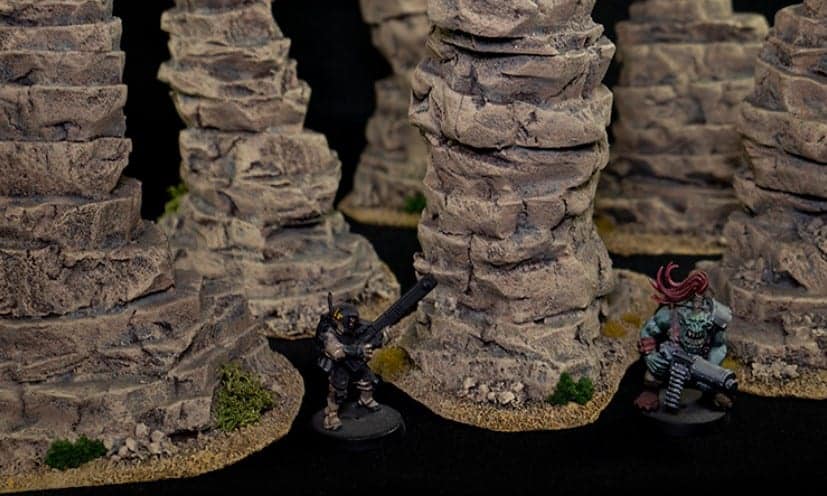
I’m already looking at some of the examples here in this jungle terrain set my people have done and it has me rethinking strategy. The taller ferns here, the trees that your units ordinarily might not even look up into. The underbrush and bushes all around that indigenous life might hop out of. How I might want to set up a killzone or an ambush. All the decisions I might not even take into consideration on the hexmap open up to me and suggest different strategies towards my victory conditions.
The very practical ability to eyeball a situation and make it work for you, or replace the need to pull out a book and start math-ing your situation to death is, if I may paraphrase, a blood godsend. And probably worth the time and effort you’ll spend making it. Or borrowing. Or leasing, if you get my drift. We’ve got those too.
The Windup and the Pitch
 So we’ve covered points a bit more in-depth than I’ve seen when it comes to some of the research and reading I did for this article. Oddly, I was astonished at how little it was commented on in a cursory search on the matter. I mean, I’m not re-inventing the wheel here. I’m kind of editorializing on the idea of terrain on the gaming table. I wanted to know what observations I could bring without repeating what’s been said ad nausea, etc. Most of what I found was a commentary on what point strength armies recommended for this or that kind of terrain or reviews of existing terrain. Not the actual practicality of the stuff or why it’s a good idea.
And it is a good idea. It can make the difference between what’s a good course of action or a party wipe. It’s the difference between advantage and disadvantage on the battlefield, and how your players will strategize. It’s the difference between a flat table and 3 dimensions. It’s certainly the difference between having to TELL your players what they can see, and being able to SHOW them. It’s the opportunity to move your players emotionally, or thrill, intimidate, terrify or otherwise astound your players instead of just rolling dice and cheering the occasional critical hit at just the right point in time. It’s whether or not your players are going to have a visual to go with the memory of that one session that will live on in their tabletop stories for years to come. It’s making memories.
What’s that worth to you?
Edward WinterRose is a 48th level nerd with a 30 year character backstory of roleplaying games across who knows how many gaming systems at this point. Oddly, he does not consider this time wasted, and will fight about it for days.