AMG has pulled the plug on Star Wars: Shatterpoint and moved it to a specialist line. Here’s what “less support” really means, what’s next for the game.
Atomic Mass Games dropped a statement about “strategic focus” and “realigning resources,” and the headline hobby takeaway is simple: Star Wars: Shatterpoint is being shifted into a “specialist core game line,” with fewer releases going forward.
The studio says it will keep Shatterpoint available and supported, but the real weight of their future attention is going to Star Wars: Legion and Marvel: Crisis Protocol.
If this sounds familiar, it should. AMG previously announced something similar at the end of development for Star Wars: X-Wing and Star Wars: Armada.
AMG Clarifies Its Statement About Shatterpoint Support
Updated March 12, 2026, by Rob Baer with a new statement from AMG.
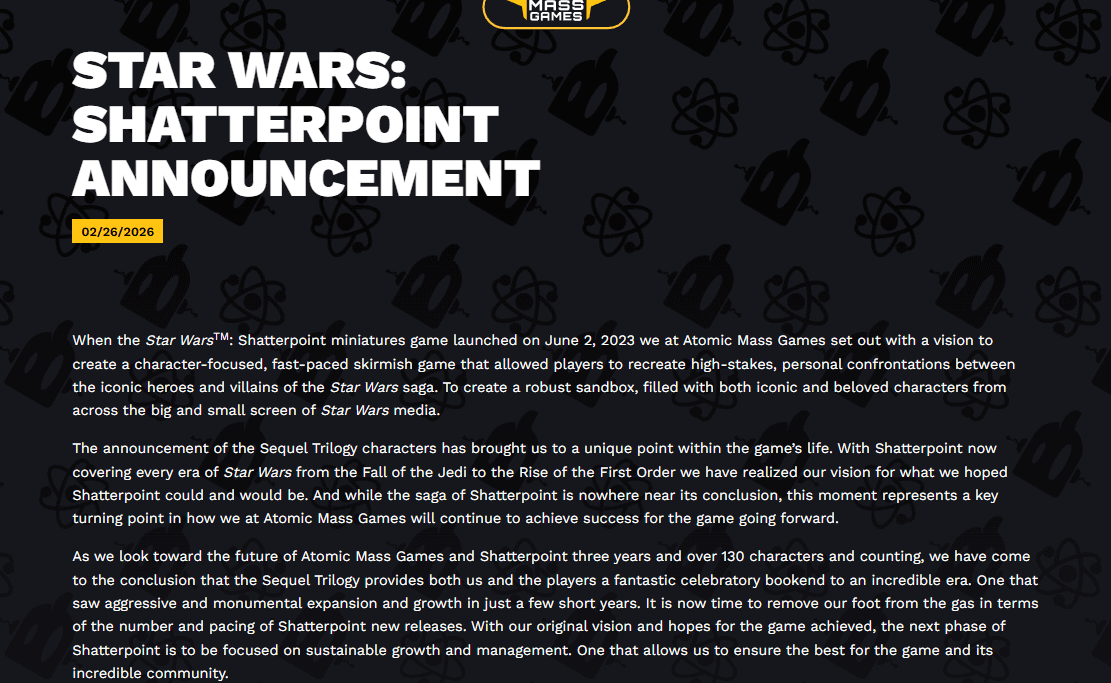 After several days, Atomic Mass Games clarified their jarring shareholder forward statement about the game, and their core message is blunt: Shatterpoint is not going anywhere.
From their point of view, the game has basically hit its “vision achieved” moment. Three years in, more than one hundred thirty characters, and every era covered from the Fall of the Jedi to the Rise of the First Order. They are framing the Sequel Trilogy characters as a celebratory bookend to that rapid expansion phase.
So what changes? AMG says it is time to ease off the release throttle. Fewer, slower new drops, and a shift toward sustainable support instead of constant expansion. They also promise the usual “keep the lights on” essentials that players actually care about: regular rules updates, an annual character balance pass, and more investment in Organized Play.

That includes everything from print and play experiences for casual tables, to in-store leagues and tournaments, all the way up to Grand Tournament and World Championship level events. They even teased a preview of the next rebalance during the AdeptiCon Roadmap presentation, which at least suggests there is a plan on the calendar.
But here’s the catch: player confidence is fragile in AMG, and they have work to do after repeated studio turnover and the baggage from Armada and X-Wing. Which makes us wonder why they made the big polished statement to shareholders first, then followed up with the message to hobbyists.
The people who actually buy the game and keep it moving are feeling a little left behind right now, and once that perception spreads, the damage is real, especially when some stores are already calling the game “dead.”
At this point, the words matter less than the follow-through. If AMG delivers consistent updates, real Organized Play support, and steady momentum, Shatterpoint will probably be fine. If not, the community will move on.
What AMG Actually Said About Star Wars Shatterpoint (And What It Means)
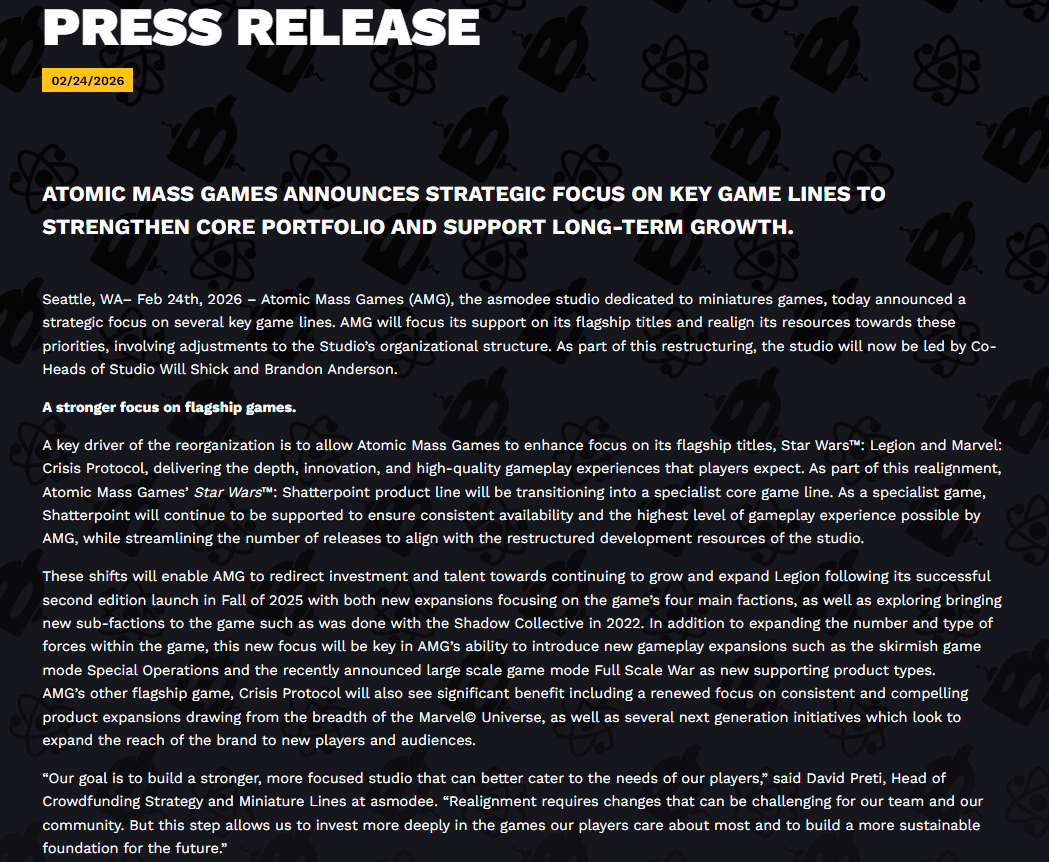
So, is Shatterpoint “dead?” On paper, no. In reality, moving a game to a specialist line usually means it stops being a regularly-fed mainline game and becomes a “keep it on the shelf, keep it playable” product.
Translation: still playable, still buyable, but not the cadence you need for a thriving scene.
AMG’s statement frames this as a reorg to focus on “flagship titles” and to “streamline the number of releases” for Star Wars: Shatterpoint to match reduced development resources. In the same breath, they highlight Legion’s growth plans and Crisis Protocol’s ongoing expansion.
The hobby translation
- “Specialist core game line” usually equals: fewer releases, fewer organized play pushes, fewer big rules shakeups, and less marketing oxygen.
- “Consistent availability” is good news for casual players and collectors. It means you are less likely to get stranded with an unsupported ruleset and disappearing stock.
- “Streamlining releases” is the part tournament communities hate, because consistent hype cycles are what keep locals firing weekly.
Why Players Are Side-Eyeing This Announcement
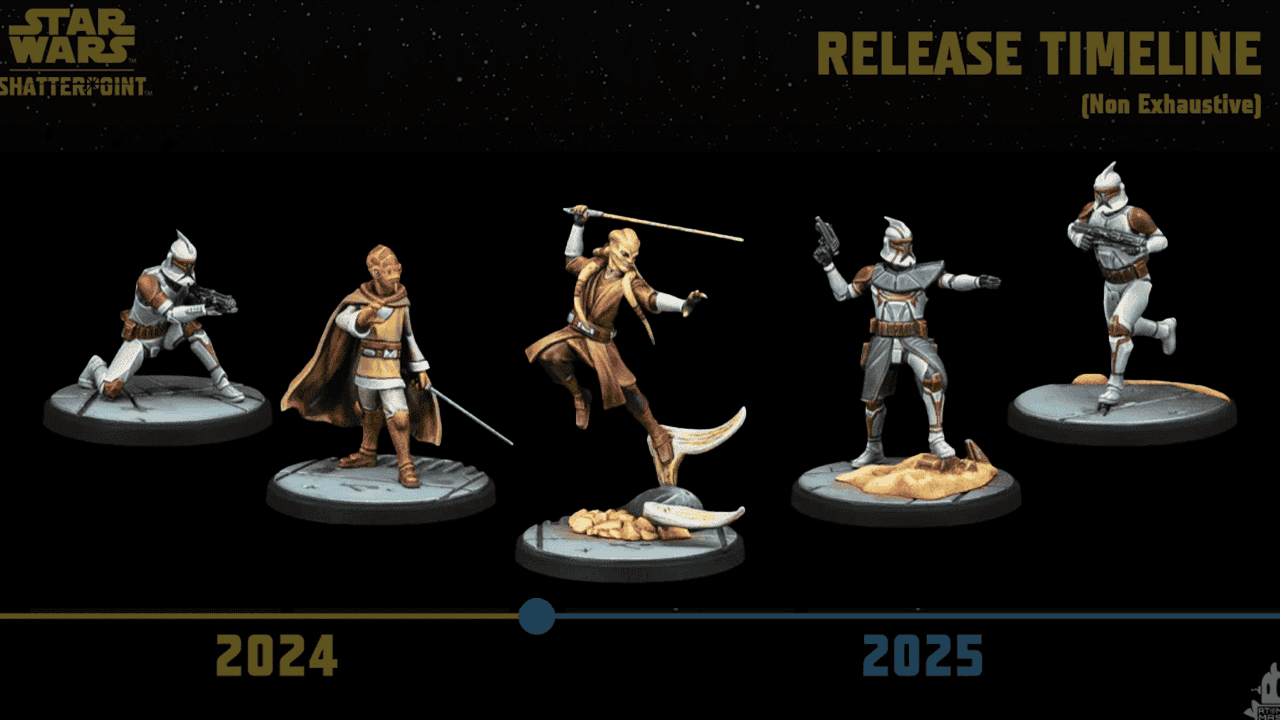 A lot of hobbyists are reading the tone as shareholder-first, community-second. That reaction is not happening in a vacuum. AMG already ended development on X-Wing and Armada, and while they said they were “not stepping away entirely,” the meaningful pipeline stopped.
If you’re a Shatterpoint player, you’re not crazy for feeling like this is the same movie with a different title card. This also makes AMG ever launching a new Star Wars game tough. IF you’ve killed off three already, it’s hard to get players to buy into another.
Timing Matters: Shatterpoint’s Launch Window Did It No Favors
 Shatterpoint launched into the market right when 10th Edition 40k launched, which obviously dominated attention and hobby budgets.
Releasing a brand-new miniatures game into a heavy 40k hype cycle is basically choosing to play retail on hard mode.
Meanwhile, Legion’s more recent momentum has looked smarter: a clearer roadmap, more structured reengagement, and a deliberate “come back to the big table” vibe. Plus, they relaunched in the middle of a 40k Edition, when players’ attention is much more up for grabs.
People only have so much hobby time and money, and it’s hard to go head-to-head with Warhammer 40k.
The Real Winners Here: Legion and Crisis Protocol
 AMG’s statement is practically a billboard for Legion and Marvel: Crisis Protocol, and the supporting ecosystem is already there.
Star Wars: Legion is getting more support and a bigger tent
Legion already has official support for different ways to play, including Special Operations as a skirmish mode. And coverage around upcoming large-format play has been circulating in the hobby media ecosystem.
Since AMG is reallocating development talent, Legion is exactly where you would expect those resources to land: it is the mass-battle Star Wars lane, with room for expansions, formats, and faction growth.
Marvel: Crisis Protocol stays the steady earner
Crisis Protocol has a deep well of characters, steady release potential, and a player base that tends to buy models because they like the character, not because the meta demands it. That makes it a safer flagship to keep pushing.
So, What Should Shatterpoint Players Do Right Now?
 Here’s a way to look at the situation.
If you love Shatterpoint and want to keep playing
- Lock in your “forever table” kit. Grab the core, the missions you like, and the squads you genuinely enjoy painting and playing. Treat it like a complete boxed ecosystem.
- Build local formats that don’t rely on new releases. Escalation leagues, narrative nights, themed events, “era” brackets, anything that keeps games fresh without waiting for a drip feed.
- Archive your rules and cards responsibly. Keep PDFs, printouts, and references organized so you’re not scrambling later when links move or product pages rotate.
- Focus on terrain and missions. Specialist games live or die on replayability. Terrain variety does more for long-term fun than one more squad you feel obligated to buy.
If you’re on the fence about buying into Shatterpoint
- Buy the game you can play this month, not the game you hope it becomes next year.
- If your local scene is strong, jumping in can still be an okay call, especially if you love the models and the cinematic feel.
- If your local scene is shaky and you are counting on AMG to “grow it for you,” that is a risk now.
- Be careful, though, don’t go wild and spend your whole hobby budget, because the scene will shrink
Is “Specialist Line” Always a Death Sentence?
Not always, but it’s always a status change.
A specialist game can be healthy if:
- core product stays available,
- rules stay stable,
- the community self-organizes events,
- the company does occasional refreshes and seasonal updates.
A specialist game struggles when:
- it loses organized play oxygen,
- releases become unpredictable,
- rules updates slow to a crawl,
- people lose interest in playing the same missions and minis,
- new player onboarding fades.
AMG’s wording points to stability and availability, but also clearly signals reduced release cadence. That combo tends to produce a game that is great for friend groups and dedicated locals who already have a collection, and rough for players who want a constantly evolving scene or new players coming in.
The Bottom Line: Shatterpoint Isn’t “Gone,” But the Growth Era Looks Over

AMG is telling you, in corporate-speak, that Shatterpoint is no longer a top priority. That doesn’t delete your collection, and it doesn’t cancel your game nights.
It does mean the smart move is to treat Shatterpoint like a game that will be supported “enough,” while Legion and Crisis Protocol get the real investment.
If you want to keep Shatterpoint alive, the play is simple: build community momentum that doesn’t depend on new boxes showing up every other month. That way the specialist status becomes a label, not a tombstone.
See the Existing Shatterpoint Roadmap & Releases Here