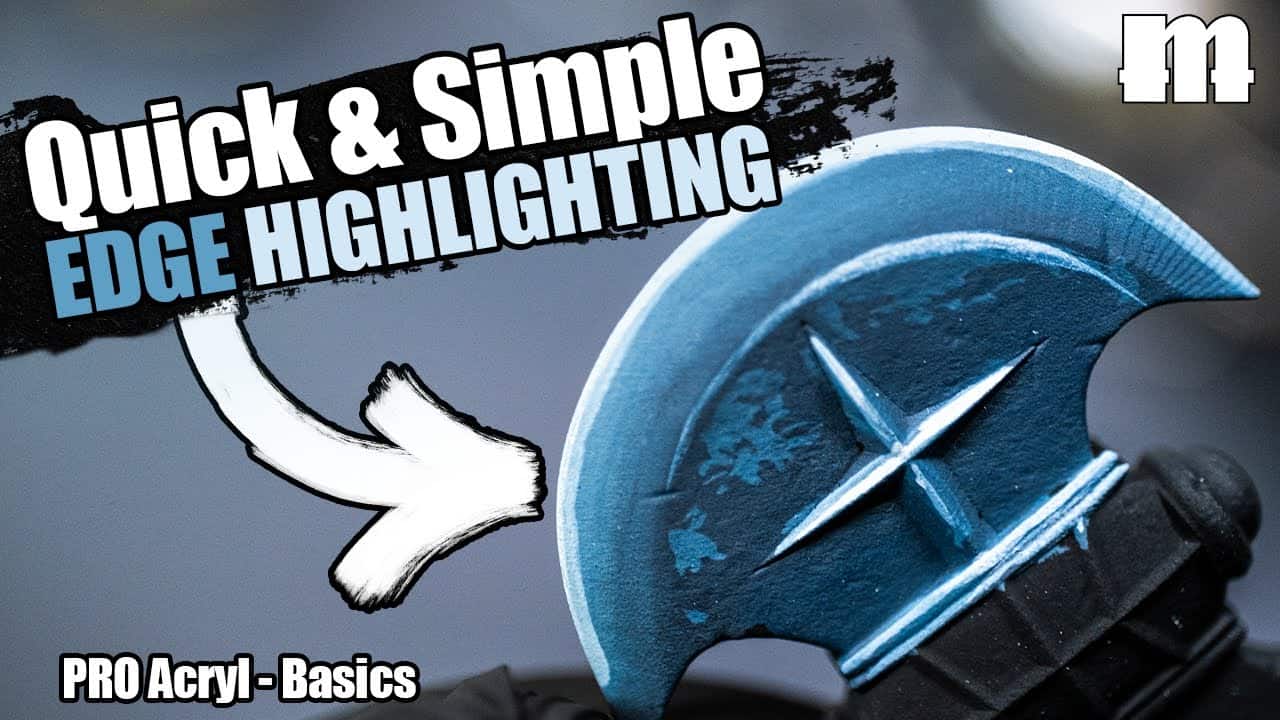
Learn how to edge highlight miniatures fast, clean, and without the stress; big brushes, right angles, and no neon mess from Monument Hobbies.
Edge highlighting doesn’t need to feel like brain surgery with a size OO brush. If you’ve ever ended up with neon stripes instead of crisp accents, you’re not alone—and yes, there’s a better way.
This method skips the stress, keeps your shadows intact, and leans on big brushes, smart angles, and smooth transitions.
Straight from Monument Hobbies, this quick and simple approach gives your minis that final pop without turning them into glowing sci-fi billboards.
Let’s break it down and get your highlights looking sharp, clean, and actually under control.
How to Edge Highlight: The Not-So-Secret Sauce

Edge highlighting. It’s the final touch. The finishing flick. The subtle flex that says, “Yeah, I know what I’m doing.”
And while it may seem like wizardry at first, it’s really more like making toast: if you know the timing, angle, and pressure, you won’t burn it—or in this case, jam bright paint into your darkest recesses.
This breakdown comes straight from Monument Hobbies, where brushes are big, opinions are strong, and learning is delightfully unpretentious.
Let’s get into the gritty (and slightly glowy) details of edge highlighting—without turning your mini into a rejected prop from Tron.
Get Your Paints From Monument!
 The paints used in the video are from Monument Hobbies, and you can grab them here!
Snag your new Monument goodies and give us a high-five in support! Every qualifying purchase helps Spikey Bits keep the lights on and the fun going.
Be sure to get 10% off on your purchase by using promo code: Spikeybits
Big Brush Energy
 Forget the size-zero brush you’ve been clutching like a security blanket. Get yourself something chunkier. A number six works great here. Why? You’re using the side of the brush, not the point.
A larger brush gives you more control over the line’s consistency and less chance you’ll slip and throw a pale streak across your painstakingly shaded surface.
Start in the Shadows
 The real strength of edge highlighting doesn’t come from slapping on bright ivory and calling it a day. It’s about building up to that final moment. Think of it like layering up for winter: if you go straight from base coat to max brightness, it looks jarring.
Like your miniature got hit with a neon Sharpie. Start with a dark base—maybe a blue-black mix—and slowly work your way up through midtones.
For metal? You’re probably beginning with steel tones. Blend in a little dark ivory to that base for your first highlight.
It doesn’t need to be perfect; go for quick blends with a soft texture.
You’re just getting the forms to start catching light. Wet blending, stippling, whatever feels right. The point is to build that transition before the edge highlight comes in to steal the show.
The Angle Game
 Here’s where the magic starts: angle control.
When you apply the highlight, hold the brush at about 75 degrees to the surface. Drag the side of it gently along the sharp edges.
This isn’t a paint-by-numbers exercise—rotate the model constantly to keep that line clean and consistent. You want the paint to just kiss the edge.
Once you’ve got your initial line down and the gradient underneath is looking good, crank things up. Grab your brightest color—say, bright ivory.
This time, increase the brush angle closer to 90 degrees. This lets you skim only the very top of the edge, laying down a much thinner, crisper line.
Want it to glow a little more at a focal point? Here’s the trick: change the angle again. Start at 90 degrees, then drop back to 75 just in that one area.
Your line naturally thickens, giving the illusion of light concentrating at the center and fading at the ends. It’s a visual trick, and it works beautifully.
When the Brush Side Won’t Cut It
 Not all edges are created equal. Sometimes, like with tiny stars or oddly shaped armor bits, the side of the brush just isn’t going to do the job. That’s when you go back to the tip—but carefully for miniature edge highlighting.
Use short, deliberate strokes with the point of your brush. Stay light. This isn’t a fencing match. Sketch in the line slowly, making sure it hugs the edge without flooding the crevices.
Once the shape is there and you’re happy with the placement, you can thicken it a bit by applying more pressure, just in key areas where you want to suggest stronger reflection.
This applies to pretty much any material: armor plates, fabric folds, weapon blades. Where light would naturally hit hardest, your line gets a little thicker.
Where it fades off into shadow? Keep it thin and subtle.
Directional Light with Minimal Drama
 The goal isn’t to create high-contrast outlines that look like cel shading from a comic book (unless that’s your style—no shade). It’s to blend that top highlight into the previous work in a way that makes it feel natural.
So maybe you’re highlighting a curved blade. You apply a thin line near the hilt, then let it get thicker toward the center where the light would catch more, then taper off again near the tip. You’re sketching with light, not just tracing edges.
And don’t forget about the less obvious surfaces. The tops of points, the upper ridges of details, even little star tips—these can all catch that final touch of brightness. Just keep your brush light and your intention clear.
Wrapping Up: How to Edge Highlight Miniatures
 Edge highlighting might look like the cherry on top, but it’s really the result of all the flavors you built underneath. That last bright streak doesn’t stand on its own—it works because of the shadows, the transitions, and your control of line weight and angle.
From start to finish, this method leans on simplicity, speed, and solid fundamentals. No gimmicks. Just clear steps, intentional layering, and a bit of brush awareness.
And if all this sounds like the kind of approach that makes you want to grab a mini and start painting right now—well, that’s exactly what Monument Hobbies is known for.
So grab a bigger brush, get your base tones down, and start sliding that highlight across like you’ve been doing it for years.
Because by the end of this process for edge highlight miniatures, you kind of have.
Grab Your Paints From Monument Hobbies Here!
Will you be using this method the next time you are edge miniature painting?