
Official Warhammer 40k 10th Edition Core Rules PDF download link, plus a quick overview of the core concepts and how the game plays.
This is the core rules book only, so you get the overall game rules that are used for every faction. Codex rules and individual army lists still come separately, with a free faction index Datacard PDF filling that gap on day one.
If you play 10th Edition Warhammer 40k, this is the file to save right now. We have the download link below.
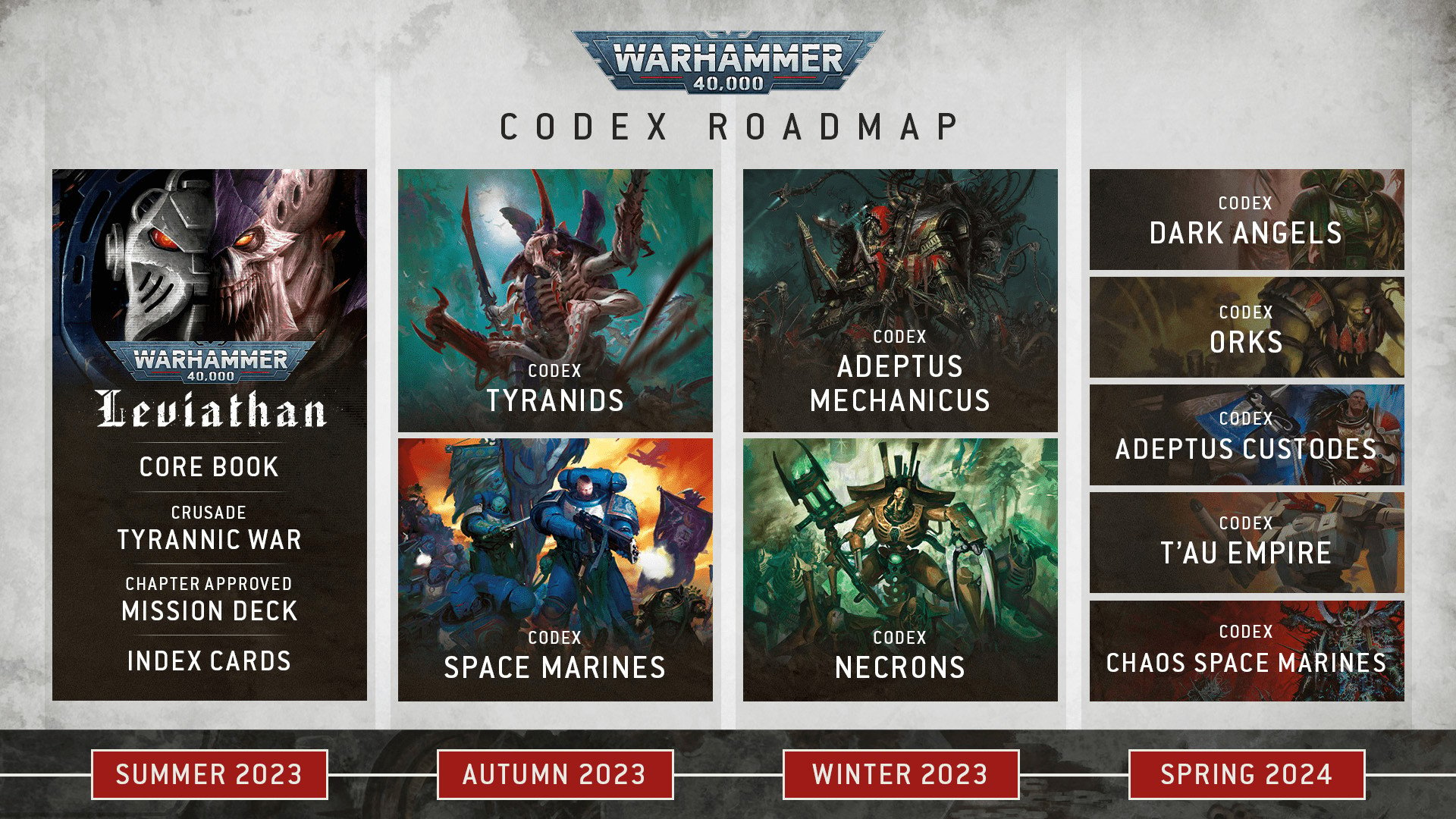
Warhammer 40k 10th Edition Year One Codex Rulebook Roadmap
Updated July 2nd, 2026, by Rob Baer with the latest information and links.
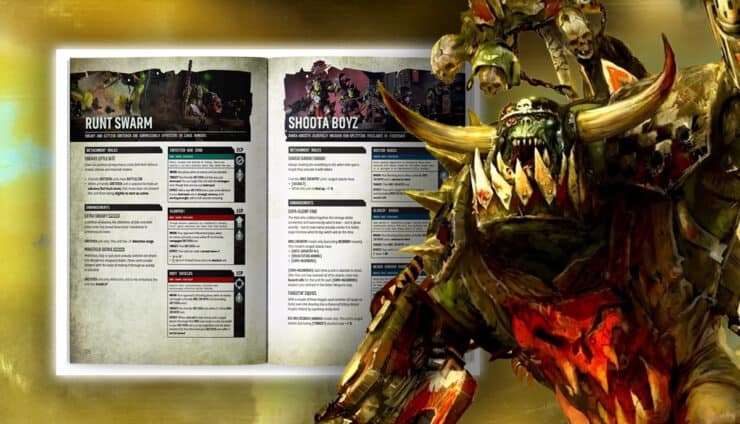
Here’s the overall take: don’t wait for your codex to start playing. Every faction gets a full set of Index Cards with datacards, Detachment rules, Stratagems, and Enhancements as a free download on day one, and affordable physical copies dropped at the same time.
You won’t even have to wait for your Codex to start playing! Every single faction is getting a complete set of Index Cards with datacards for each unit that’s currently available, as well as their own Detachment rules, Stratagems, and Enhancements. These will be available to download online for free from day one, while they’ll also become available in the app. You’ll be able to buy inexpensive physical copies at the same time.
Games Workshop also confirmed on the livestream that each faction on the year-one codex roadmap will get a new model released alongside its rules. That’s the concrete part worth planning around, since it means if your army is on that list, at least one new kit is coming with the book.
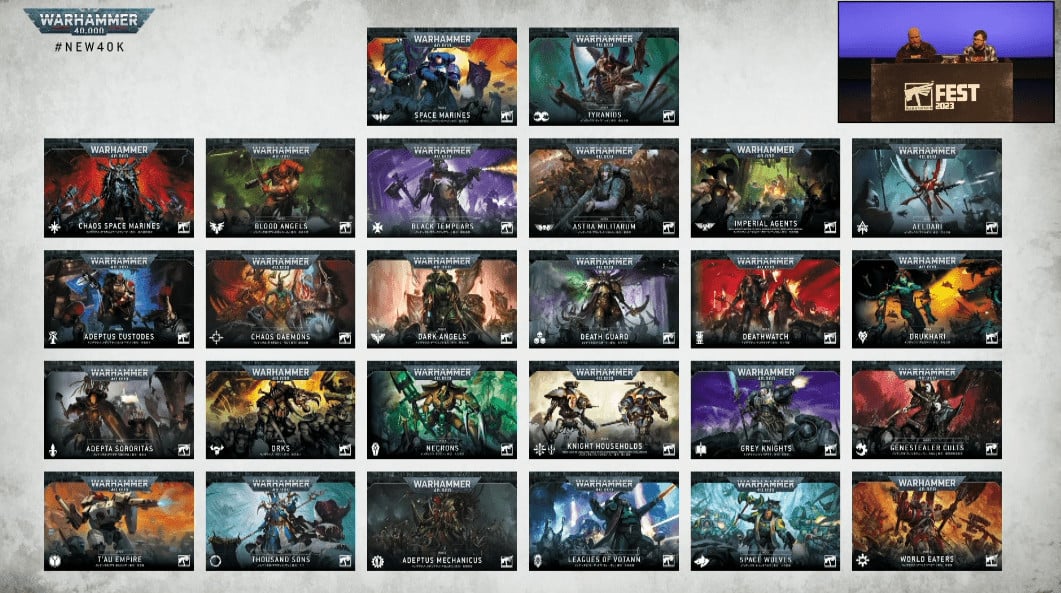
All 28 Warhammer 40k factions get datacards free to download and on store shelves. This makes the plan for 10th pretty simple: grab the indexes when they land, and check the roadmap for when your codex is up so you can budget for the new model (or models) that comes with it.
Latest Updates & New Rules Articles For Warhammer 40k 10th Edition
For deeper reads on each phase and each subsystem, these are the core rules deep-dives worth pulling up alongside the PDF.
- Core Rules: Command Phase & Battle Shock Tests – how the new first-phase battle-shock tests work.
- Core Rules: Movement & Reinforcements – the new movement step and the dedicated reserves sub-phase.
- Core Rules: Shooting Phase – Lone Operative, Stealth, and Big Guns Never Tire.
- Core Rules: Charge & Fight Phases – how the melee sequence shakes out.
- Core Rules: Weapons & Deployment – weapon abilities and the new deployment rules.
- Core Rules: Reserves & Stratagems – the 12 core stratagems and reserve limits.
- Core Rules: Transports & Aircraft – embark, disembark, and the new aircraft reserves rule.
- Core Rules: Terrain Features & Cover – the new cover cap and terrain movement rules.
- Core Rules: Muster Your Army & Missions – army building limits and mission setup.
- Free GW Warhammer 40k App Army Builder – official list builder for the new edition.
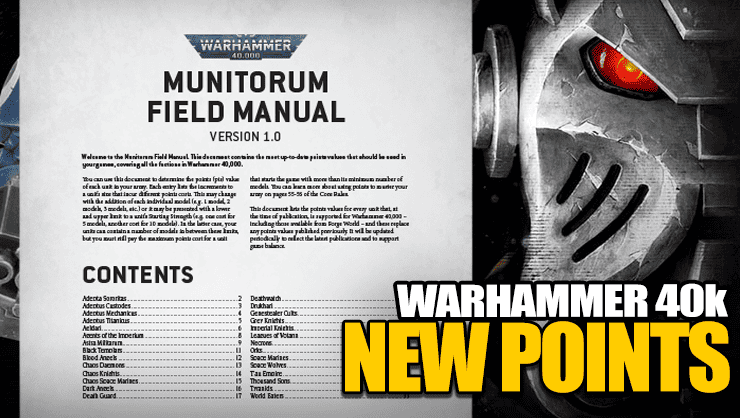
- All the 10th Edition Munitorum Field Manual Points – the full points update for every faction.
- 10th Edition Rules FAQ & Designer’s Commentary – GW’s official rulings on the new edition.
- New 10th Edition Warhammer 40k Starter Set – Leviathan box contents and value breakdown.
- What Will Happen to Codex Books in 10th Edition – the codex release plan.
- How to Build Army Lists in 10th Edition – the new army building framework.
- Free PDF Download for 10th Edition USR Rules – the printer-friendly universal special rules chart.
- A Pattern in the 10th Edition Codex Releases – what the roadmap timing tells us.
Here is where you can download all the full 40k Core rules. The file is the core rules only, so save it alongside your faction index Datacard PDF, and you have everything you need to start playing.
FREE Download 10th Edition Warhammer 40k Core Rules PDF

If you’re looking for a chart of the USR rules, a “printer-friendly” version is also posted here. Here are all the latest rules changes from the Free 10th Edition 40k PDF Rules Book download!
10th Edition 40k core Rules: Core Concepts
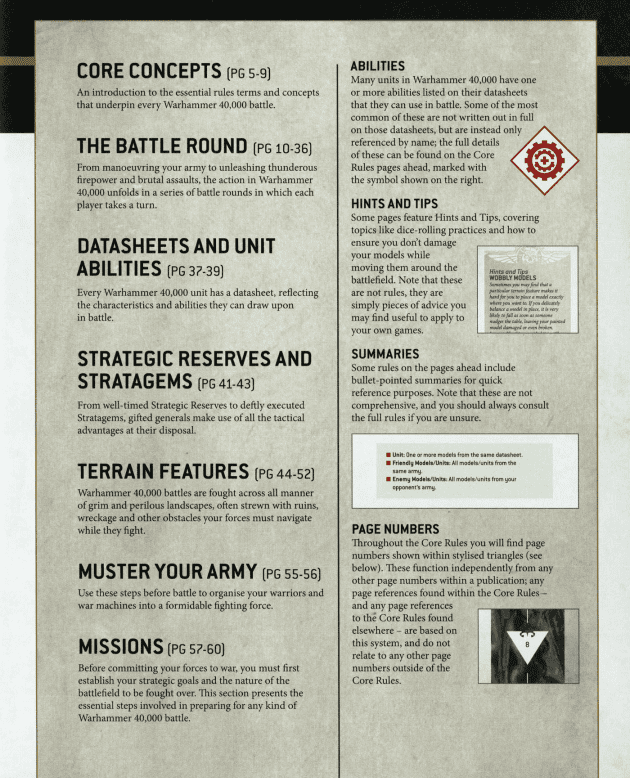
First up in the PDF is the table of contents and the glossary. It’s worth flipping to for one practical reason: the core rules use their own page numbers, independent of the Leviathan box book, so any group can point to the same page whether they’re using the boxed rulebook or the free download.

The glossary is where a lot of table arguments will get settled. Terms like Engagement Range, coherency, and OC (Objective Control) get single-line definitions in one place, which helps at the table when someone asks whether OC applies to models that jumped out of a transport this turn. Save the page or bookmark it, because you will look at it during games.
Coherency & Engagement Range
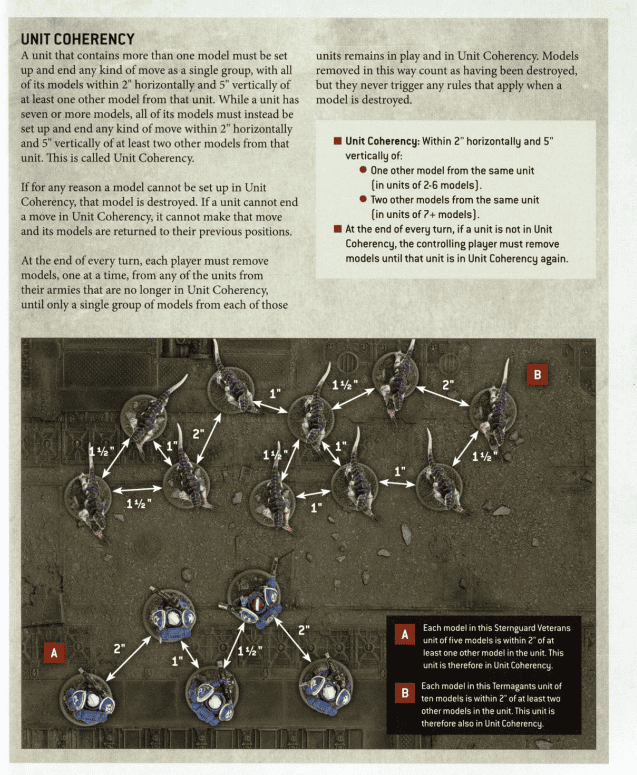
Coherency depends on the size of the unit now. So, if you’re a unit under seven models, you have to be within 2″ horizontally and 5″ vertically, letting you have units go up buildings.
Then, if you’re a unit of seven models or over, you have to be within the coherency of at least two models. If your turn ends and you’re not in coherency, you must remove models until the unit is coherent.
Having to be within two models will probably stop the insane conga lining we have seen in the past.
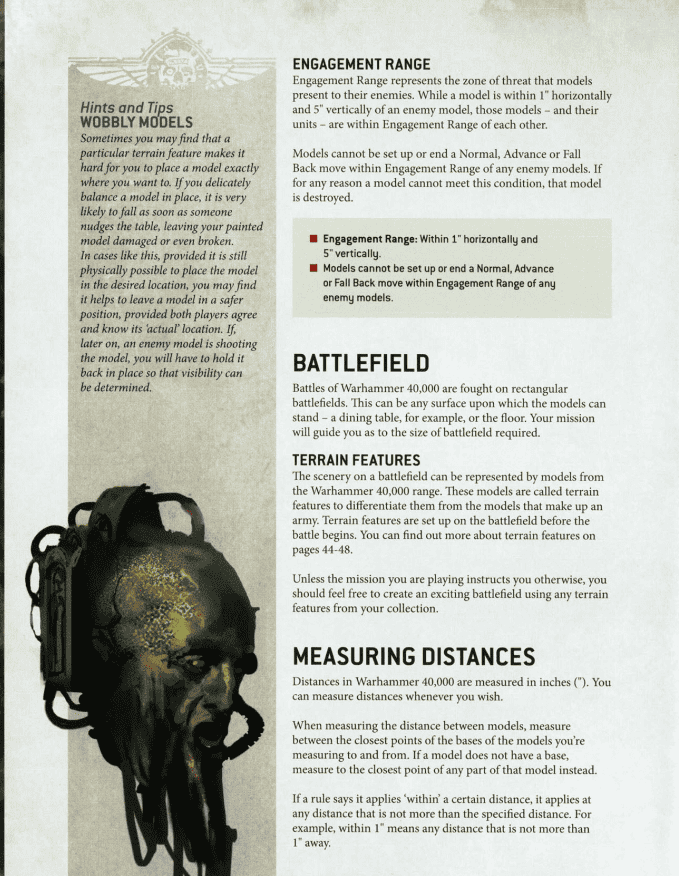
Engagement Range is still 1″, but also 5″ vertically, meaning you don’t have to go all the way up a terrain feature to count as being in combat. You can still pre-measure distances, and when you do, measure closest to closest.
Visibility

Visibility is model-to-model, and if you can see any part of a model in the target unit, you can shoot at it.
The edge case that comes up at the table: partial visibility still counts. So if a single Ork boy’s shoulder is poking around a ruin, the whole unit is a legal target for that shooter. Line of sight from the shooting model to the target model, not unit to unit.
10th Edition 40k Core Rules: Muster Your Army & Missions

1,000 to 3,000-point games are pretty standard, but there will also be a Combat Patrol style game type as well. Just keep in mind when you build your army, you must pick a keyword faction for your entire army.
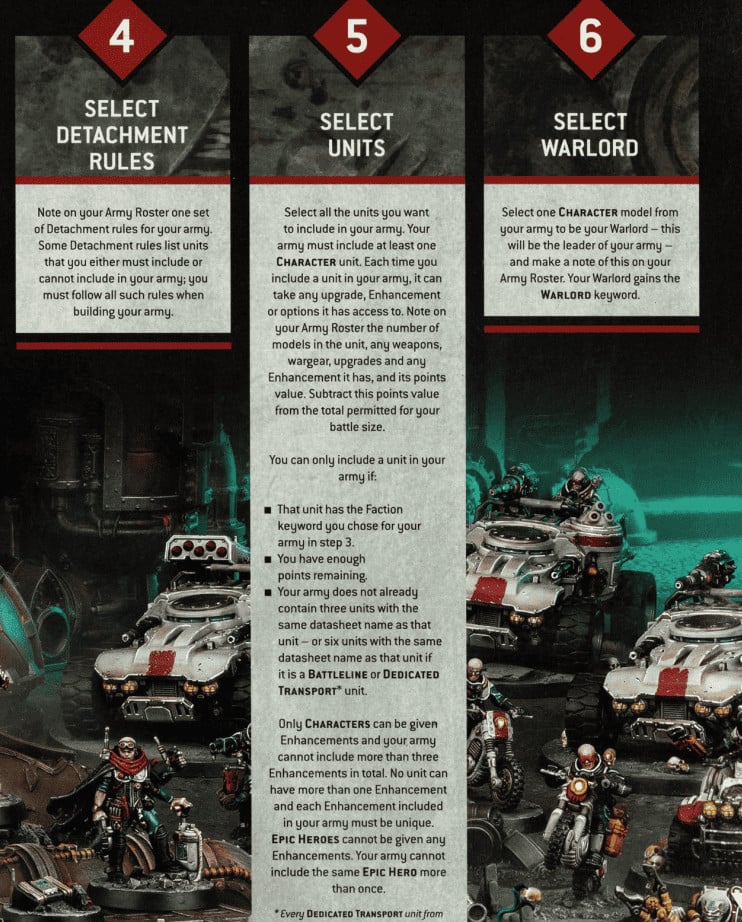
From there, when you pick a certain detachment, your army gains the additional rules. Then, your characters can have enhancements now instead of Relics. For the rest of your forces, you can basically take anything as long as you don’t have more than three of any one unit (with battleline and dedicated transports having a maximum of six).
You can also include more than one Epic Hero, just not more than one of each. Lastly, you pick who your Warlord is.
10th Edition Warhammer 40k Missions
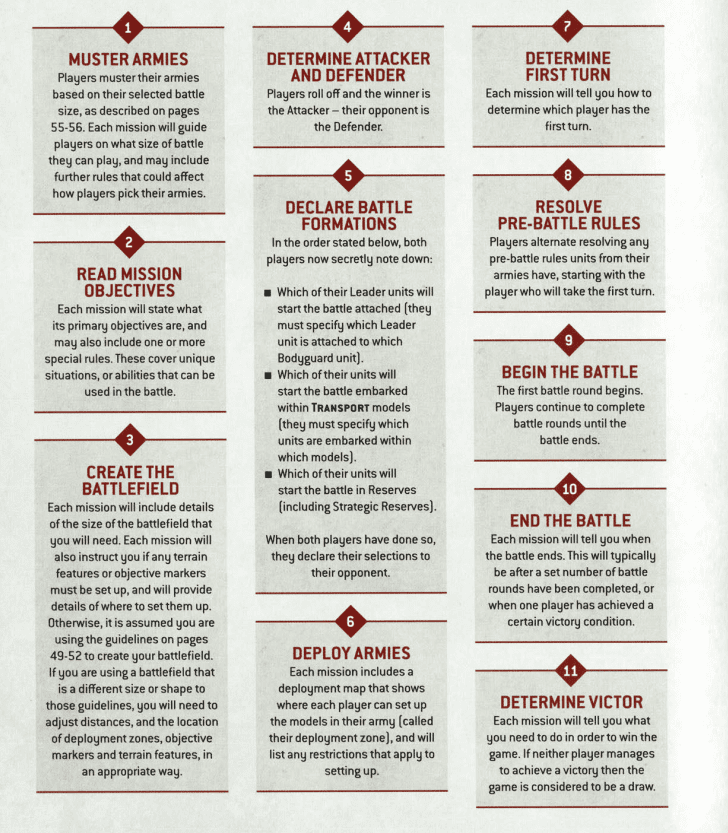
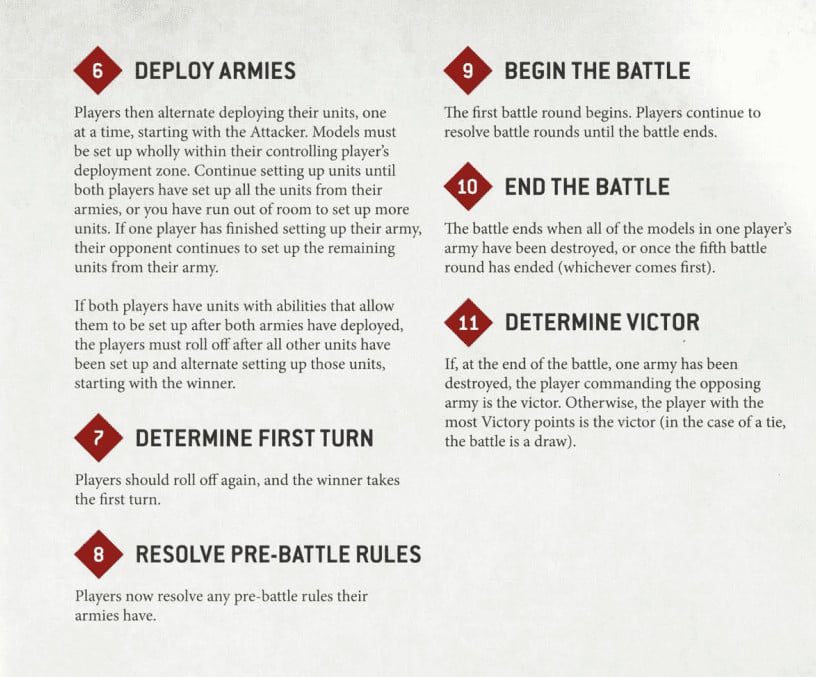
Here are the mission changes that actually change how you play, pulled from the missions in the PDF:
- Deployment declarations happen before models hit the table: which units your characters join, which units start embarked, and which models go to Strategic Reserves.
- The player taking the first turn moves their Scouts first, then you do infiltrators.
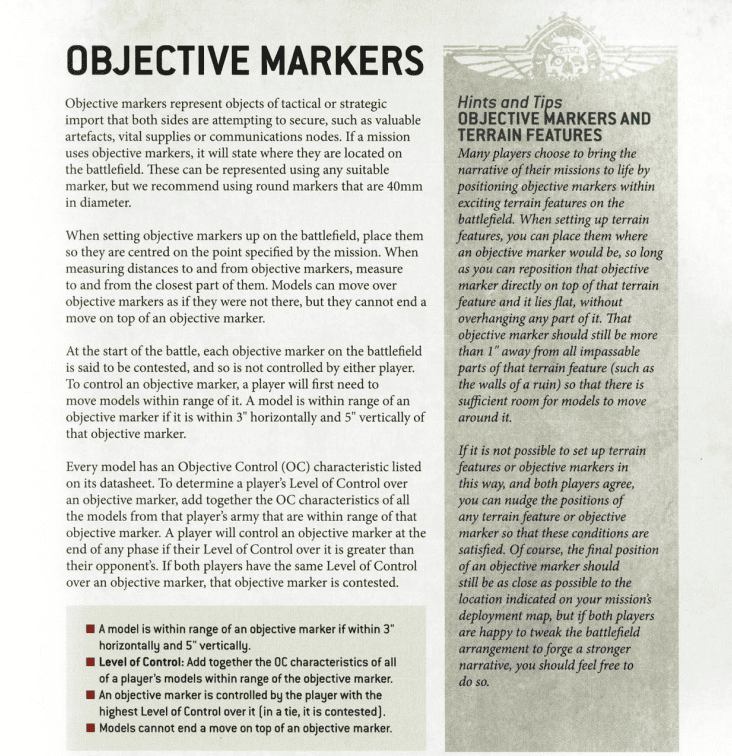
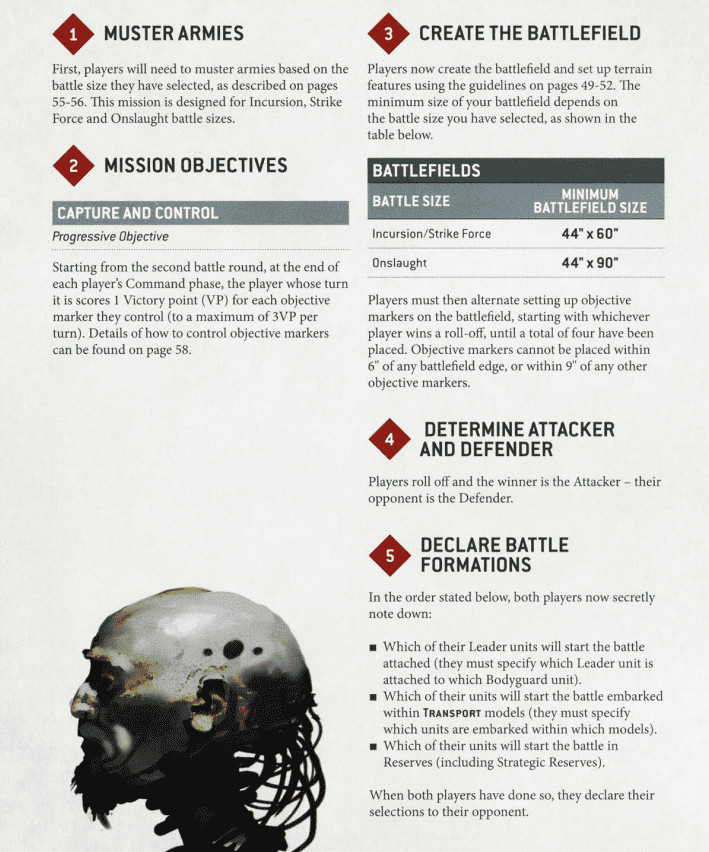
- Objective markers no longer let you stand on top of them. You control an objective by having a model within 3″, using roughly a 40mm base as the marker.
- Objective control uses OC. If your combined OC in range is higher than the enemy’s, you hold the objective, so bringing an OC-heavy unit into range is what decides the objective, not raw model count.
- You start scoring VP for primary objectives from turn two, not turn one. Boards stay the same size.
- Secondaries can be fixed or random, and each player picks which they use.
- Games run five rounds. The winner is whoever tables the opponent or scores more points by the end.


Terrain Features & Cover: Key Changes
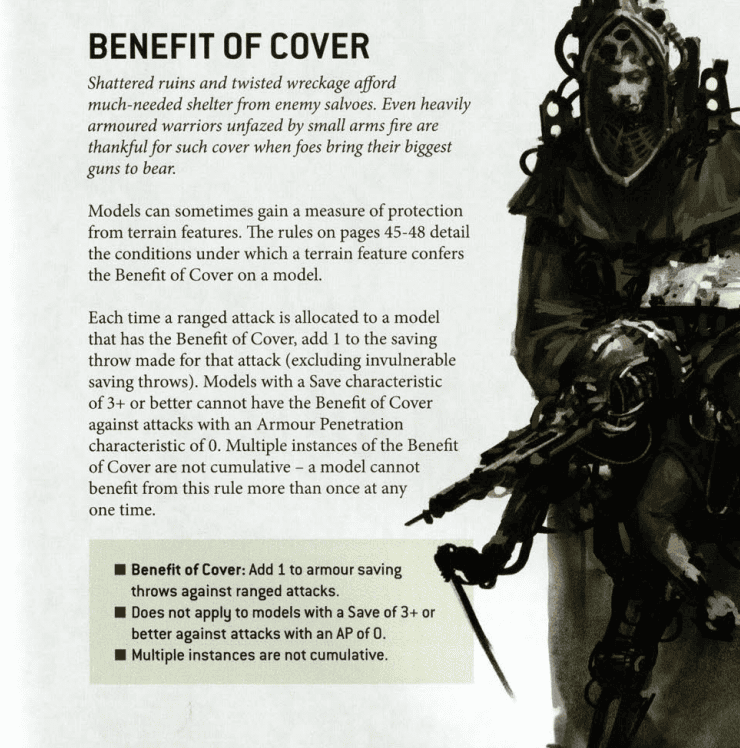
Cover is capped in 10th. You get +1 to your save from cover, but a 3+ save cannot improve to 2+ against AP 0 attacks, so cover no longer stacks a marine into a nearly untouchable model against light shooting.
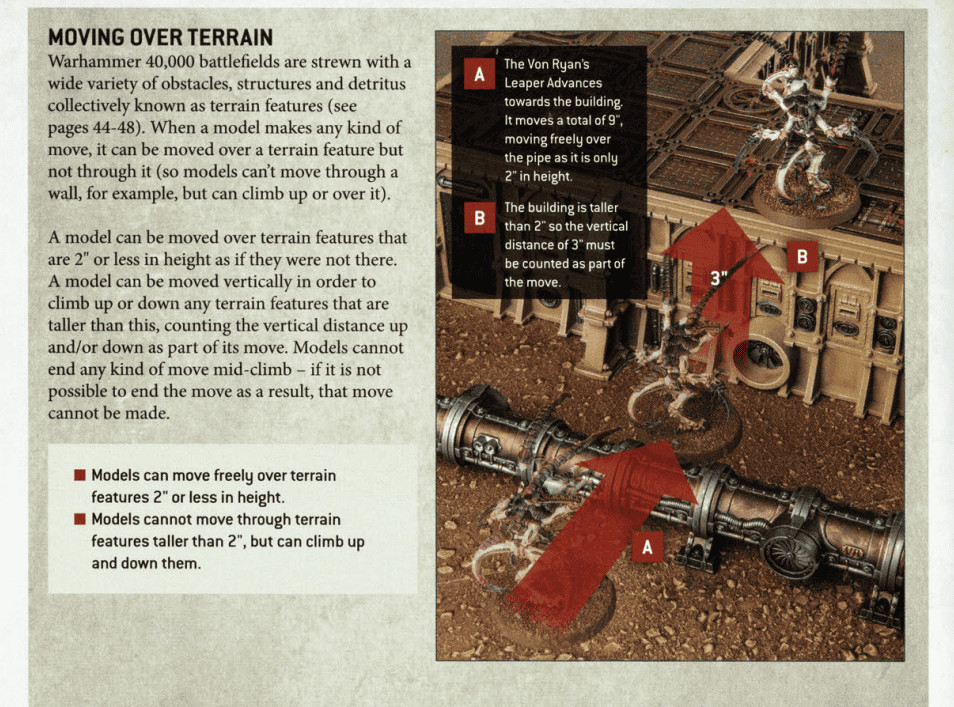
Terrain itself does not penalize movement anywhere on the board. Infantry and beasts move through ruins and terrain as if it were not there, though anything higher than 2″ still requires actual movement to climb. That one takeaway covers most of the terrain screenshots, so we’re not going to repeat it in every subsection.
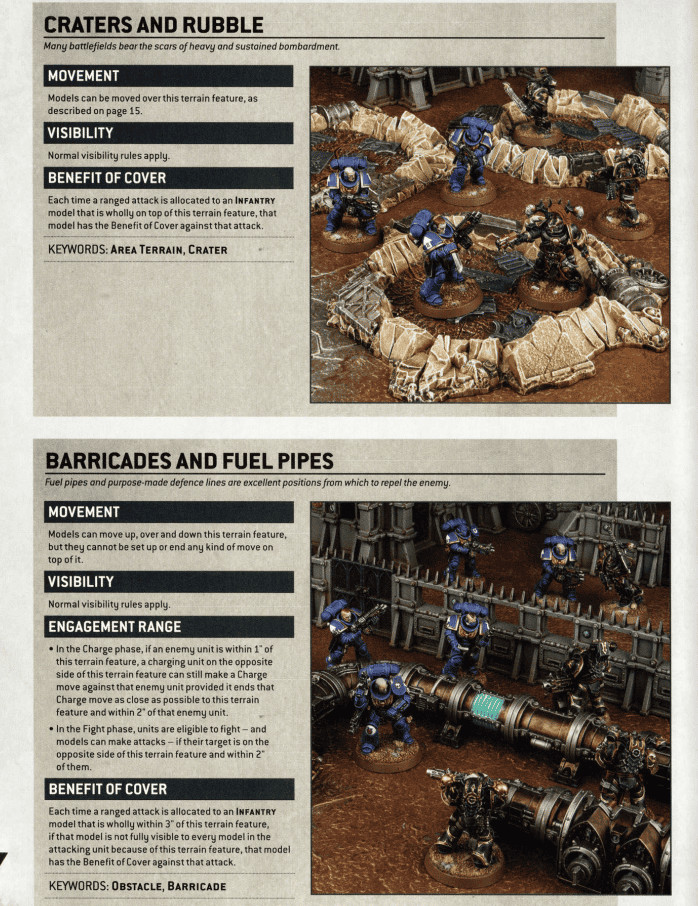
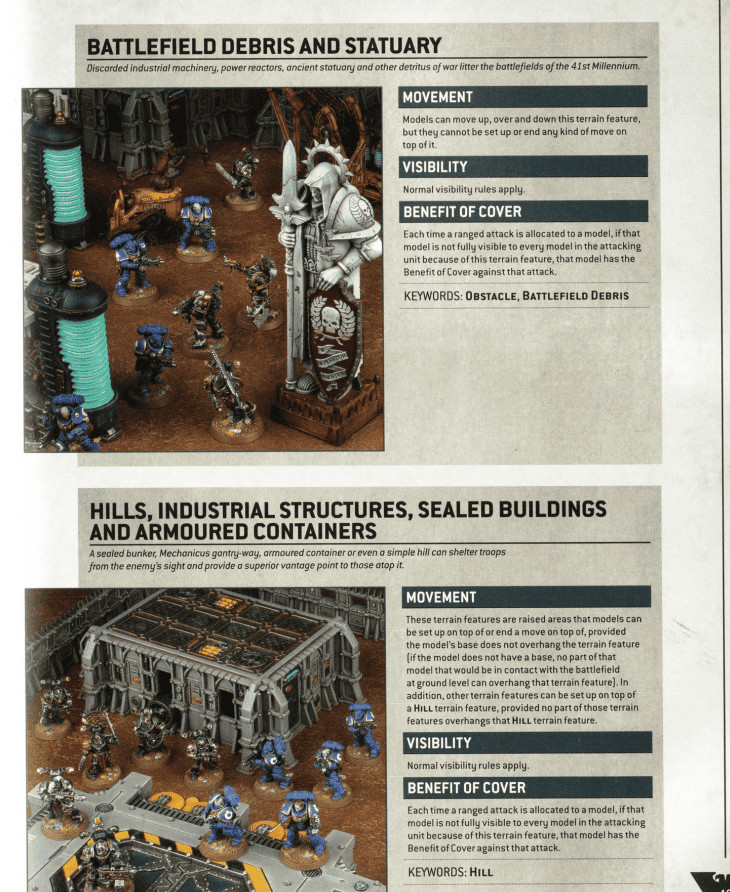
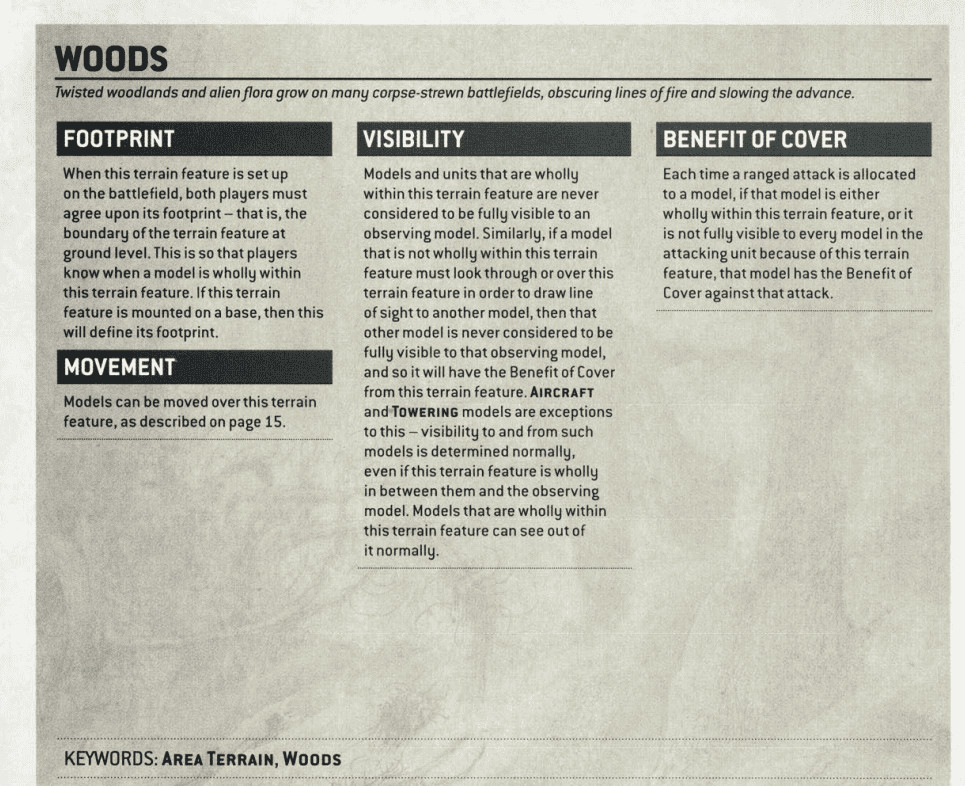
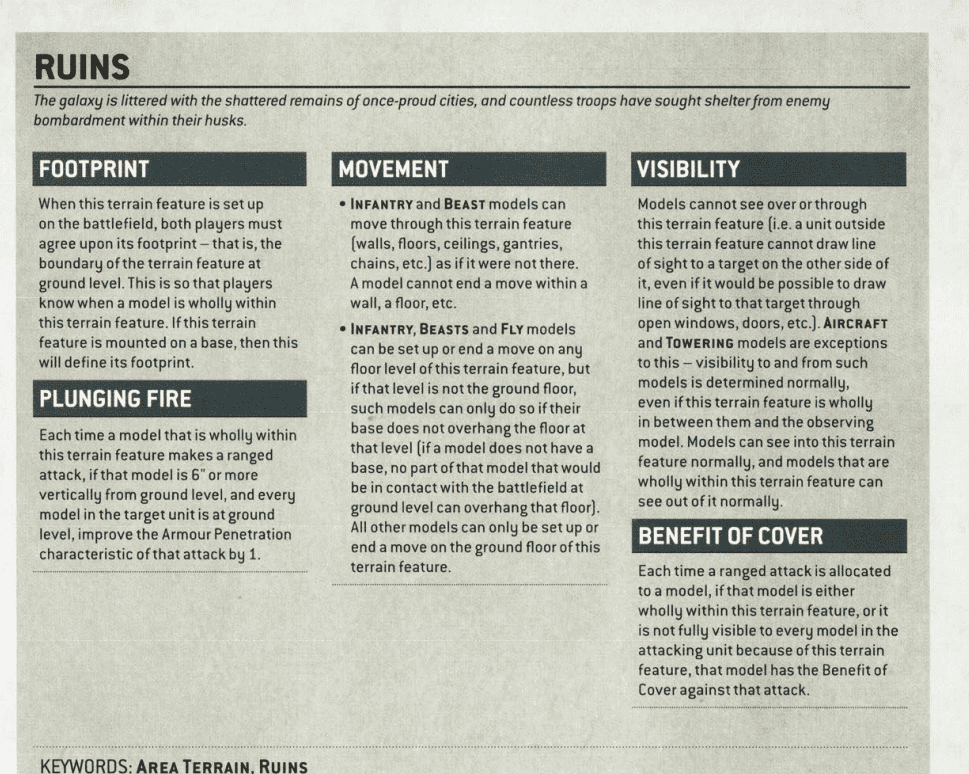
The specific terrain types then add their own quirks. Statues and hills give cover when you’re obscured or behind them, but you can’t stand on top of a statue. Woods give cover full-time, though aircraft and towering models still draw line of sight normally, cutting both directions. Ruins have the biggest twist: if you are 6″ or more above the enemy, plunging fire adds +1 AP, and your base has to be entirely on the higher level, no hanging off the edge. That last part might force some terrain rebuilds.
10th Edition 40k Core Rules: Transports & Aircraft
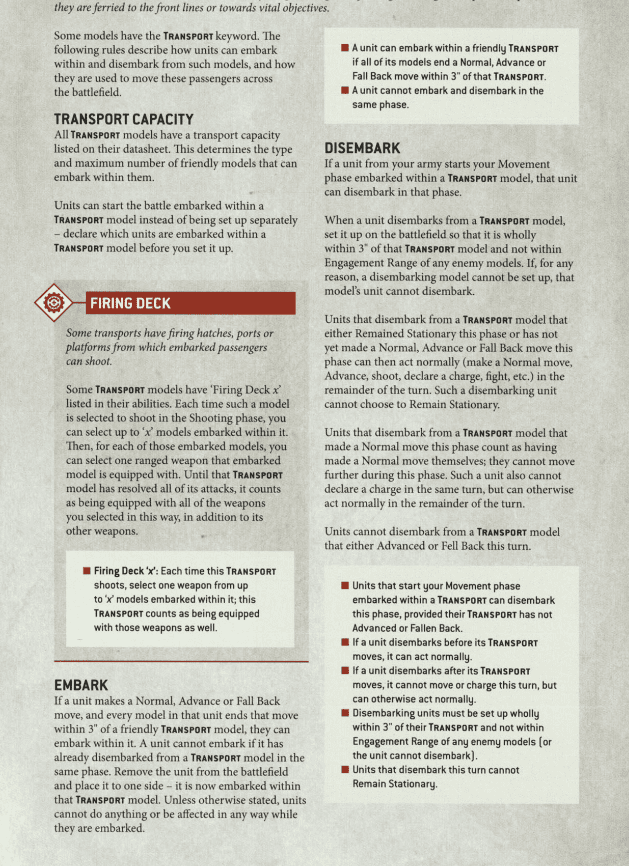
To start, we’ve seen Firing Deck ‘X’ a lot, but simply, you can shoot with X number of models in the unit embarked in the transport. Then, the transport capacity is just how many models it can carry, and if you’re starting the game in the transport, you have to declare what unit is in what.
You can embark on a transport whether you are moving, advancing, or falling back, but the whole unit has to be within 3″ of the vehicle. For disembarking, you can either get out before the vehicle moves to charge or you can get out after the transport moves, but you cannot charge.
Lastly, you cannot disembark if the vehicle advances or falls back, and you cannot disembark if you cannot fit all models with 3″ as well.
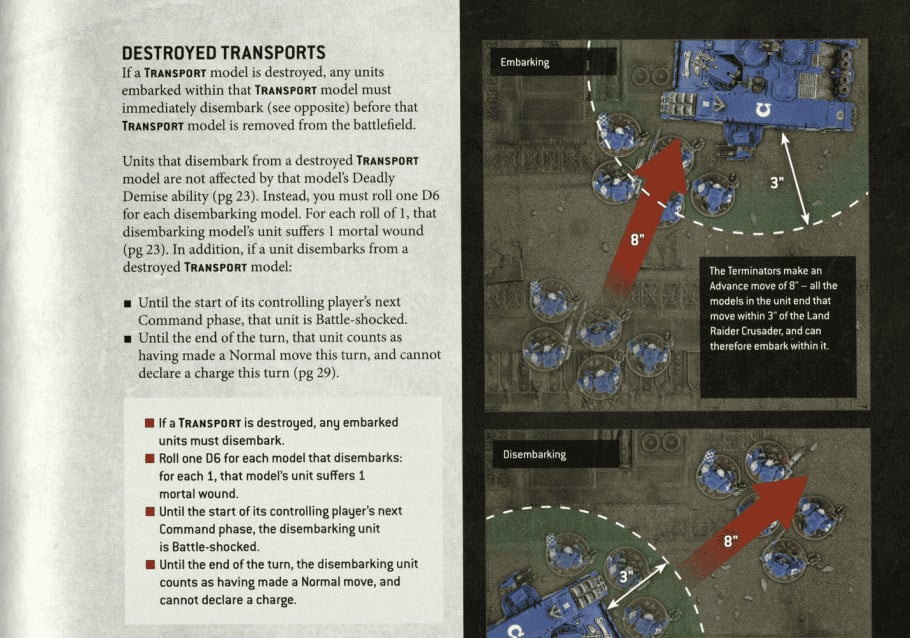
Now, you only suffer one mortal wound for each one rolled, not instantly killing a whole model. This makes transports far better right off the bat.
However, while you don’t take as many auto-deaths, you will be battle-shocked until the start of the next command phase. Lastly, the unit cannot declare a charge if you somehow get your tank destroyed in your movement phase.
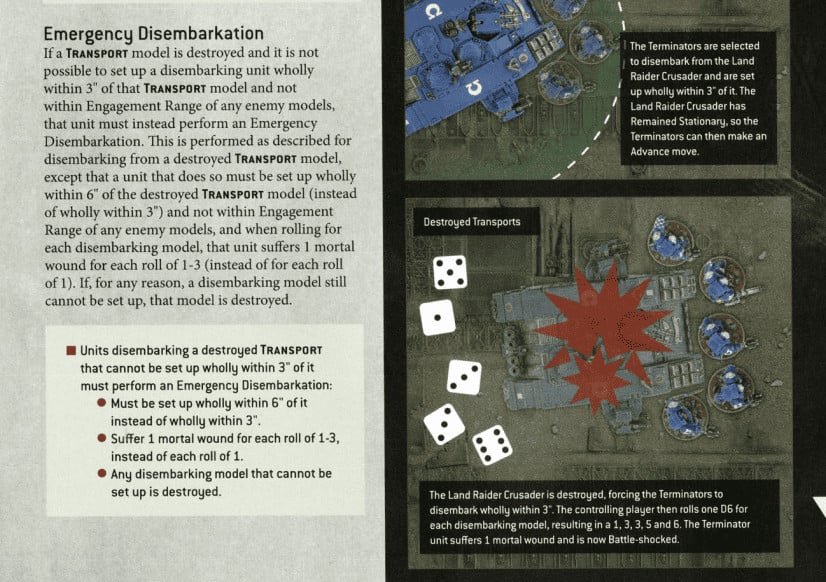
If you are surrounded and cannot disembark within 3″, you can make a move up to 6″, but you suffer mortals on a roll of 1-3 instead.
New 10th Edition Core Rules: Aircraft

Maybe the biggest change off the bat, you have to start aircraft in Reserves; they then come on as Strategic Reserves.
Aircraft can move any amount of distance now and must make a minimum move of 20″ (but cannot advance, fall back, or charge). However, you do have to make a straight line move and can rotate 90″ at the end.
You can also hover your models, which means they don’t have those other aircraft rules but can start the battle on the board. But you have to declare this at the beginning of the game.
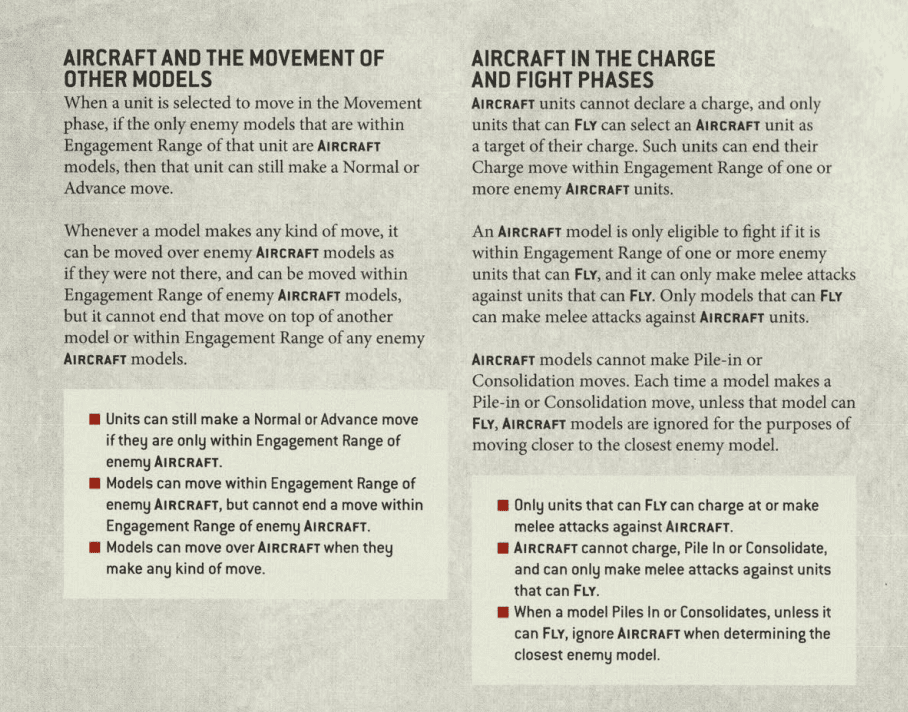
Aircraft obviously don’t hinder troops on the ground for movement, and only units that can fly can charge them. However, even in combat, they cannot pile in or consolidate.
They also don’t count as being the closest model for other units.
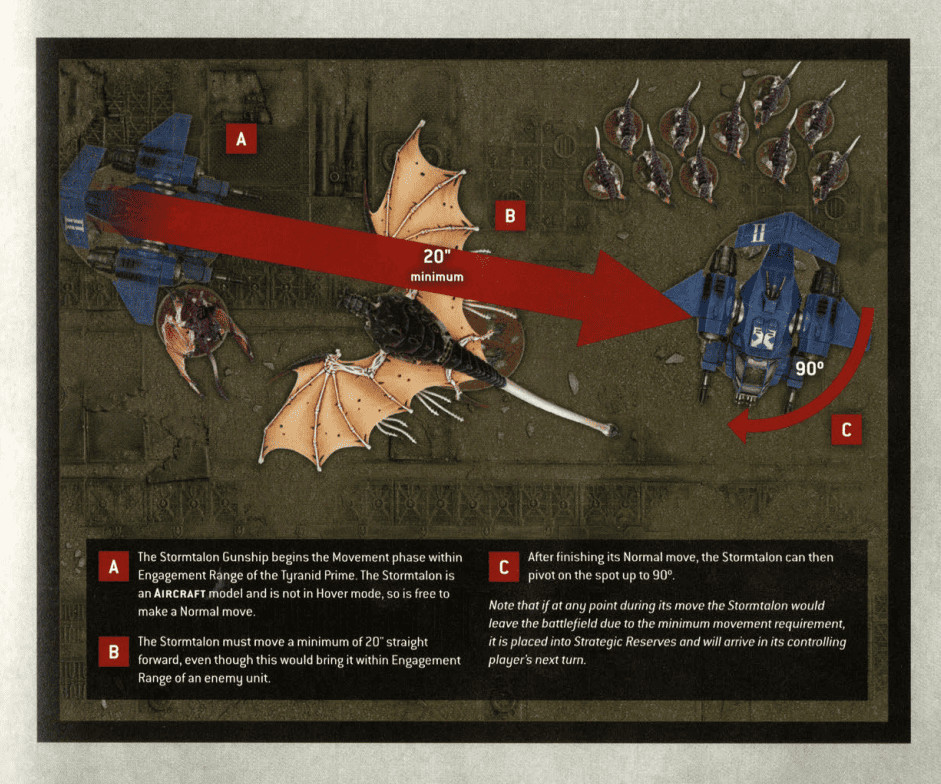
Just a quick picture of how you can fly aircraft now.
10th Edition 40k Core Rules: Movement & Reinforcements
 This picture comes from Warhammer Community.
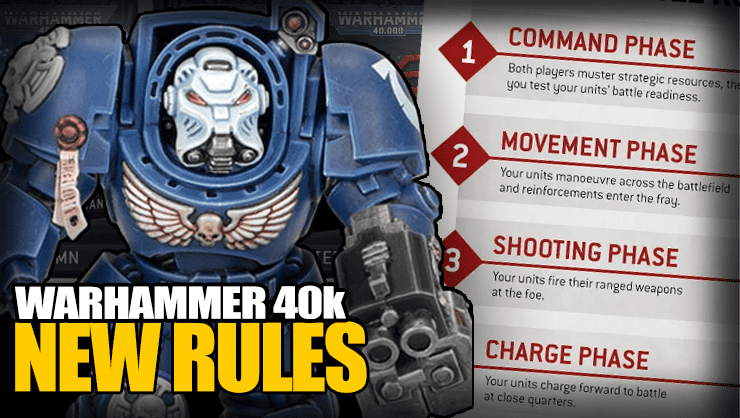
The turn structure survives mostly intact from 9th, but the phases are compressed. Here’s Warhammer Community’s own summary of what changed:
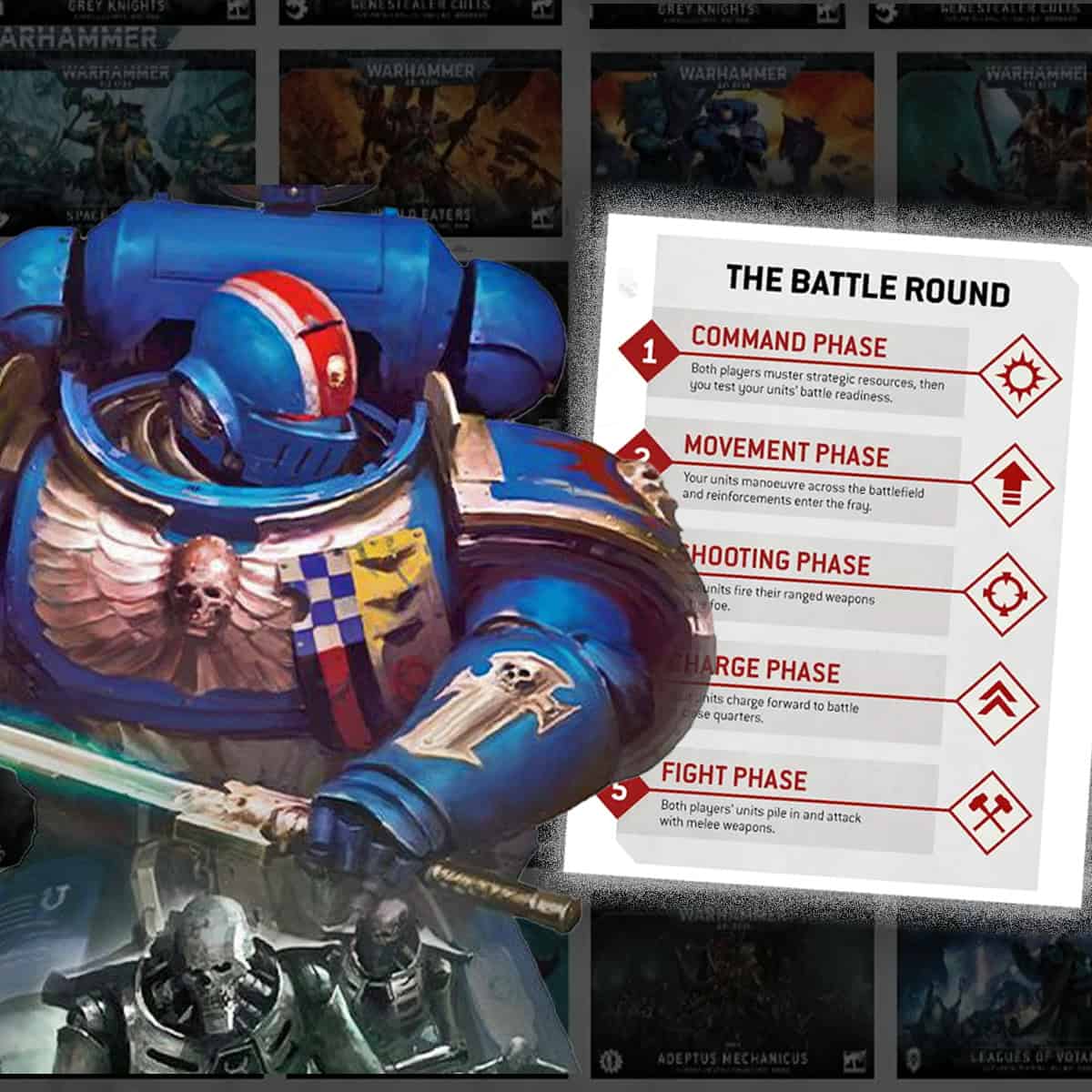
The turn structure is still the same: one player still takes the first turn, to manoeuvre and fight with all the forces at their disposal, and then the second player does the same. This is still called the Battle Round, but seven phases have now become five – and both players will now contest each one to the fullest.
Here’s how the movement phase breaks down on the tabletop: you move first, then you get a dedicated reinforcements step.
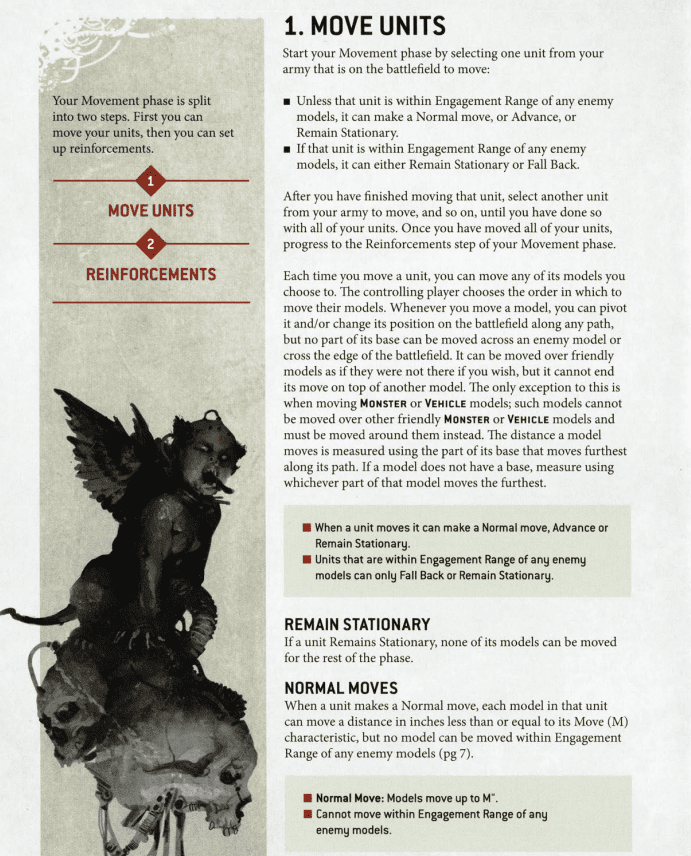
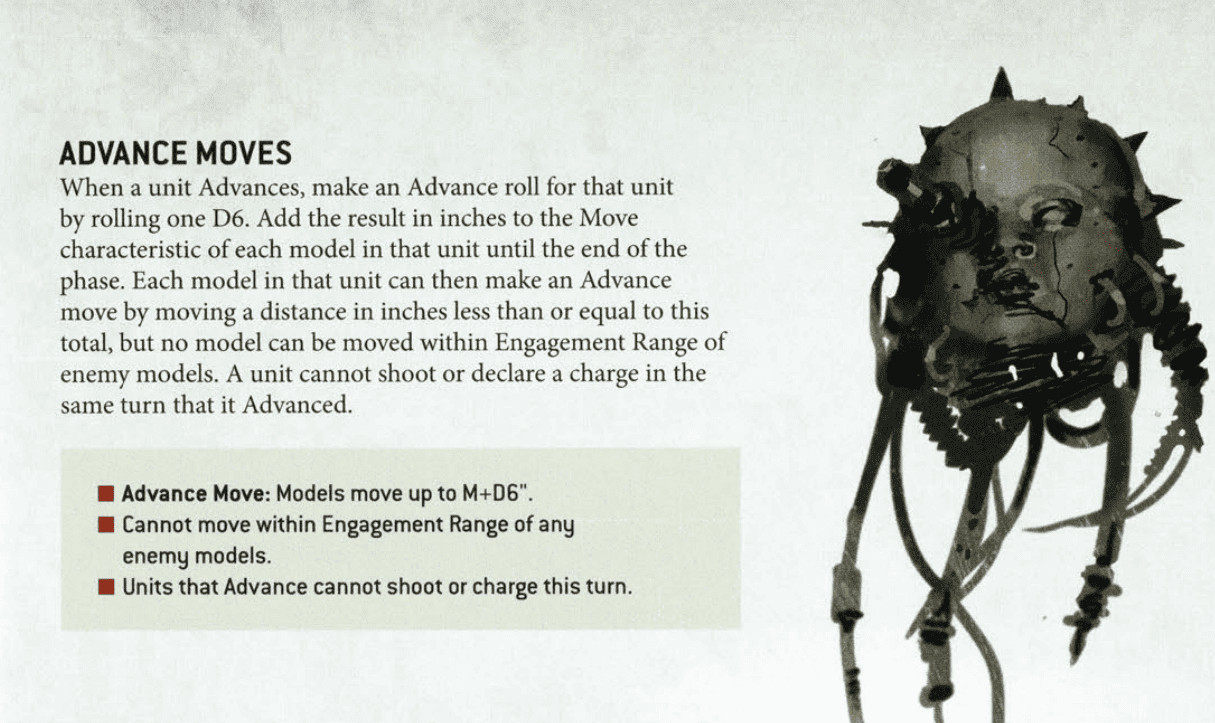
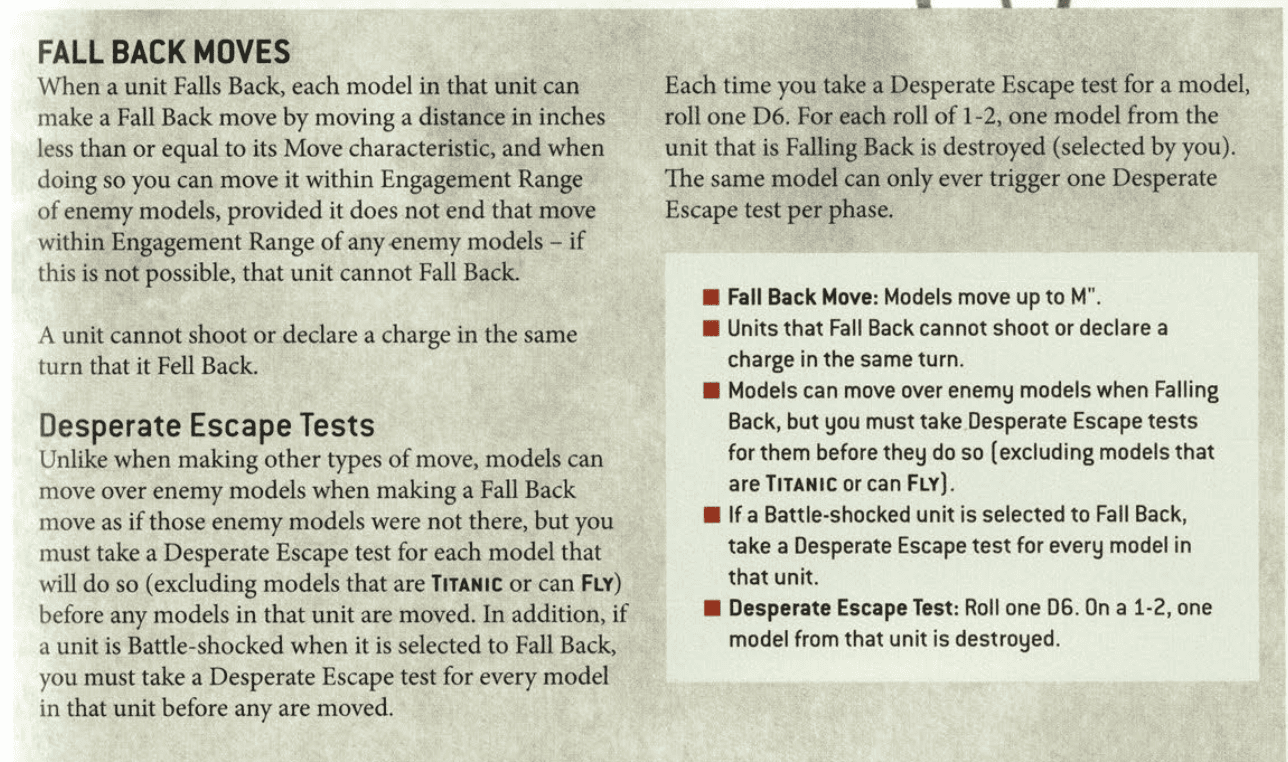
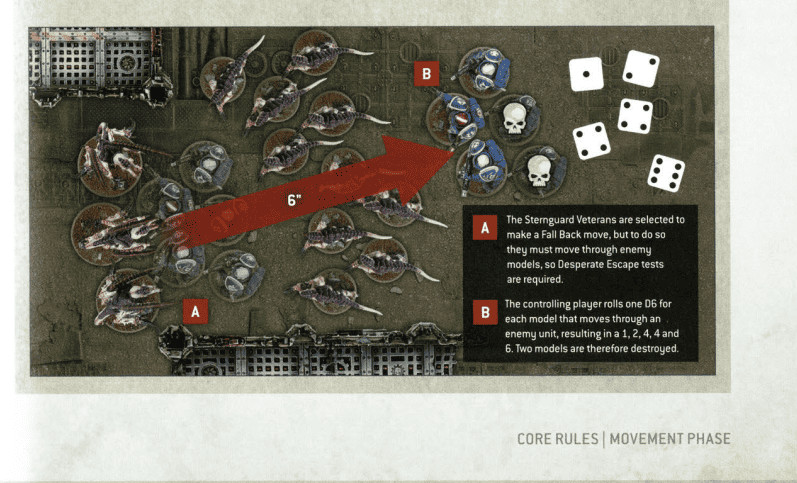
Movement changes worth knowing at the table:
- Advance rolls still add d6″ to your move, and advancing still shuts off shooting and charging unless a special rule says otherwise.
- Falling back keeps the no-shoot, no-charge rule and now lets you fall back through enemy models if you’re surrounded, which is new.
- Monsters and vehicles must move around units of their own type, and flying models measure to the hull if they have no base.
- Desperate Escape rolls happen when you fall back while Battle-Shocked: on a 1 or 2, a full model dies regardless of remaining wounds. Example scenario: a five-Terminator squad, Battle-Shocked and falling back, could lose one or two models on the way out, which turns a routine escape into a real cost.
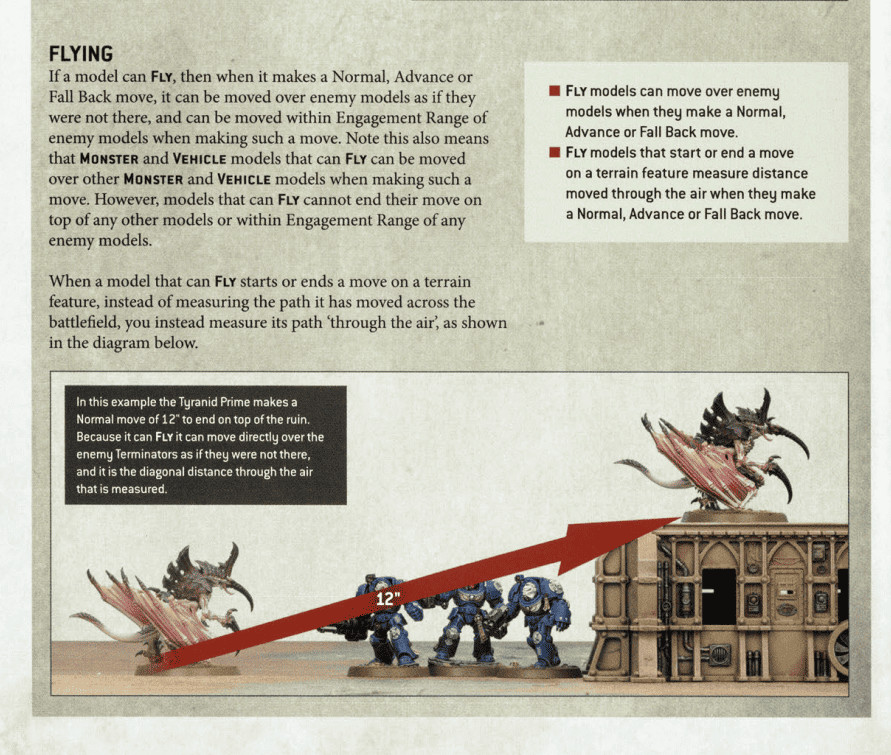
- Diagonal movement for Fly: units with Fly measure their movement along the actual path through the air when climbing terrain, not the straight-line horizontal distance. So a Fly unit moving up onto a ruin is spending more of its move than a ground unit covering the same horizontal ground.
- You can move over most low terrain (tubes, barrels, low walls) freely. Anything taller than 2″ needs movement to climb, and walls still block movement rather than letting you go through them.
10th Edition 40k Core Rules Reinforcements
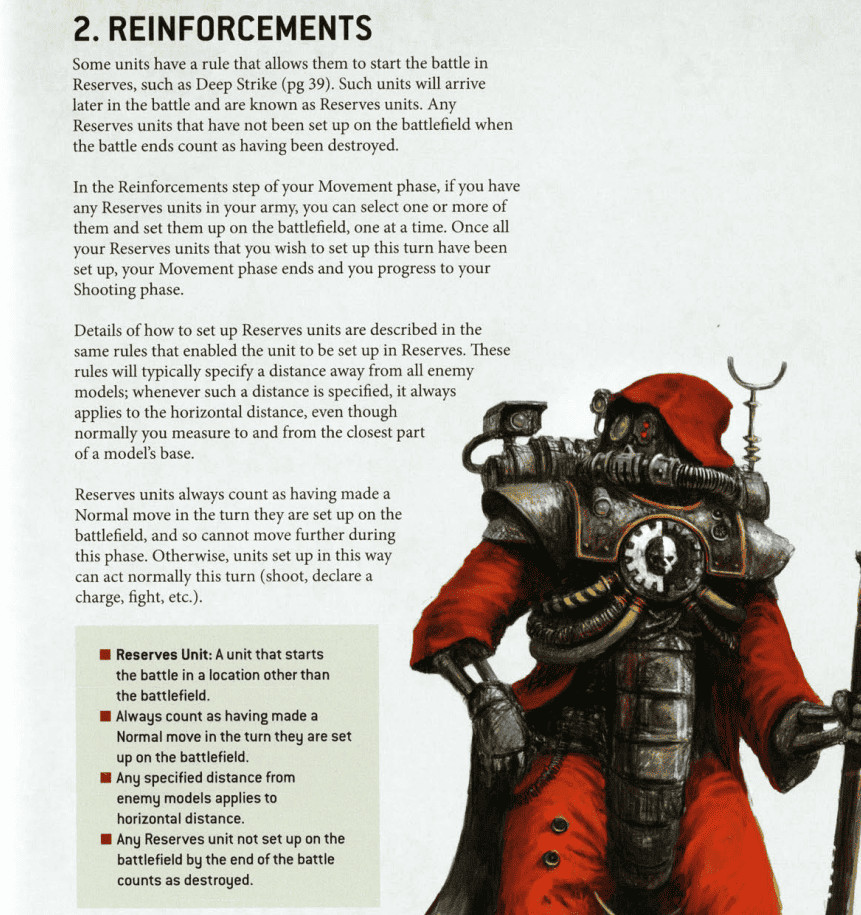
This “sub-phase” takes place after movement, and once you have set up your reinforcements, the movement phase is over. You can still deploy reserves, shoot with them, and charge.
Command Phase & Battle Shock Tests
The command phase is where you take Battle-Shock tests now, and this is the phase where 10th’s morale system actually shows up. Here’s how GW described it:
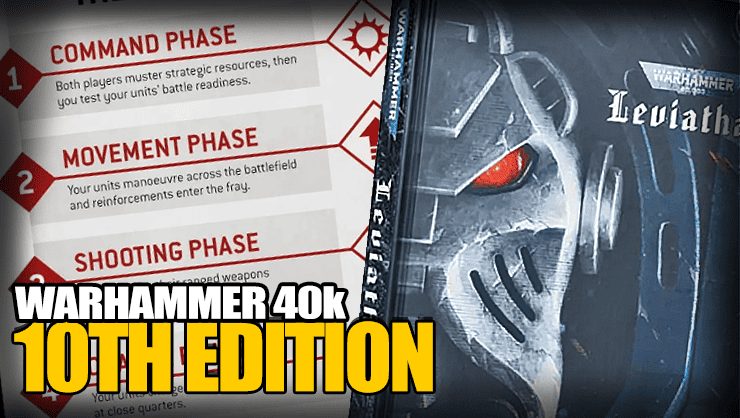
Here’s the headline: the phase structure is broadly the same. You perform admin for the turn ahead in the Command phase. Then you manoeuvre in the Movement phase, take aim in the Shooting phase, charge into melee in the Charge phase, and get biffing in the Fight phase.
So what’s changed? The Psychic phase and the Morale Phase are now no more – but this doesn’t mean that psychic powers and morale are gone. The effects are still very much present, but they’ve been smartly compressed into the other phases. Let’s break it down.
Both players still gain a CP at the start of every command phase, and scoring, stratagems, and abilities still resolve here. The change is that Battle-Shock tests all happen in the first phase of the turn, and any unit at Below Half-Strength has to take one.
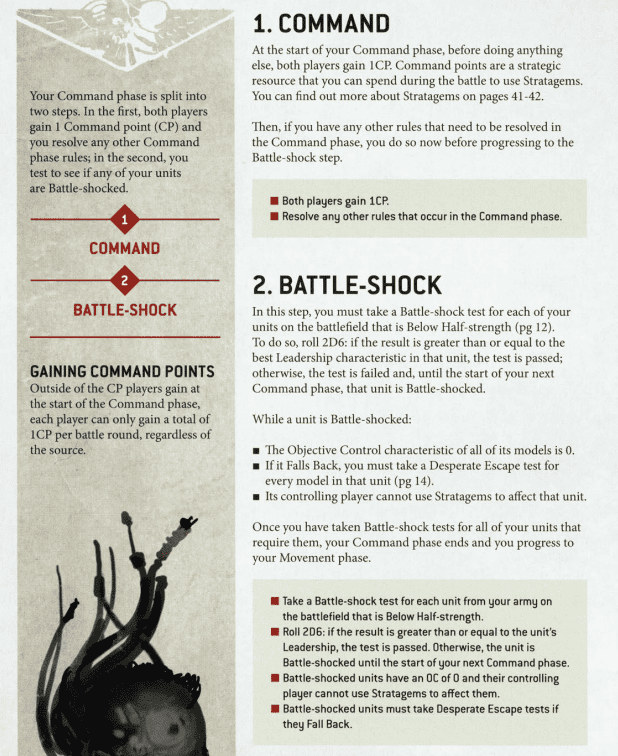
Morale is even simpler – that all gets sorted in your Command Phase, when you take Battle-shock tests for any units that have taken enough losses.
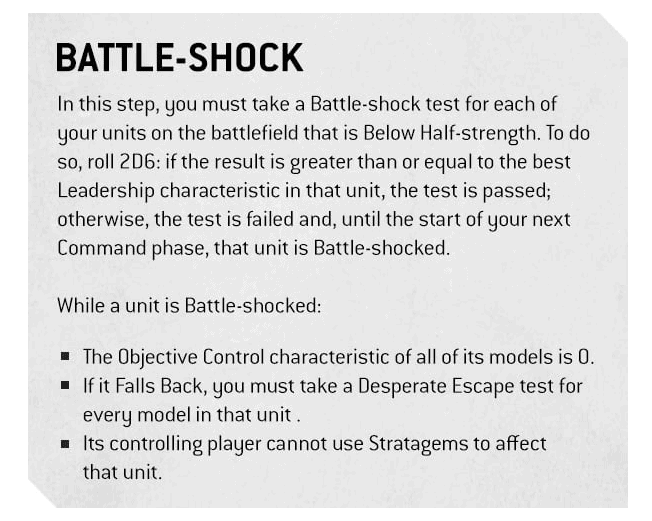
Battle-shock tests are super simple. Roll a 2D6 for every unit that’s Below Half-strength – that means they’re a squad with less than half of their starting models, or a single model with less than half of their starting Wounds. You’ll need to roll equal to or above your new Leadership characteristic – if you fail, that unit suffers some nasty penalties until your next turn.
A Battle-Shock test is 2d6 versus your Leadership. Fail it, and the unit can’t hold objectives and can’t be the target of stratagems until your next turn. Here’s where this hurts your army: your Below-Half-Strength squad is sitting on the objective you need for VP, it fails its Battle-Shock roll, and suddenly it can’t score, can’t be buffed by a stratagem, and can’t take Command Re-roll to save itself in the shooting phase that follows. One failed roll and the objective is functionally lost for the turn.
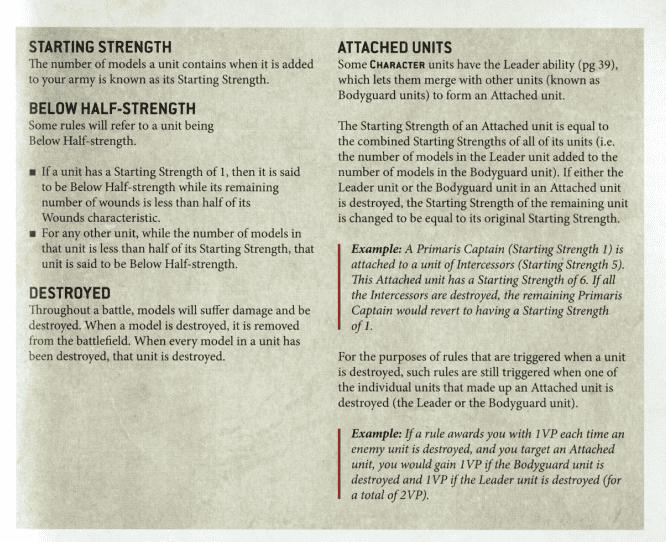
Adding a leader to a unit changes the threshold because the leader adds to the starting strength. A five-model squad plus a leader (starting strength six) is Below Half-Strength at three models or fewer, not two. But killing the whole combined unit, character included, still gives your opponent extra VP.
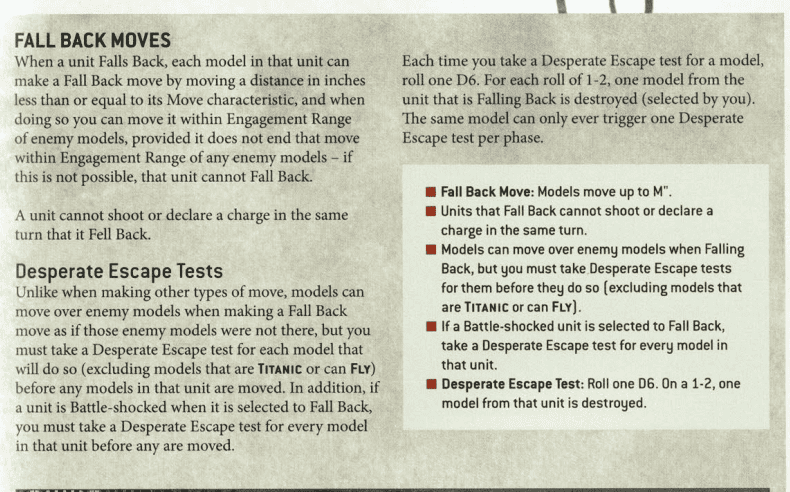
Falling back while Battle-Shocked triggers a Desperate Escape roll, and a 1 or 2 costs you a full model regardless of wounds. So the choice becomes real: stay in combat and hope you win it, or fall back and probably bleed a model on the way out.
10th Edition 40k Core Rules: Weapons & Deployment

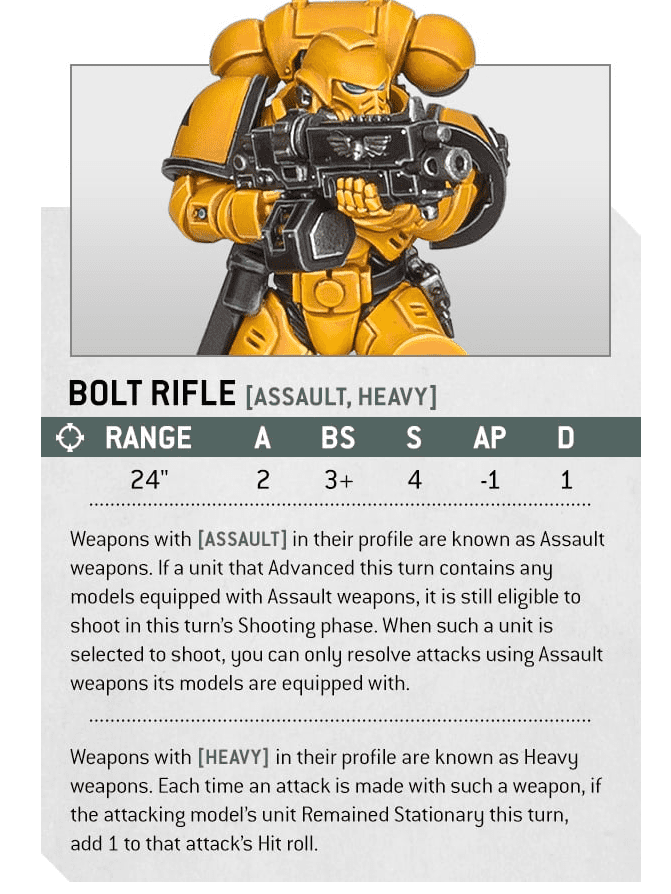 This picture comes from Warhammer Community.
Up until now, your guns were divided into several categories: Heavy, Rapid Fire, Assault, and so on. In the new edition, these classifications become weapon abilities.
This change allows weapons to behave in more varied ways than before, without increasing the number of rules you need to learn. A bolt rifle has both the Assault and Heavy abilities, for instance – meaning it can be fired on the move or braced for extra accuracy, as needed.
Interestingly, Heavy has no minuses for moving, but a lot of the heavy weapons start off with a worse BS, meaning they go to their “normal” BS when standing still. Next, pistols can be shot into combat, and rapid fire doesn’t just double the attacks; it can be whatever number GW wants it to be.
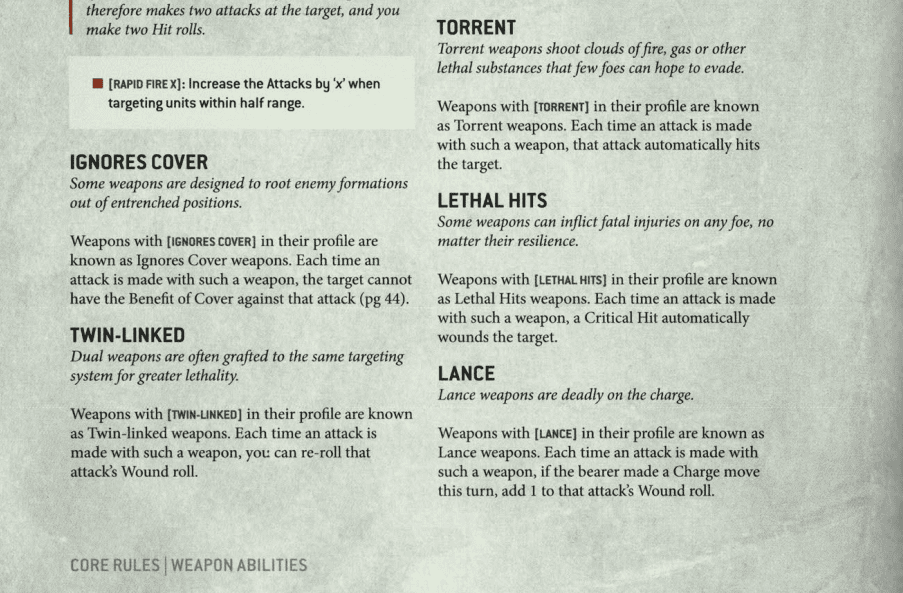
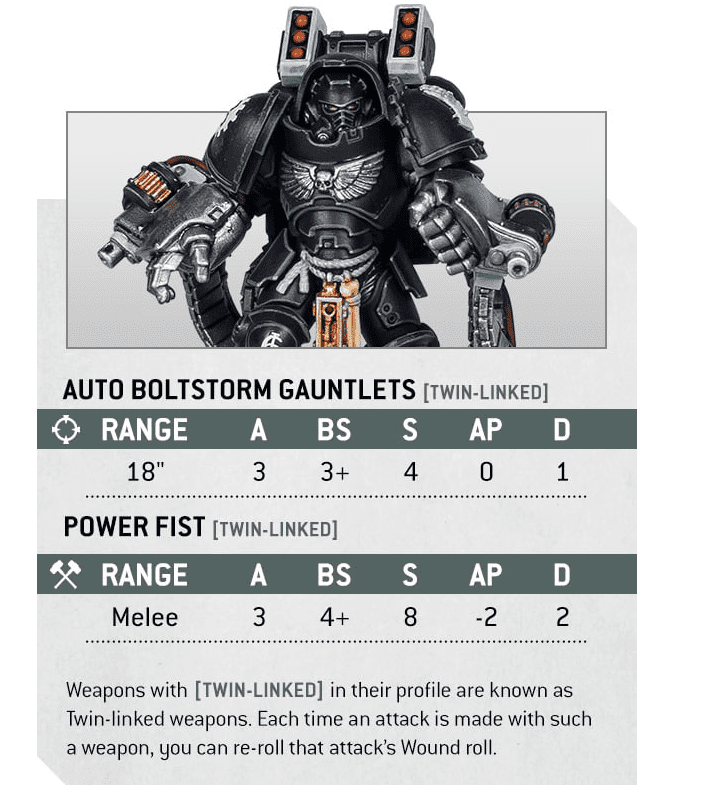
Melee weapons can also have abilities, including a blast from the past – Twin-linked is back! This classic rule is now found on ranged and melee weapons alike, and confers a re-roll to wound. In recent editions, many weapons that used to be twin-linked were instead treated like two guns taped together, which had a serious impact on balance. This change makes them more reliable, rather than twice as killy.
Twin-linked now lets you re-roll the wound roll instead of more attacks, torrent is basically the same thing as a flamer, and Lethal Hits means rolls of 6 to hit automatically wound the target.
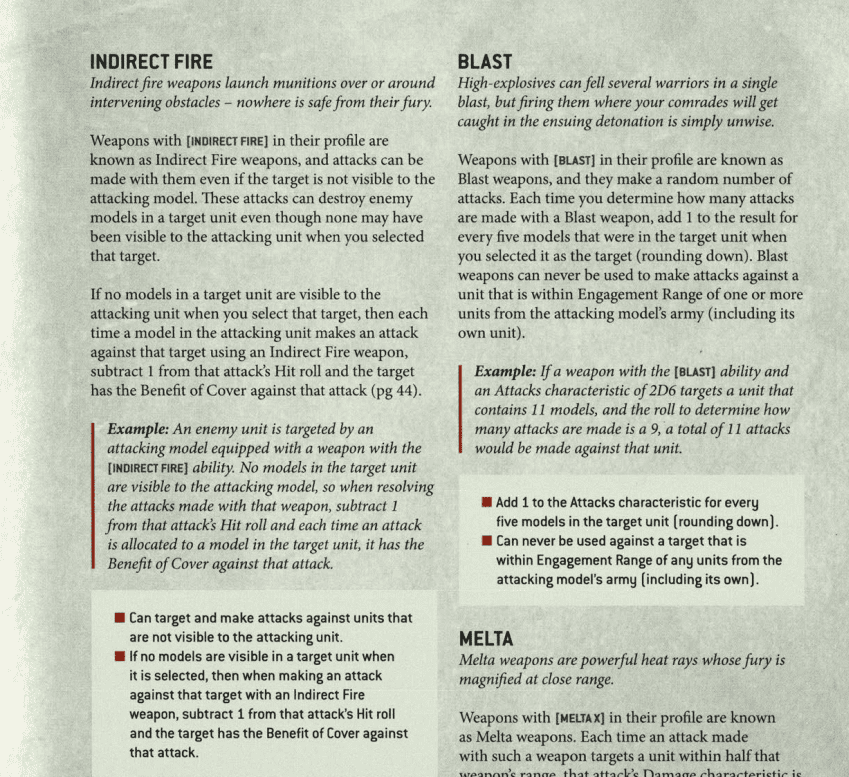
Blast can basically have unlimited extra dice, but generally, it will add one or two extra hit rolls, but you cannot use this in melee.
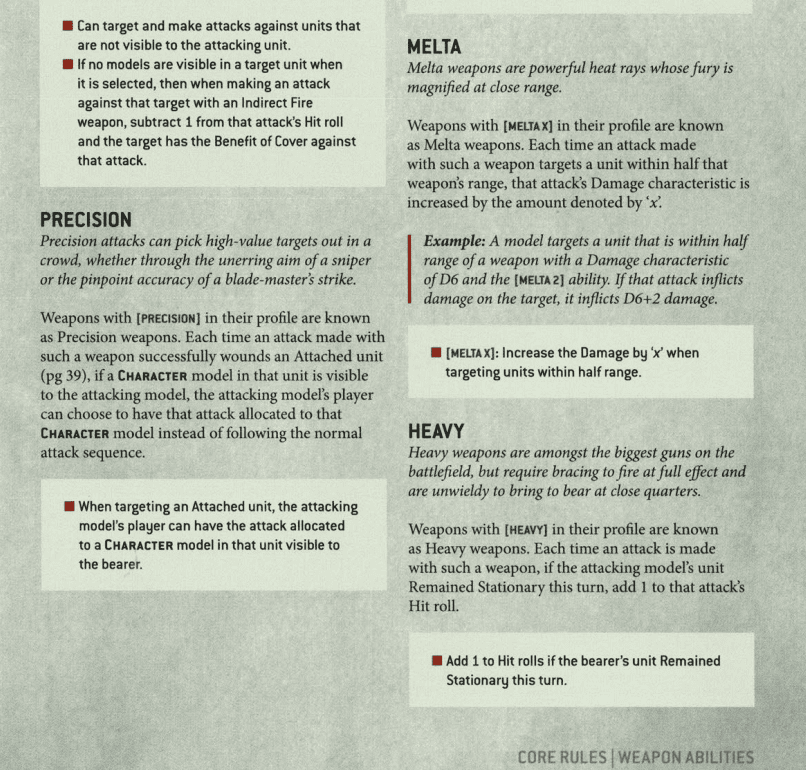
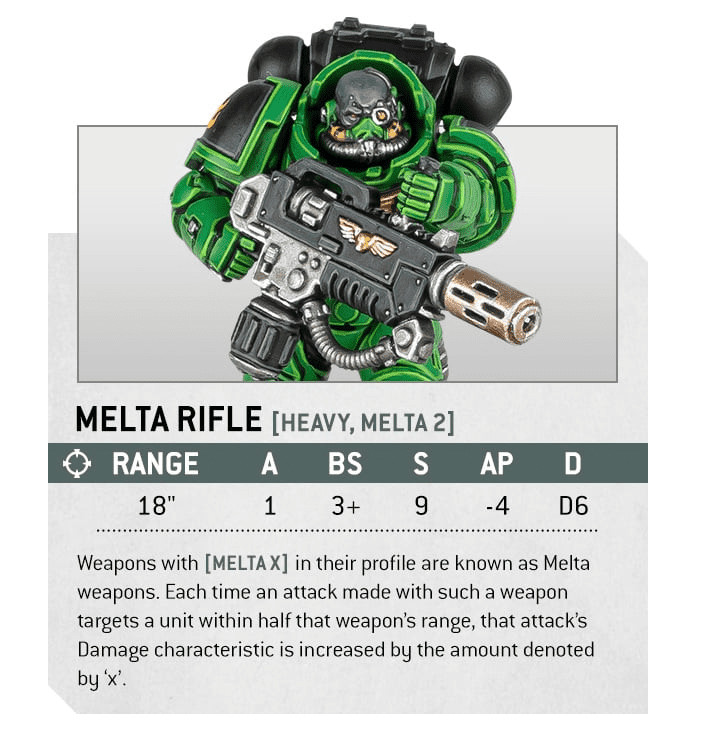
The melta rifle, for example, gains a bump in Strength and the Melta rule to boost its Damage at short range, while the Hammerhead’s infamous railgun soars to Strength 20.
Precision allows you to attack character models as long as they’re visible. Then, melta will increase the damage, and even on a melta rifle, it will be D6+2.
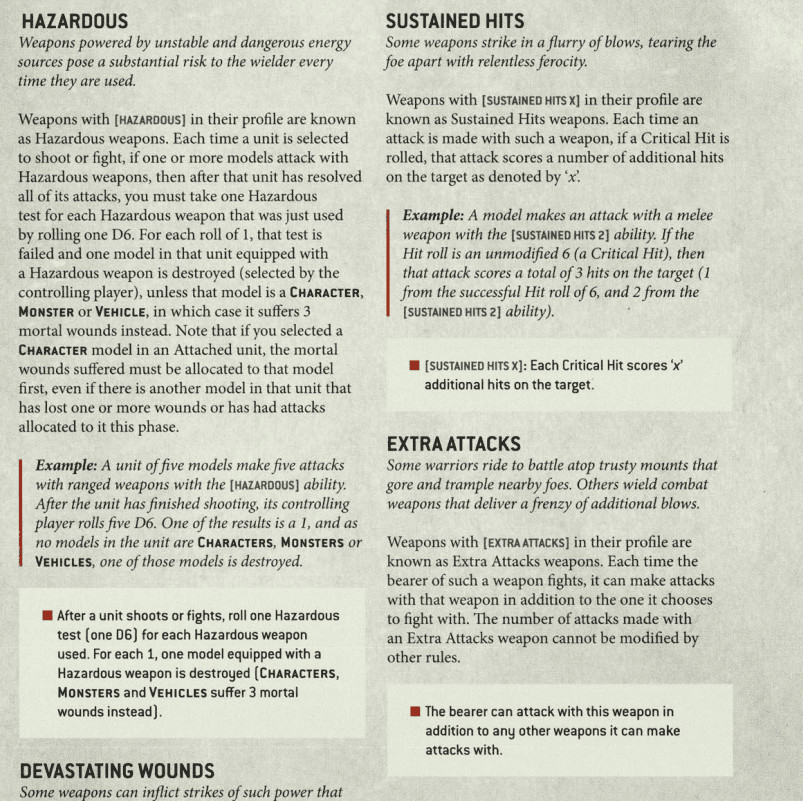
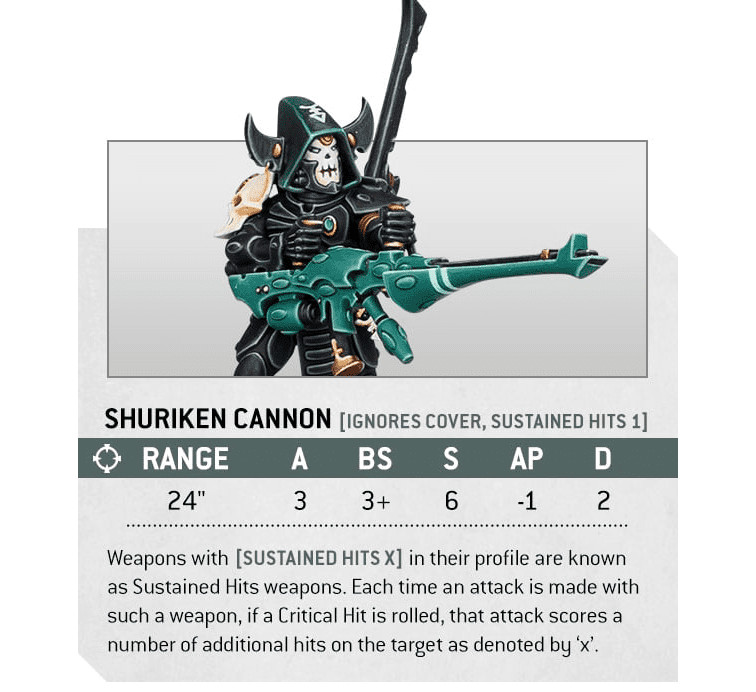
The shuriken cannon picks up Sustained Hits, common among weapons that throw massive amounts of firepower down range – and on swarming Tyranid Invasion Fleets. This one simply adds the listed number of extra hits when a Critical Hit is scored – that’s an unmodified Hit roll of 6. Easy to remember.
Sustained Hits can add up to a huge amount of extra hits, and Hazardous is different now, as you just roll a single die at the end instead of on the hit rolls. So, if you roll a one on that test, it’s just bad luck.
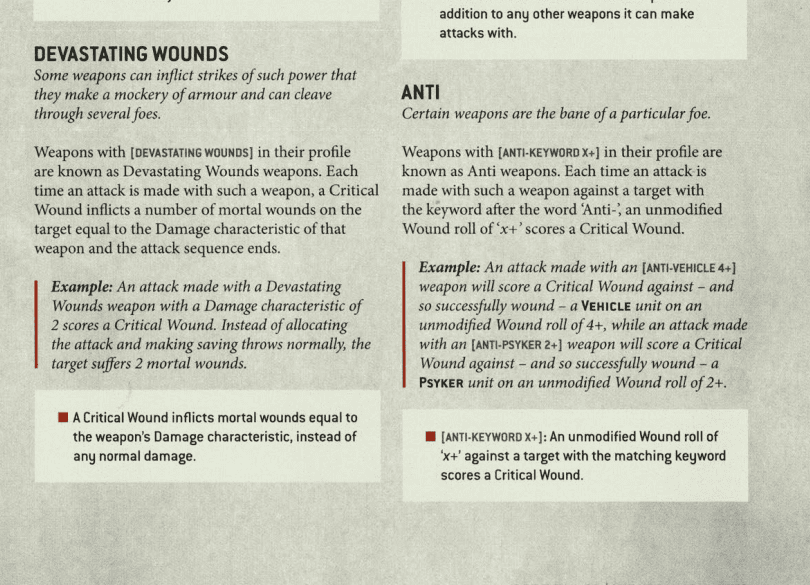
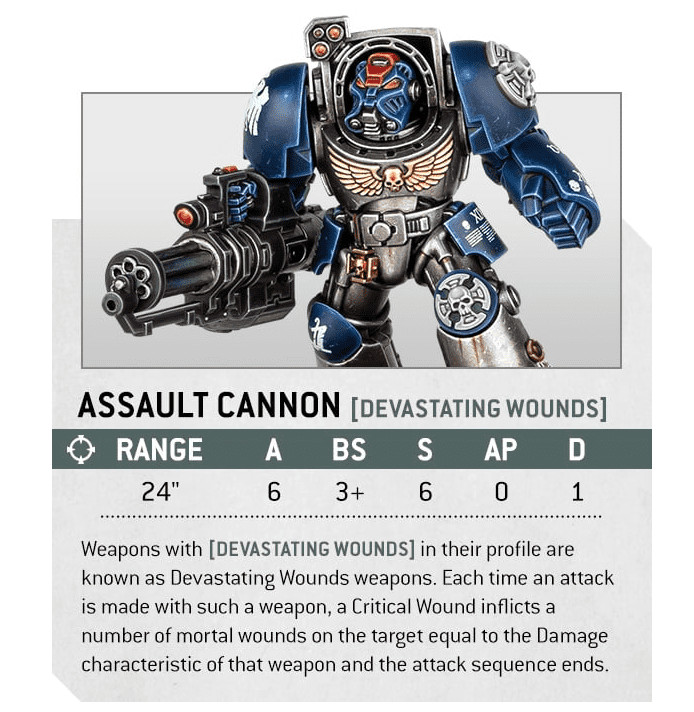
The core rules include a variety of other weapon abilities, which tie together similar effects found across factions. Weapons that shredded through armour on lucky rolls can now share the Devastating Wounds ability instead. This allows them to dish out mortal wounds on a Critical Wound – that’s an unmodified Wound roll of 6.
Almost all weapons have had their core statistics changed to help pull their weight in this new, more durable edition – especially those designed to tackle vehicles. You’ll generally find that most guns have not increased in strength, and have often lost a pip of AP.
This could add up to a huge amount of mortals; it really just depends on the number put in the profile.
10th Edition 40k Deployment Abilities
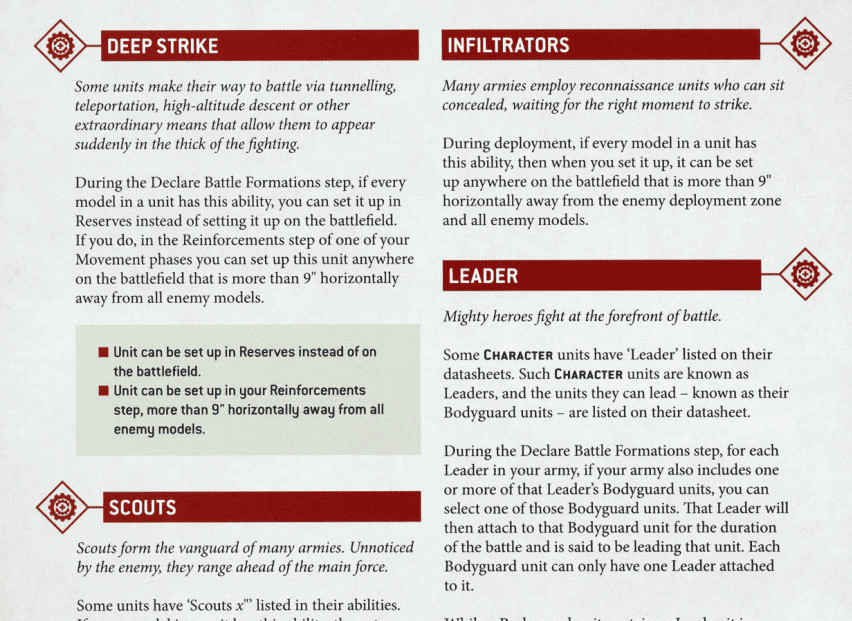
Here’s how the deployment abilities work on the tabletop:
- Deep Strike: units declare they’re in Deep Strike at deployment, then arrive later at 9″ or more from any enemy model.
- Infiltrators: set up anywhere on the board 9″ or more from enemy units at game start. If you win the roll to move first, an infiltrator unit is close enough to charge on turn one, which is why this ability is worth planning around.
- Scouts: get a pre-game move, and they can drag a dedicated transport along for the ride as long as they’re embarked in it. So a scouting squad in a transport is really a scouting transport.
- Character targeting: most characters can join a bodyguard unit, and while they’re in that unit, they can’t be picked out as targets or take wounds from attacks unless a special rule specifically allows it.
Stratagems & Reserves Rules
Preview images of the stratagems and reserves rules circulated ahead of the PDF drop, and we have the full summary below.
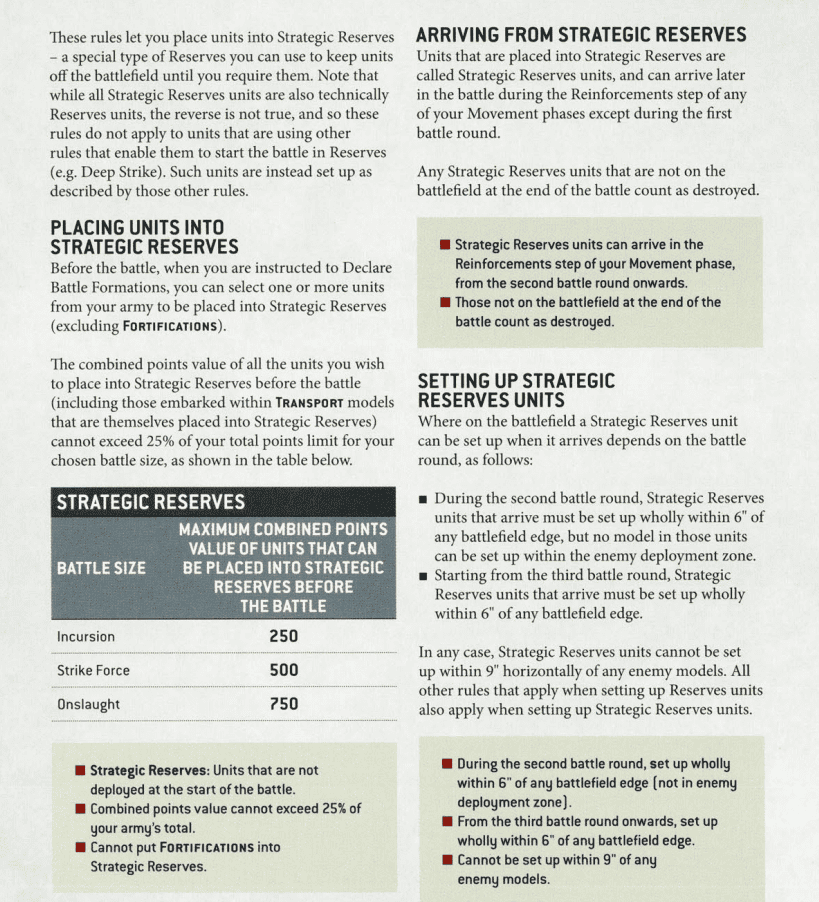
Strategic reserves are limited again, just like they were in previous editions. This is mostly language to make it as clear as possible, like including the points of models in transports that are in reserves. As the game size increases, so do the reserve limits in increments of 250.
The rule of thumb is that no more than 25% of the list can be in reserves!
Reserves can arrive during the reinforcements step of YOUR movement phase, starting from the second round onwards. Anything that doesn’t make it to the battlefield by the end of the game is counted as destroyed. You can still deploy reserves, shoot with them, and charge.
If they come in on the second round, it has to be within 6″ of the edge of the board and not in the enemy deployment zone; on and after the third round, it can be in the enemy deployment, and of course, they can never be within 9″ of enemy models.
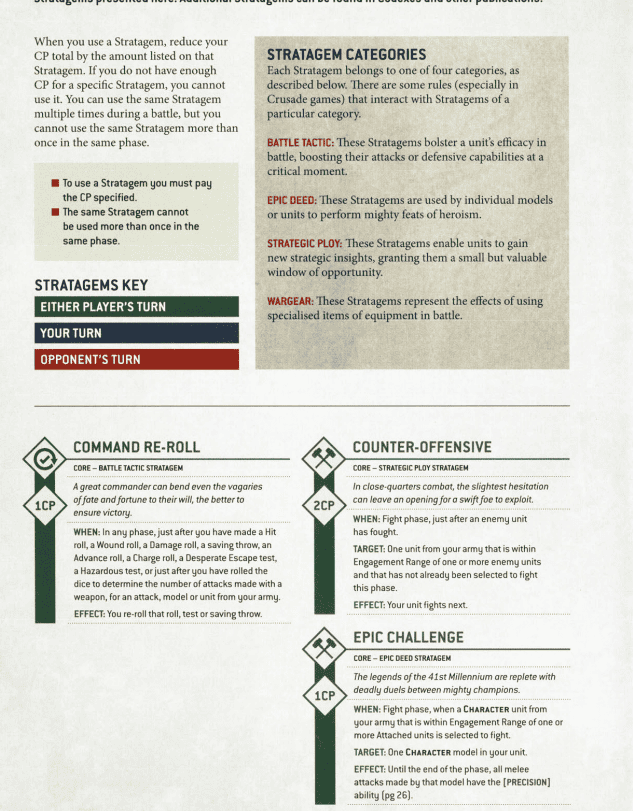
The stratagem list itself is roughly the same shape, but the book layout is easier to read at a glance. Here are the core stratagem highlights worth knowing:
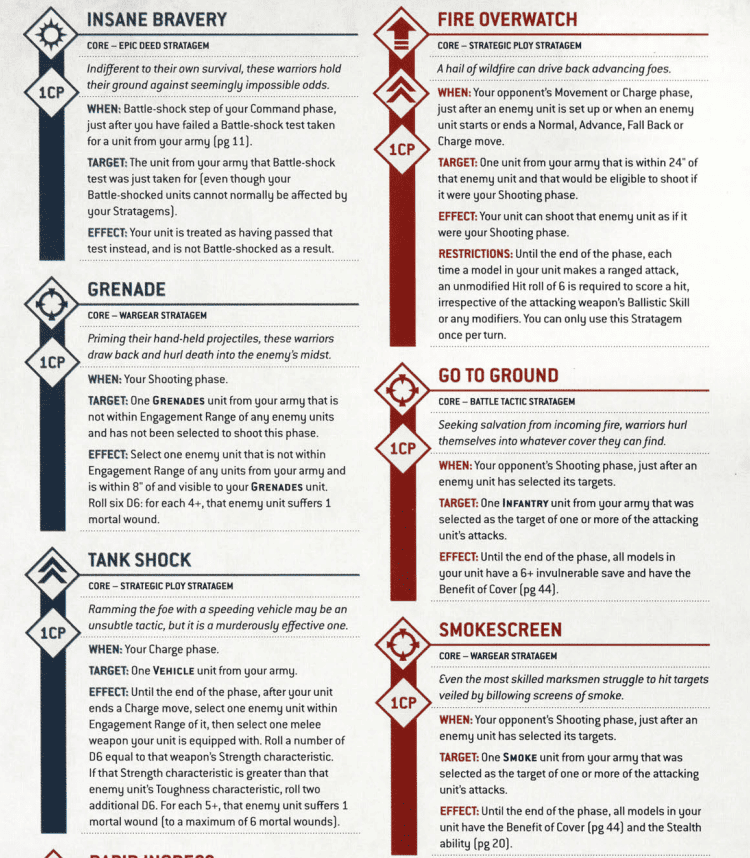
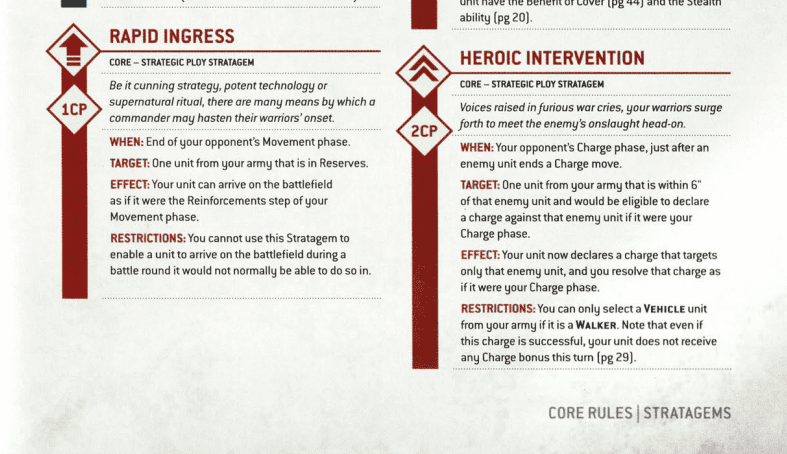
- Command Re-roll returns as the iconic first stratagem, and it’s the one every player will use every game.
- Grenades are a stratagem in 10th, costing 1 CP to use.
- Heroic Intervention is back and costs 2 CP, which is steep enough that it’ll be a real decision every time you consider it.
- Games Workshop said there are 12 core stratagems in previews, but the printed book only shows 11 by our count. The missing one is likely a tactical missions stratagem, since there’s a blank space on the first page that fits that shape.
For more 10th Edition coverage, check out our Warhammer previews and rumors hub.
What do you think about all the 10th Edition rules changes?

Think you need to replace 10th with 11th! 😁