Jordi Bejar’s 7-0 Necrons took the Atlantic City Open 2026 army lists crown, running double C’tan and Awakened Dynasty through 89 players without dropping a single game.
There is only one way to walk out of a seven-round major holding the trophy, and Jordi Bejar made it look easy.
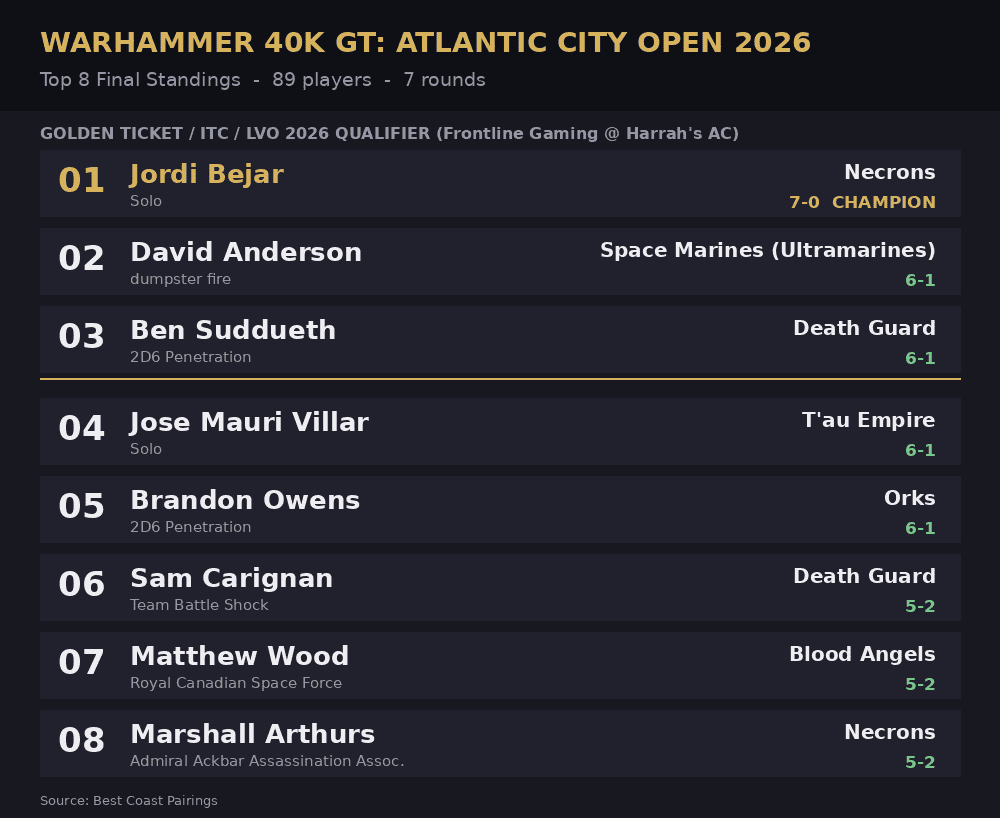
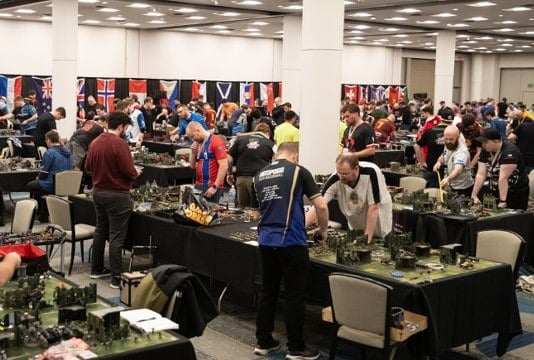
Frontline Gaming’s Atlantic City Open hosted 89 players at Harrah’s Resort over June 12-14, and the weekend doubled as an ITC Circuit stop, a Teams Tournament, a GW Golden Ticket event, and an LVO 2026 qualifier. That’s probably why the top 3 finishers look the way they do, with big-base army lists all the way down.
We’ve covered this venue’s previous Atlantic City Open top-3 lists before, and the 2024 ACO Necron winner makes Jordi’s run feel more like a Tomb World thing than a coincidence at this point.
Atlantic City Open 2026: Top 3 Warhammer 40k Army Lists
Updated on June 18, 2026, by Rob Baer with the latest winning armies
- Jordi Bejar’s Awakened Dynasty Necrons posted the only undefeated run at the Atlantic City Open 40k: Two C’tan Shards and Illuminor Szeras carried him 7-0 across all seven rounds, the only zero-loss finish in the room.
- Two C’tan, one Calgar in Antilochus armor, and a Mortarion-led Tallyband filled out the top 3: The character-and-monster meta showed up at full strength, with Necrons, Ultramarines, and Death Guard each landing a big-base brick at the top of the cut.
- The top 3 detachment list mirrors the meta run hobbyists have been seein all spring: Awakened Dynasty, Blade of Ultramar, and Tallyband Summoners all delivered when the cut went deep.
Thanks to Best Coast Pairings, we can walk back through the whole event with real pairings and battle point data.
Jordi Bejar’s Awakened Dynasty Necrons Brought Two C’tan and Never Dropped a Game
Jordi’s list is summed up as “what happens when you put both C’tan in the same army and dare your opponent to do something about it.”
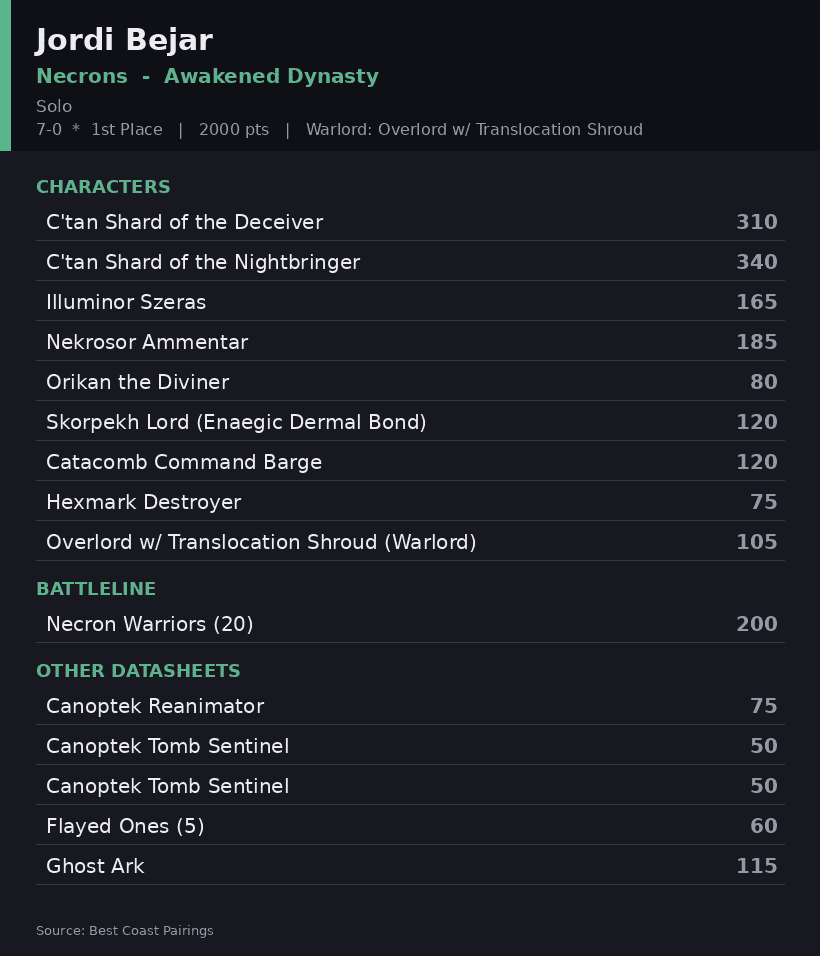
Awakened Dynasty Roster Breakdown
Two big-base C’tan as your damage threat doesn’t work in every Necron detachment, but Awakened Dynasty’s Necron playstyle gives them the reanimation and movement support that lets them camp on objectives, throw fists, or do both whenever they want. The Deceiver wanders through terrain like a Lictor in tall grass, while the Nightbringer just walks at you, and there’s not much in 40k that wants to walk back.
Illuminor Szeras and Nekrosor Ammentar hit up the support work, while Orikan is the cheap, mean little tech-priest who keeps the back line ticking. The Skorpekh Lord with the Enaegic Dermal Bond is the hard counter to whatever wades into him in combat, and the Overlord with the Translocation Shroud plus the Nether-realm Casket is the Warlord package that lets Jordi pull his most important model wherever the action moves to.
The support units in here is where the build feels distinct from the all-vehicle Necron lists circulating. One Ghost Ark, one Canoptek Reanimator, two Tomb Crawlers, a Hexmark Destroyer, and five Flayed Ones.
That’s a lot of bodies for an army built around two C’tan, and it’s also a lot of bubbles your opponent has to wade through before they get to the big stuff.
How Awakened Dynasty Wins the Reanimation War
The way an Awakened Dynasty Necron list wins is by making the opponent spend their resources earlier than they want to, then having more left at the back end. Two C’tan forces that bargain every game, along with the other twelve units in the list that are all out there collecting the opponent’s lunch money.
Plus, the win is even more impressive given the level of competition here. ACO is one of the deeper US majors of the year, with 89 players with ITC, GW Golden Ticket, and LVO 2026 qualification all on the table at once, which is a lot of pressure.
David Anderson’s Blade of Ultramar Gunline Put Marneus Calgar in the Antilochus Armor
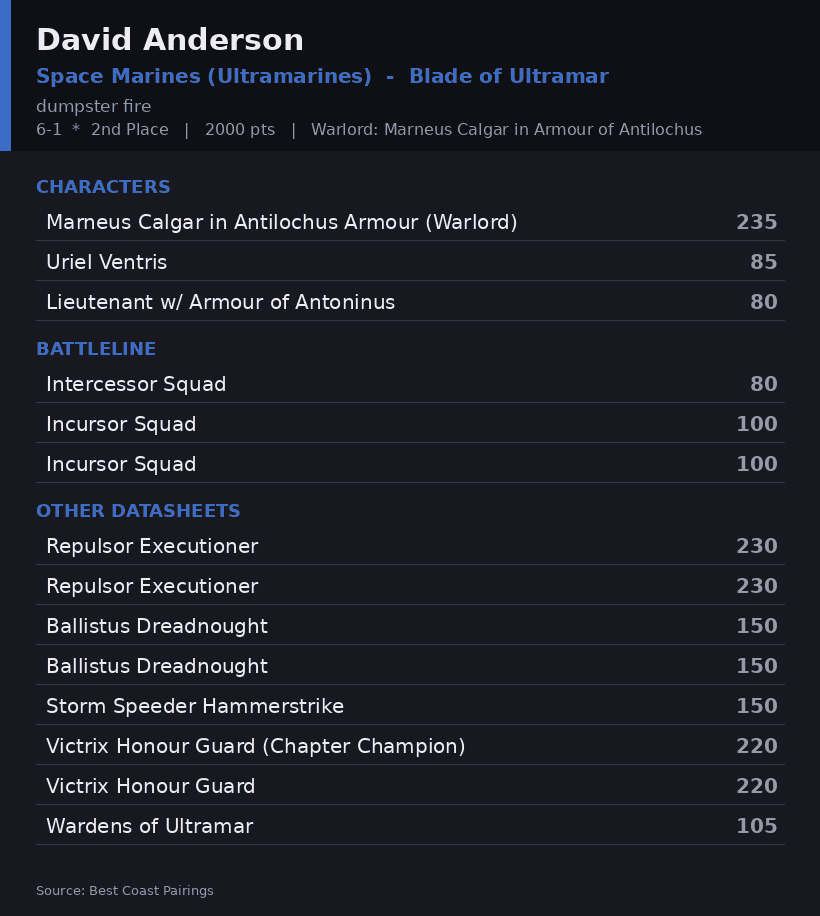
David’s “Behold! My UltraTemplars!” list ran Marneus Calgar in the Armor of Antilochus as the Warlord, with Uriel Ventris and a Lieutenant in the Armor of Antoninus filling out the character bench.
The list nickname telegraphs the plan pretty well. It’s a Durable gunline doing the points damage while Calgar and the Victrix Honor Guard sit ready to punish over-commitment. It’s the kind of build that needs a player who knows when to hold and when to push their line, which is what a 6-1 record shows.
Blade of Ultramar Roster Breakdown
The Blade of Ultramar detachment rewards Ultramarines lists that can do two things in the same turn: threaten and answer, and David’s build has that on repeat. Calgar in the Armor of Antilochus is a durable Warlord who can sit on the main objective and survive being shot at. Uriel Ventris is the second support character, freeing Calgar to commit forward when the matchup calls for it.
The shooting platform is two Repulsor Executioners and two Ballistus Dreadnoughts. Plus, the Wardens of Ultramar named-unit pack lets them score while doing their normal duties, like shooting.
The Storm Speeder Hammerstrike is the wildcard that deep strikes onto a thin flank when the opponent overcommits to the middle, and it pressures vehicles the rest of the time. Two Incursors and a single Intercessor squad fill the small-body utility slots, doing the scoring work that the big stuff is too important to handle.
How The Blade of Ultramar Hits Better
The Blade of Ultramar makes your shooting hit harder when your characters are nearby. David’s list takes advantage of that, with Calgar, Uriel, and the Lieutenant all triangulating around the Repulsors and Dreads so the army’s points damage stays high every turn. The Storm Speeder Hammerstrike gives him the threat range to pull opponents out of position, and the Victrix bodies finish what the guns started.
One loss across seven rounds is the kind of result that puts a player in a first or second-place spot. That being said, sometimes the matchup gives you a loss is just one that trades hits better with your list, and Necrons with two C’tan does exactly that.
So this second-place finish was probably due to the matchup, not to a specific missed play.
Ben Suddueth’s Tallyband Summoners Death Guard Brought Mortarion, Two Great Unclean Ones, and Rotigus
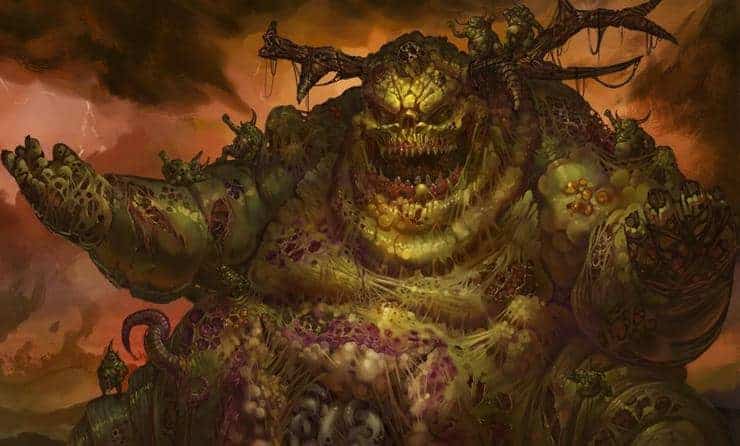
Ben’s “poop scoop v3” Tallyband Summoners is a daemon-heavy Mortarion Death Guard list in the truest sense.
Daemon-stuffed Death Guard isn’t where the meta has been pointing for most of the spring. Most of the lists that have shown up at majors this year have leaned more on the Death Guard datasheets themselves, so seeing a Tallyband build with this much daemon weight closing out third at ACO is worth checking out.
Tallyband Summoners Roster Breakdown
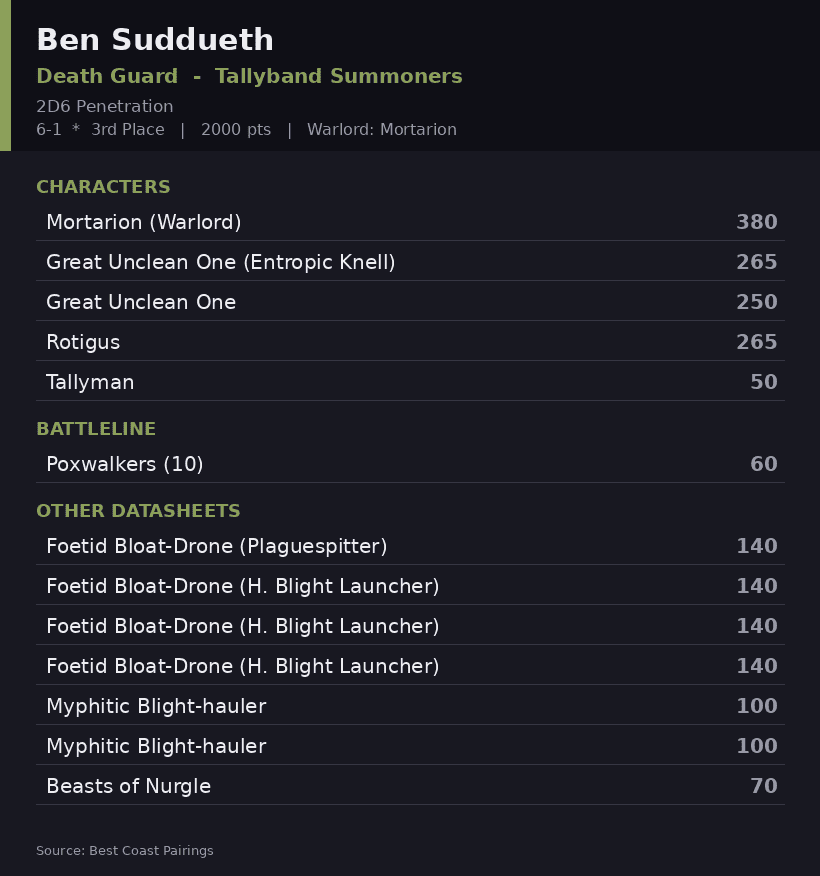
Tallyband Summoners is the Death Guard detachment that earns its keep when you bring more daemons than your opponent expects. It featured Mortarion and three Great Unclean Ones (yes, Rotigus counts) on four large bases of “go around me.” All while the Tallyman keeps the contagion count rising, which is the whole point of that detachment.
The support shell features four Bloat-Drones (one Plaguespitter, three Heavy Blight Launchers), two Myphitic Blight-haulers, the Beasts of Nurgle, and ten Poxwalkers. Meanwhile, the Drones do the flank work, and the Plaguespitter variant means he’s not relying on shooting alone to clear chaff. And finally, the Poxwalkers are a cheap, mean little screen.
How Tallyband Summoners Win the Slow Game
A list with four large bases plus a Daemon Primarch wins by being too big to ignore and too durable to remove in one turn. Every turn Ben kept Mortarion alive was a turn the opponent had to spend more shots than they wanted to.
The two Great Unclean Ones and Rotigus also benefited from that, and by round 4 or 5 in most games, the opponent was out of high-damage weapons or activations.
With a single loss across seven rounds, Ben had the same record as the runner-up. Honestly, Ben’s Tallyband Summoners build is the same Death Guard tactic that’s worked since the codex dropped. It’s all about bringing too many priority targets and letting your opponent decide which one to ignore.
His list just does it more aggressively than most.
Final Thoughts on the Atlantic City Open 2026 Army Lists & the 40k Meta
The detachments players have been arguing about all spring, just closed out a major in the same room. So the question isn’t whether Awakened Dynasty, Blade of Ultramar, or Tallyband Summoners are competitively viable; it’s how the next round of LVO-feeding majors responds to seeing all three of these at once again.
We’d guess more bracket lists pivot toward big-base trades in the early days of 11th, as even the Clutch City GT army lists from earlier this season were already pointing this way.
Also, with the new edition hitting this week, there’s about to be a huge shakeup overall. Either way, it’s worth keeping in the back of your head when you’re planning to play in your first Warhammer 40k tournament of 11th edition.
🔗 Related Reads:
- How to Play Necrons
- How to Play Death Guard
- Top Warhammer 40k Army Lists
- More Top Warhammer 40k Army Lists
- 40k Tournament Guide
- Warhammer 40k Factions Guide
- Latest 40k Balance Dataslate
- Munitorum Field Manual Points Updates
What do you think about the Atlantic City Open 2026 army lists and where the 40k meta is heading next?