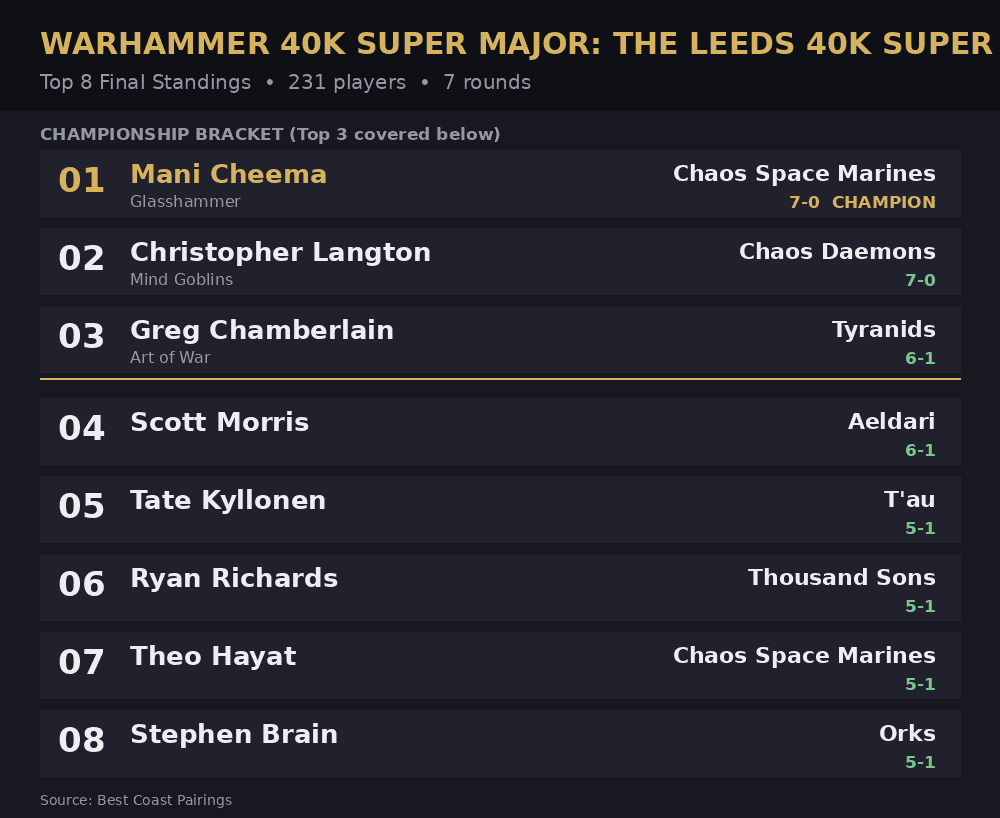
Mani Cheema’s 7-0 Chaos Space Marines took the Leeds 40k Super Major army lists crown over a second undefeated 7-0 Chaos Daemons roster on strength of schedule.
Two players went undefeated at Leeds with Chaos rosters (but not the ones you think) which is the bigger takeaway from this weekend. Mani Cheema’s Pactbound Zealots edged Christopher Langton’s all-Greater-Daemon Daemonic Incursion on strength of schedule, and neither one dropped a single game across seven rounds of Swiss against a 231-player open field.
The wider Warhammer 40k army lists meta right now makes Chaos builds even harder to dodge, as the faction took half of the Top 8 tournament placings here.
We dug into all three top finishers below.
Leeds 40k Super Major: Top 3 Warhammer 40k Army Lists
Updated on June 18, 2026, by Rob Baer with the latest winning armies
- Mani Cheema’s Pactbound Zealots went 7-0 with triple Defilers and Abaddon as Warlord: the Glasshammer player swept five of seven rounds at the 100-BP max and took first on Strength of Schedule.
- Christopher Langton’s Daemonic Incursion stacked five Greater Daemons and matched the 7-0 record: Be’lakor, Kairos, Lord of Change, Great Unclean One, and Skarbrand brick-walled the whole field on trade math.
- Chaos took seven of the top eight seats which is the meta read of 2026 [Family 4 — cousin of “X is the read”]: only Aeldari and T’au broke the Chaos wall, and Tyranid Invasion Fleet was the only non-Chaos roster in the top three.
Thanks to Best Coast Pairings, we can walk back through the whole event with real pairings and battle point data.
Mani Cheema’s Pactbound Zealots Stacked Defilers to Take the Crown
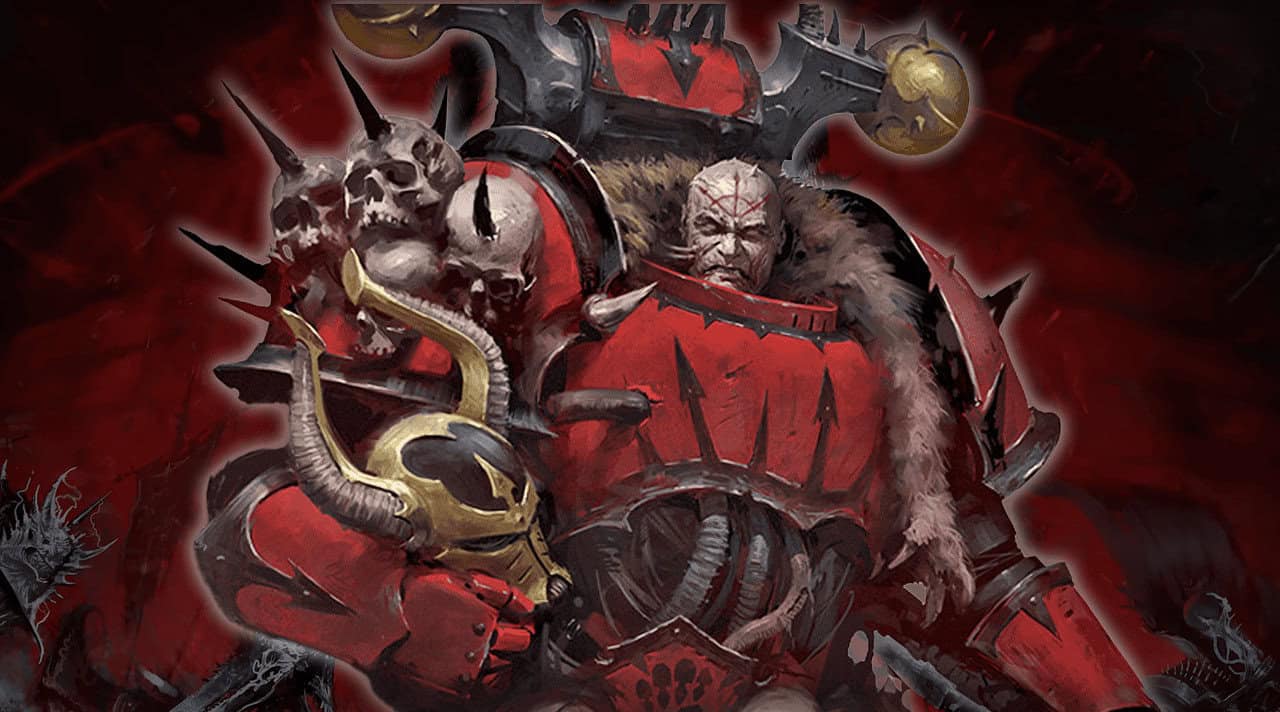
Mani Cheema rolled into Leeds with Glasshammer, three Defilers, and Abaddon the Despoiler, taking heads. Seven rounds later, he was the only player walking out of the bracket with a clean 7-0 record and the first-place trophy.
Pactbound Zealots keeps taking down events because the detachment lets you stuff the list with Defilers and still front-load it with three named characters.
Pactbound Zealots Roster Breakdown
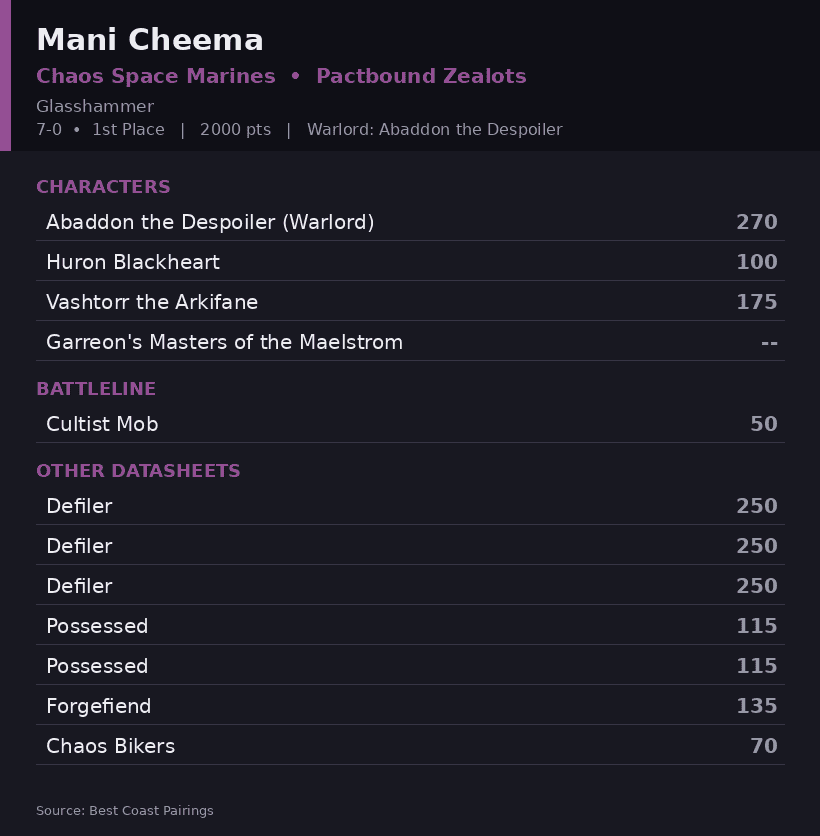
The 2000-point “Zealots!!” list runs Abaddon as Warlord, Huron Blackheart, and Vashtorr the Arkifane as the character core, then drops Garreon’s Masters of the Maelstrom character pack as a wildcard. Three Defilers anchor the heavy slot, with Possessed and a Forgefiend giving Mani close-fight and mid-range firepower.
Mani’s character suite is a huge part of his success. The big reason is Garreon’s Masters of the Maelstrom, a four-character bundle that gives him an extra activation lever in the deployment phase, and Mani has had this list on lock for half the calendar year already.
How Pactbound Zealots Win the Damage Race
Mani max-scored five of seven rounds at Leeds. Rounds one, two, four, six, and seven all closed at 100 battle points; round three landed at 98, and round five’s 92 was the only round where the opponent put real pressure on the secondaries.
The Strength of Schedule tiebreaker over Langton is why the 7-0 versus 7-0 split fell his way.
Christopher Langton’s Daemonic Incursion Walled Off the Field With Five Greater Daemons
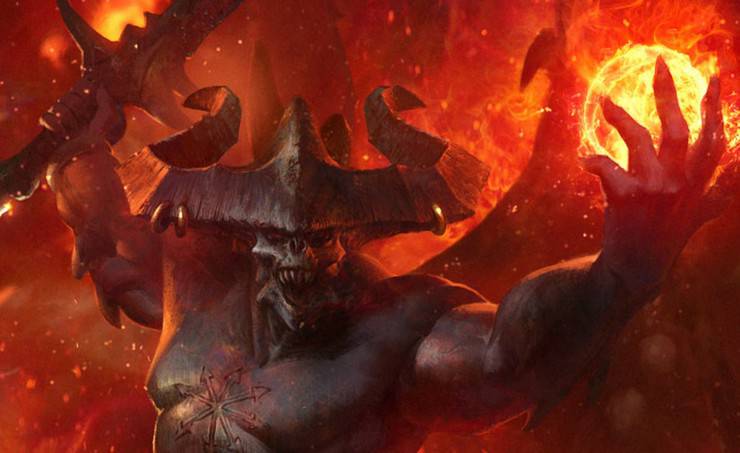
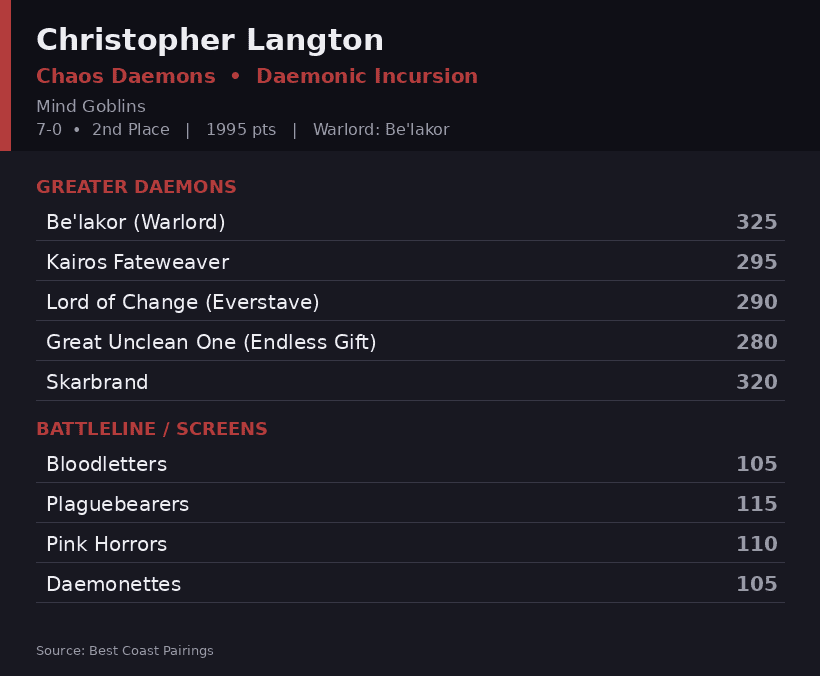
Christopher Langton came up big for team Mind Goblins with the most expensive five-model unit list anyone fielded all weekend: Be’lakor, Great Unclean One with Endless Gift, Kairos Fateweaver, Lord of Change with the Everstave, and Skarbrand on one roster.
He also went 7-0, with five God-tier Greater Daemons, a thin troop screen, and absolutely nothing else worth pointing at.
Daemonic Incursion Roster Breakdown
Be’lakor is the Warlord and the brand-name reason this list exists. Daemonic Incursion has been the showcase detachment since the codex dropped, and Langton is running it to the max. His Great Unclean One gets the Endless Gift Greater Reward, Lord of Change carries the Everstave, Kairos comes naked because he doesn’t need a relic, and Skarbrand exists to delete whatever the other four leave on the table.
That model count is a big factor in this 1995-point list. Five Greater Daemons is a chunk of real money, and on the table, it’s five activations against opponents bringing fifteen or twenty. Langton is betting that one Greater Daemon trade always goes his way, because the trade ratio on a 280-point character into a 200-point opponent unit is the basic math of the Daemonic Incursion in 10th edition.
How Daemonic Incursion Wins on Trades
Langton’s per-round scoring line is bumpier than Mani’s. The seven rounds read 92, 94, 71, 74, 93, 98, 84. Rounds three and four dipped into the low 70s, which is where a five-character list will always look squishy, but he won every round. The trades kept paying out even when the secondary missions were giving him grief, but the round seven 84 against another top-table player closed the door on the top for him.
Either way, two completely different Chaos game plans both reached 7-0 in the same room, which is what every other detachment in 10th edition has to think about going forward.
Greg Chamberlain’s Invasion Fleet Ran Six Raveners and Almost Took It
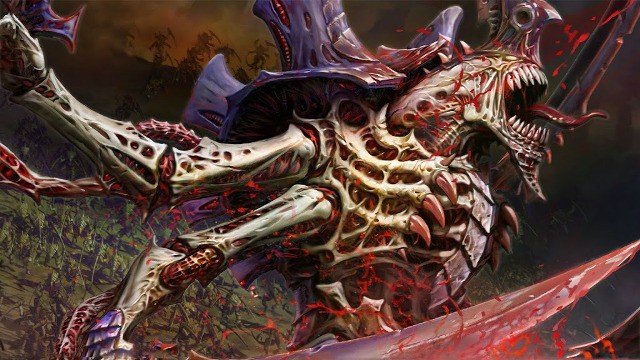
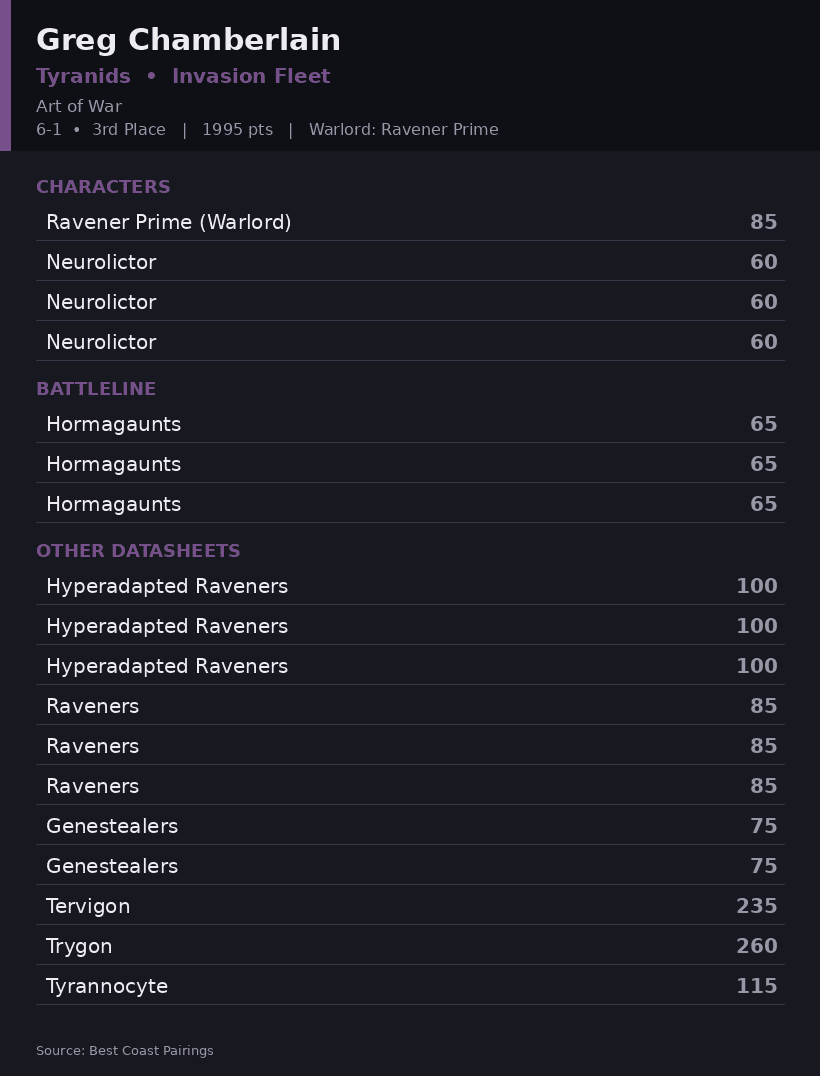
Greg Chamberlain put together the only non-Chaos roster in the top three with a Tyranid list that survived this far up the cut. Art of War packed him into Leeds with a Ravener Prime Warlord, six Raveners total (three of them Hyperadapted), and the kind of board-control mid-game that Invasion Fleet was built around.
He went 6-1, and his loss came in round seven against the top seed in the bracket.
Invasion Fleet Roster Breakdown
Three Hyperadapted Raveners and three baseline Raveners are a six-model melee power-spike that comes out of reserves. They charge opponents off the table and force them to commit where and when they don’t want to. With the Ravener Prime as Warlord is the cherry: a 5+ invuln character that can lead a Ravener pack and still cast Smite when the screens go down.
Backing up the Raveners, Greg ran three Hormagaunts and two Genestealer squads as cheap troops to claim primary, plus three Neurolictors as Lone Operatives doing the secondary work. The Neurolictors are the part most opponents underrate. At 60 points apiece for a Lone Operative that can sit on Behind Enemy Lines or Engage on All Fronts without contesting, three of them is the kind of cheap secondary-scoring mechanic that Tyranid lists used to lack.
How Invasion Fleet Wins the Movement Phase
The scoring tells you what Greg’s game plan does and where it bends. Four rounds at 96 or 100 (rounds one, two, four, and six), then a 61 in round three and a 64 in round five. The 61 is the round where the opponent disrupted the Ravener charge timing, and the 64 was the only round where the screens couldn’t keep the Neurolictors alive long enough to score. He still won both rounds, because the screens did just enough.
Round seven was the loss, and the 76 BP score against a top-of-bracket opponent is the kind of close finish that is always fun to watch in real time. So Greg ended up third on tiebreakers over Scott Morris’s Aeldari, but on a different day, this list is the kind of Tyranid roster that could close out an event itself.
Final Thoughts on the Leeds 40k Super Major Army Lists & the Warhammer 40k Meta
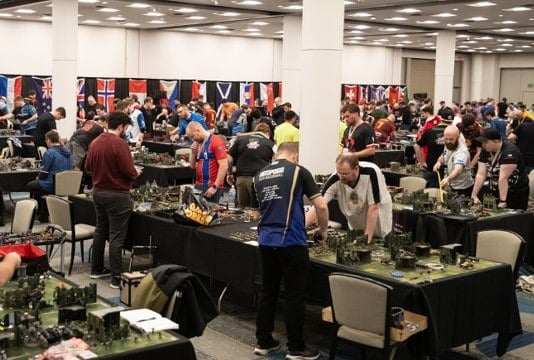
The takeaway from here is all Chaos, all the time, and the version of Chaos that wins is whichever flavor brings the most expensive single units it can fit in a list. Pactbound Zealots stack Defilers, Daemonic Incursion stacks Greater Daemons, and both detachments locked down a 231-player field with no one inside the top 8 finding a real answer for them.
On the Tyranid side, the Invasion Fleet at third tells us the codex still has legs as long as the Ravener bomb is on the table. Whether Greg’s third place was a one-off or the start of a Hyperadapted-Ravener meta run is the question worth tracking through the back half of the year.
🔗 Related Reads:
- How to Play Chaos Space Marines
- How to Play Chaos Daemons
- How to Play Tyranids
- Top Warhammer 40k Army Lists
- More Top Warhammer 40k Army Lists
- 40k Tournament Guide
- Warhammer 40k Factions Guide
- Latest 40k Balance Dataslate
What do you think about the Leeds 40k Super Major army lists and the Chaos stack at the top?