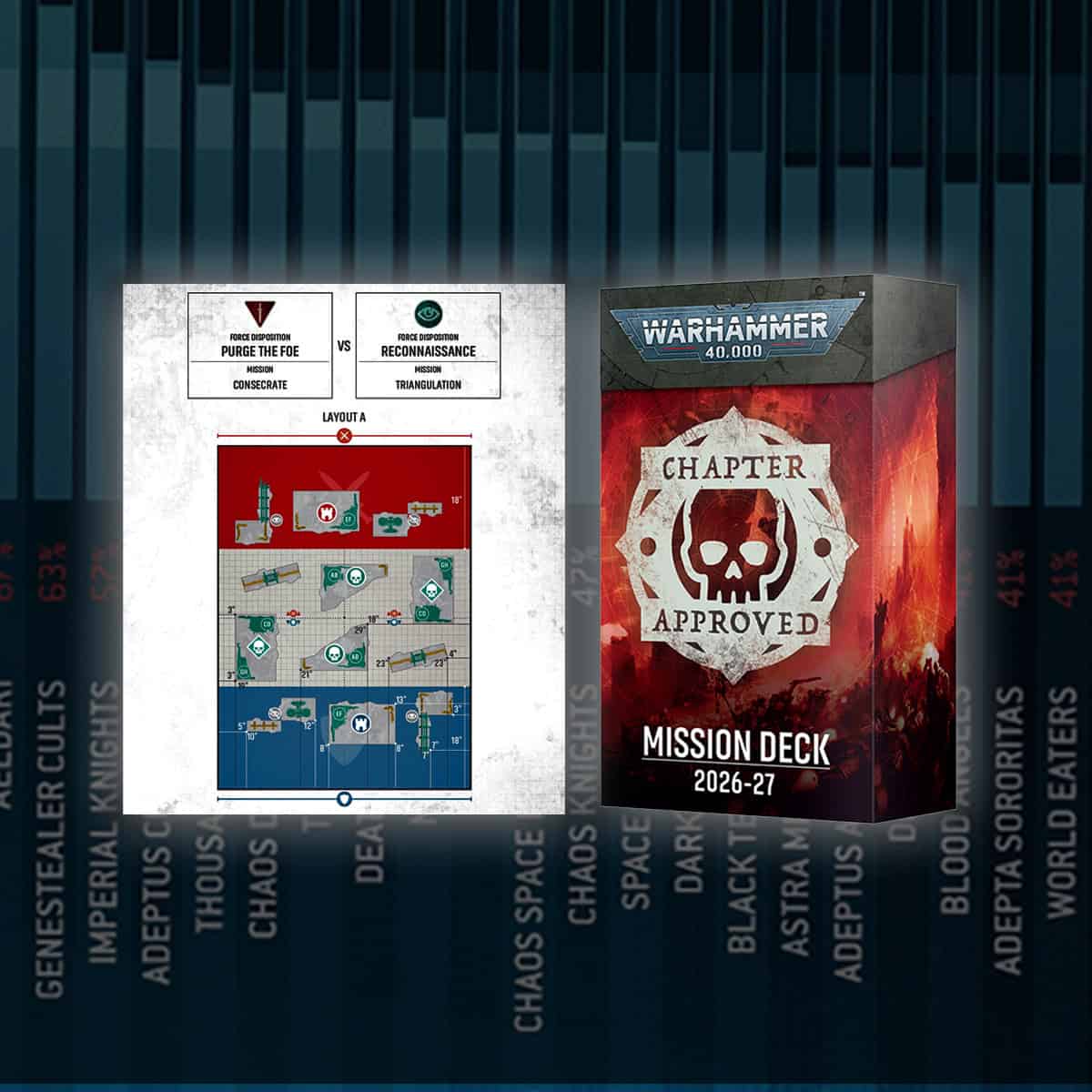
The latest Warhammer 40k Missions in the Event Companion lock your Force Disposition for the entire event; here are the latest rules and updates.
Other than the obvious change of playing all new missions, tournaments in 11th Edition will have one massive difference: you pick one Force Disposition when you submit your list, and that’s the only one you get for the entire event.
Games Workshop dropped rules updates for Warhammer 40k Missions in the 11th Edition Warhammer 40k Event Companion, along with the normal Disposition lock to how you plan, how you list-build, and how you practice before you sit down at a tournament table.
The old single-document Tournament Companion you knew from 10th edition is gone. The main Warhammer 40,000 Event Companion replaces it, applying the Force Disposition system at every step of the mission sequence, and three companion documents for Doubles, Teams, and Dominatus events sit alongside it.
So if you’re heading to any of the new Warhammer Opens this year (or any other official events), this is the framework for all your games, so it’s worth giving it a read so you’re not blindsided at the event.
We combed through PDFs from Warhammer Community and broke down the first eight pages of the main Event Companion below, then summarized how the three side companions change the rules at the table now for Warhammer 40k missions in 11th Edition.
Be sure to read all the rules updates to the new Warhammer 40k Balance Dataslate and Munitorum Field Manual in our coverage articles as well.
- Four PDFs: the main Warhammer 40k Event Companion plus Doubles, Teams, and Dominatus supplements.
- Force Disposition lock: chosen at army submission and locked for every game of the event.
- Three terrain layouts: A, B, C per mission pairing, organizer picks or rolls off.
Version 1.2 Just Changed Nearly Every Warhammer 40k Event Terrain Layout
Updated on August 26th, 2026, by Rob Baer with the new 2026-27 rules
GW updated the Warhammer 40k Event Companion again, and it’s about as disruptive as it gets. Almost every terrain layout in the current pack has been changed (luckily, the changes aren’t massive for each layout), covering Take and Hold, Purge the Foe, Priority Assets, Reconnaissance, and Disruption matchups across Layouts A, B, and C.
They are also getting more specific about how they want the layouts to rotate during events. The recommendation is now to cycle through A, B, and C sequentially, then start over as needed. So a five-round event would run A, B, C, A, B, while six rounds would get A, B, C twice.
An eight-round event would go A, B, C, A, B, C, A, B. So, if you’re playing a tournament that’s five rounds or more, you need plenty of practice on every layout.
There are also two Chapter Approved Q&A clarifications. For Plunder, the requirement that something be “not within your territory” refers to the terrain area, not the unit performing the mission. Meanwhile, Beacon is clarified to be extremely unforgiving. If the Beacon unit you nominate gets destroyed before completing the mission, you don’t get to nominate another one. The advice is basically to cut your losses, discard the mission on your turn, and take the CP.
With nearly every layout changed and GW now recommending a specific rotation order, tournament players and organizers should probably give the updated pack another look before their next event.
How the Warhammer 40k Mission Sequence Works in the New Event Companion
The mission sequence in the new Event Companion runs through 14 steps and covers everything from list submission to victory. Step 1 happens before you even show up, with steps 2 through 14 happening at the table after you’ve been matched with your opponent.
The big change from the old 40k tournament companion is step 1’s new Force Disposition pick, but the other thirteen steps tighten up how Secondary Missions, deployment, and scoring all work together.
 Here’s the full 14-step sequence in order:
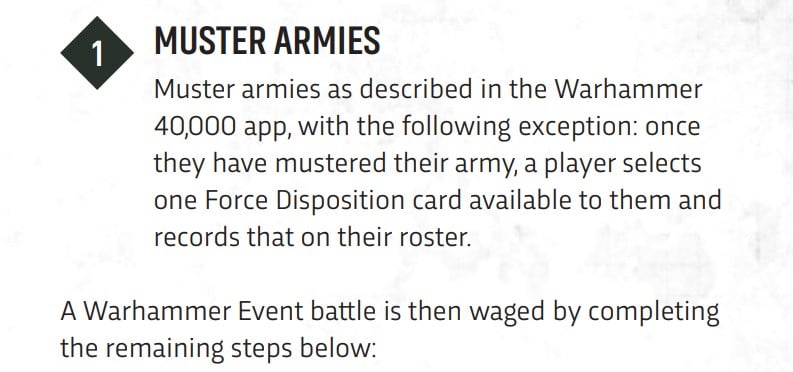
- Step 1 Muster Armies. Build your army in the Warhammer 40k app, pick one Force Disposition card available to your detachments, and record it on your roster. That choice is locked for the whole event.
- Step 2 Determine Mission. Find your opponent’s Force Disposition symbol on your own Force Disposition card. The Primary Mission listed under that symbol is what you play.
- Step 3 Determine a Layout. Each Primary Mission combination has three layouts (A, B, C). The organizer picks a specific layout, rotates by round, or has you roll for it.
- Step 4 Create the Battlefield. 44″ by 60″ board. Set up terrain areas and terrain features exactly as the layout card shows.
- Step 5 Determine Attacker and Defender. Agree on which edges of your board match the layout card, then roll off and the winner picks which side they play.
- Step 6 Select Secondary Missions. Secretly note Tactical or Fixed Secondaries, then reveal at the same time. Fixed Missions stay face-up and cap at 20VP per card. Tactical Missions get drawn two at a time at the start of your Command phase, with one 1CP discard-and-redraw allowed per battle.
- Step 7 Declare Battle Formations. Secretly note units embarked in Transports and units in strategic reserves, then reveal.
- Step 8 Deploy Armies. Alternate setting up units (excluding strategic reserves) starting with the Defender. Titanic units force you to skip your next deployment turn.
- Step 9 Redeploy Units. Resolve any redeploy rules alternately starting with the Attacker. Units placed in strategic reserves here do not count toward the strategic-reserves points cap.
- Step 10 Determine First Turn. Roll off, winner takes the first turn.
- Step 11 Resolve Pre-Battle Rules. Alternate resolving pre-battle rules, starting with the first-turn player.
- Step 12 Begin the Battle. First battle round begins.
- Step 13 End the Battle. Ends after five battle rounds. Even if you have no models left, both players play out their final turn.
- Step 14 Determine Victor. VP totals decide. Battle Ready painting gets you 10VP.
The scoring caps also got cleaned up at step 14, and you’ll want them memorized before any tournament round:
- Primary Mission caps at 45VP, max 15VP per battle round.
- Secondary Missions cap at 45VP, max 15VP per battle round, with a per-card cap of 20VP on Fixed Secondaries.
- Battle Ready Army adds 10VP at the end of the game.
Force Dispositions and Terrain Layouts: How the Three-Layout System Plays
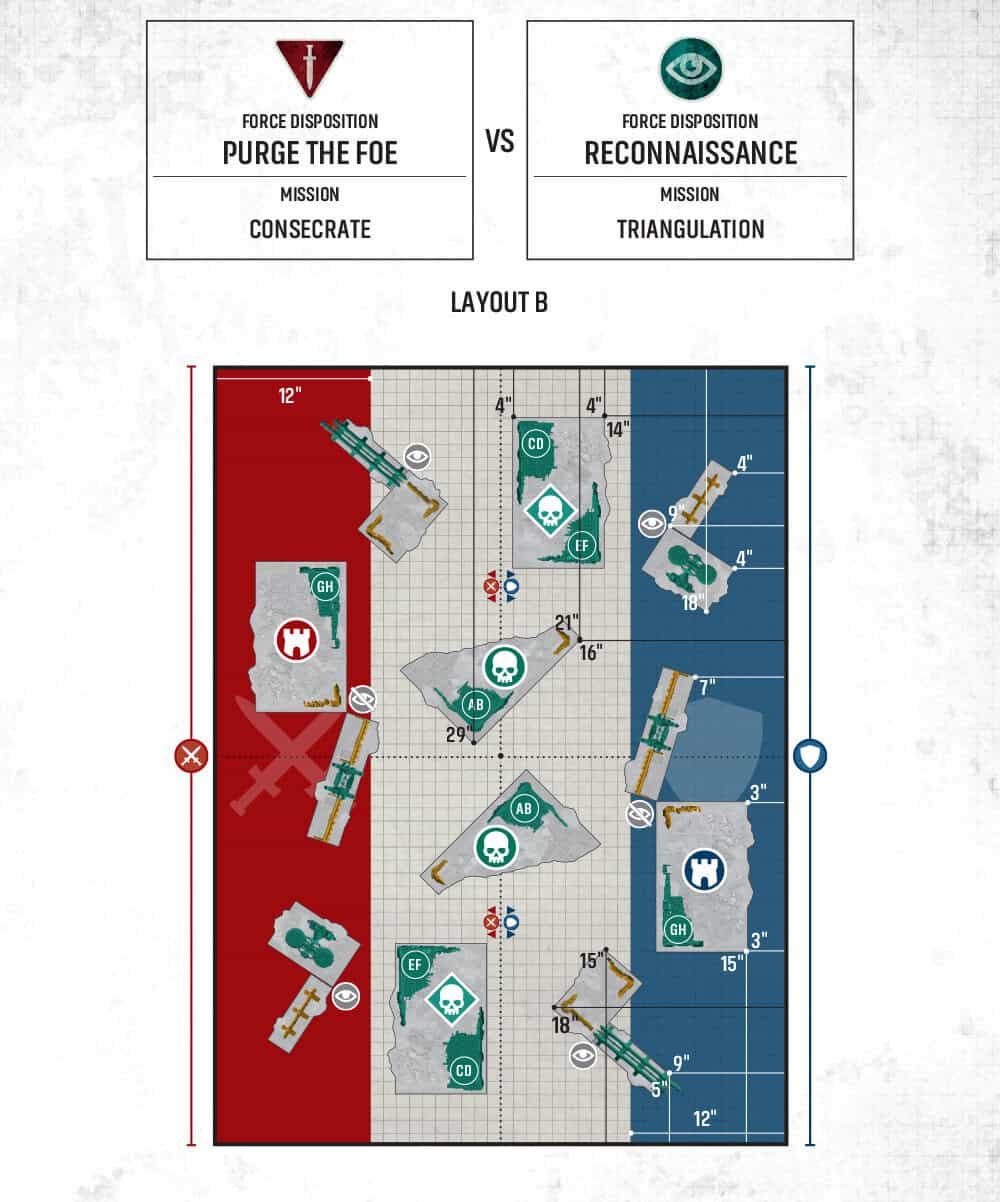
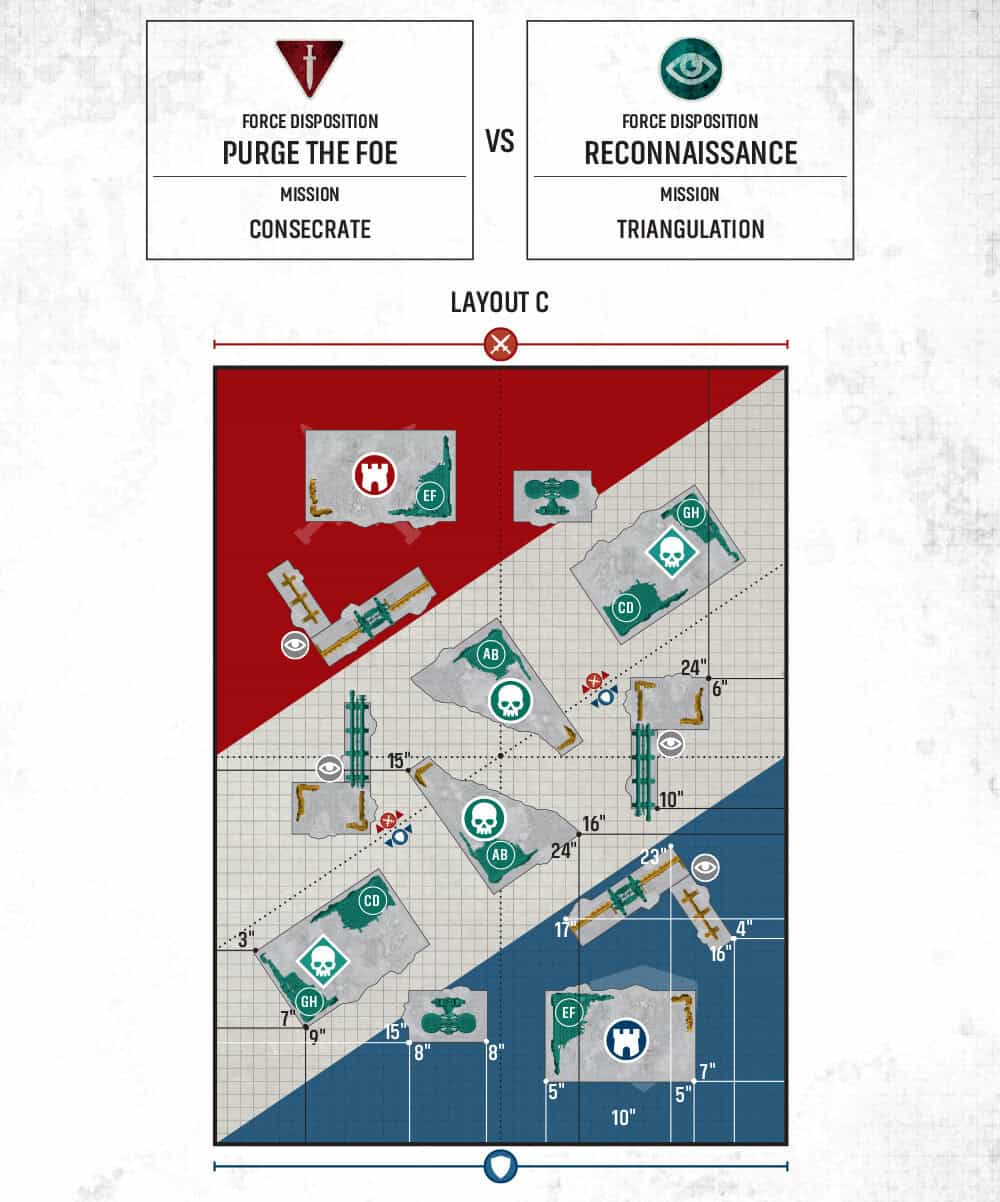
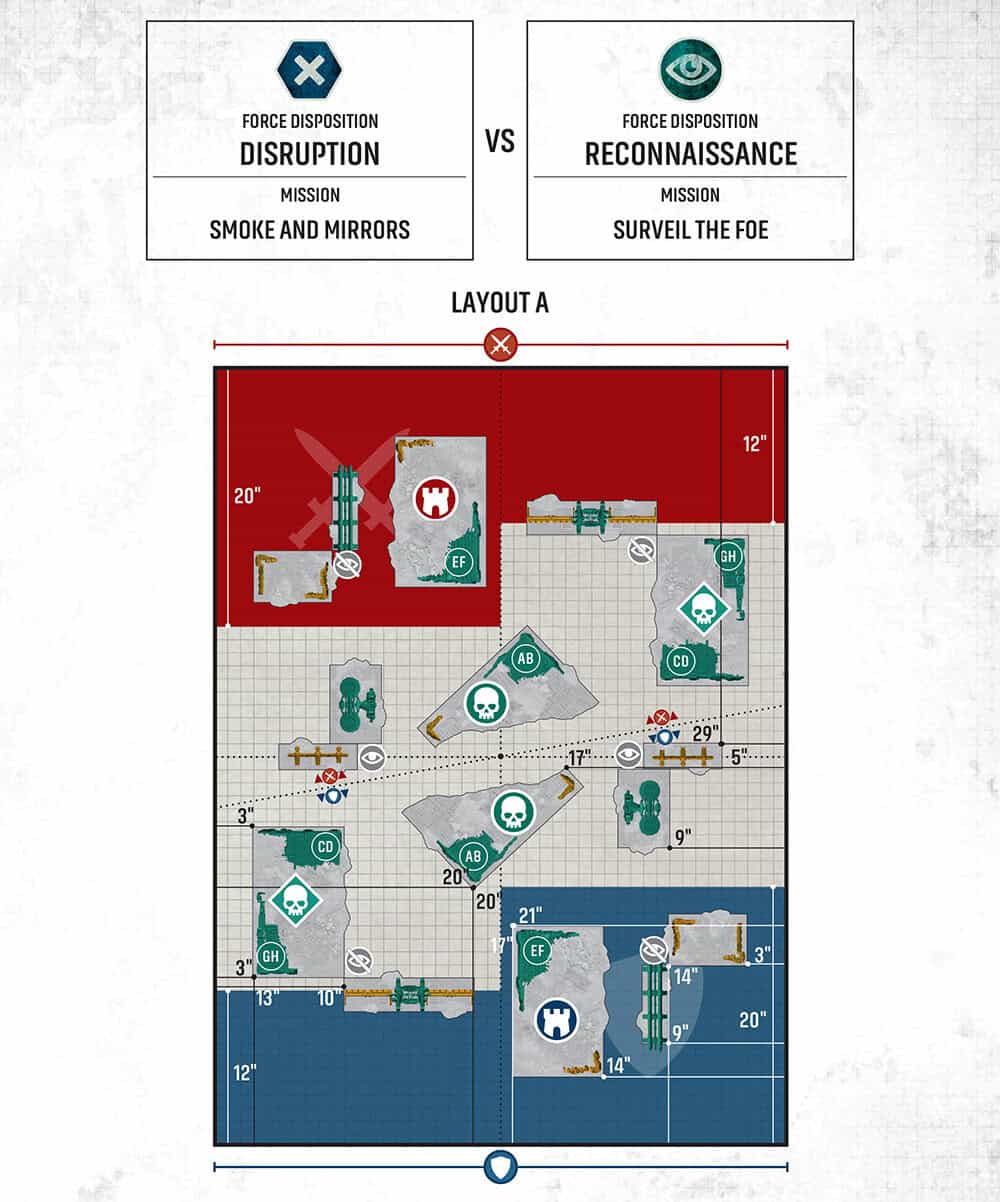
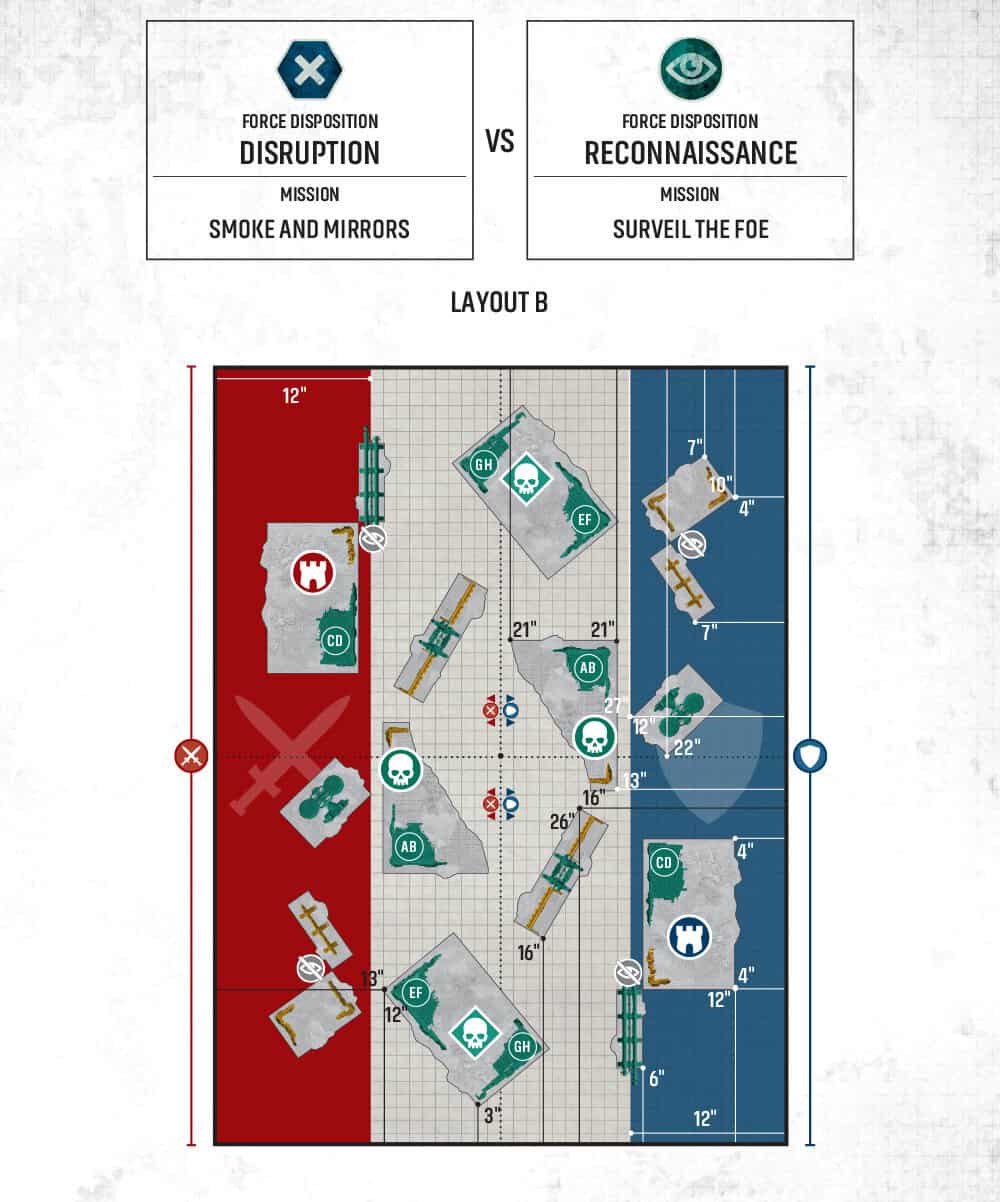
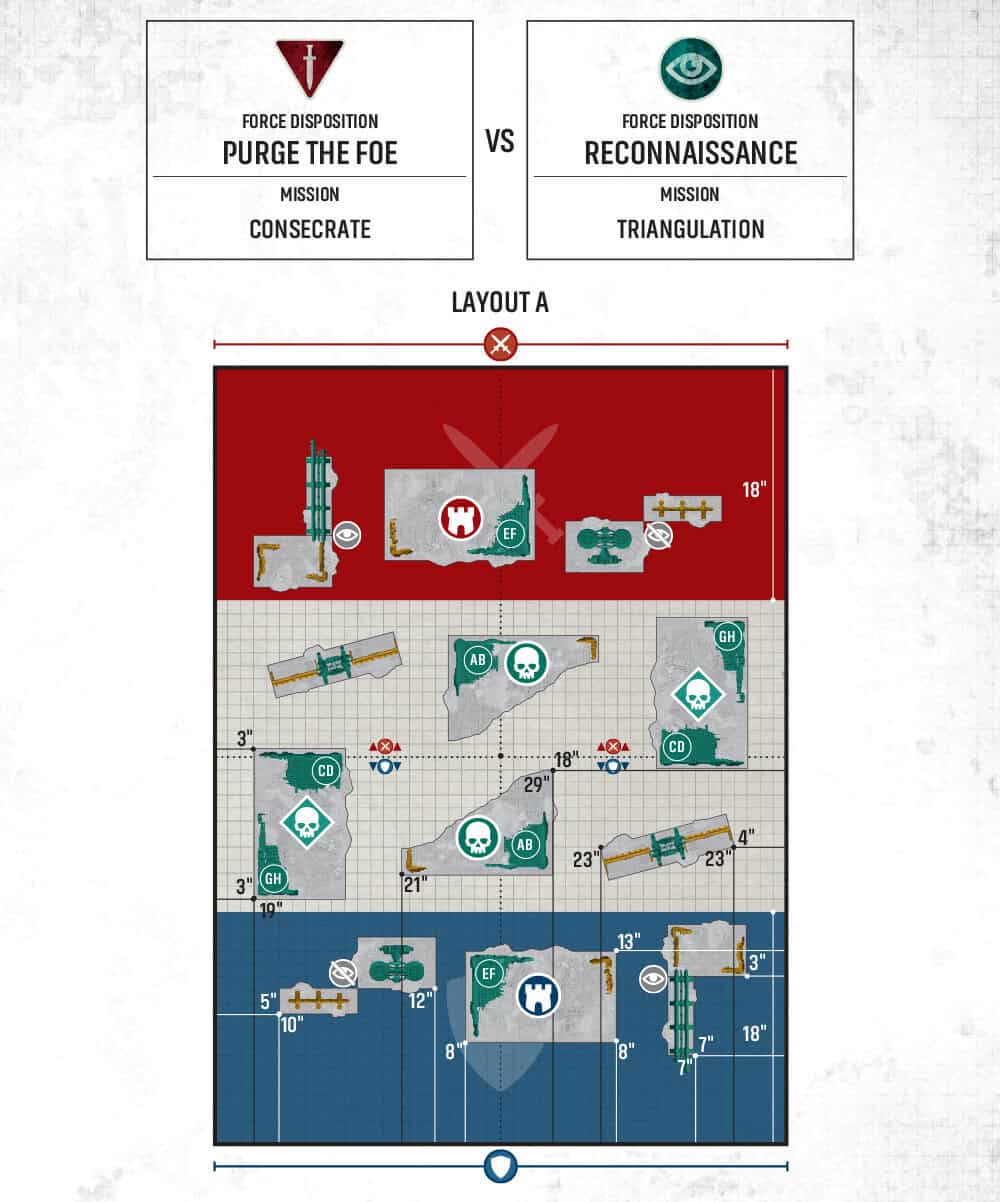 Each Primary Mission combination has three recommended layouts, A, B, and C, and they’re not just cosmetic either. Objective placement, deployment zone shape, and the mix of dense and light terrain all change between letters, so the same Primary Mission can play like three different missions depending on which letter the organizer picks.
Here are the three layouts GW showed in today’s article for a Reconnaissance army taking on a Purge the Foe force:
And here are the three layouts for a Reconnaissance army taking on a Disruption force, just to show how much the maps shift even when one side stays the same:
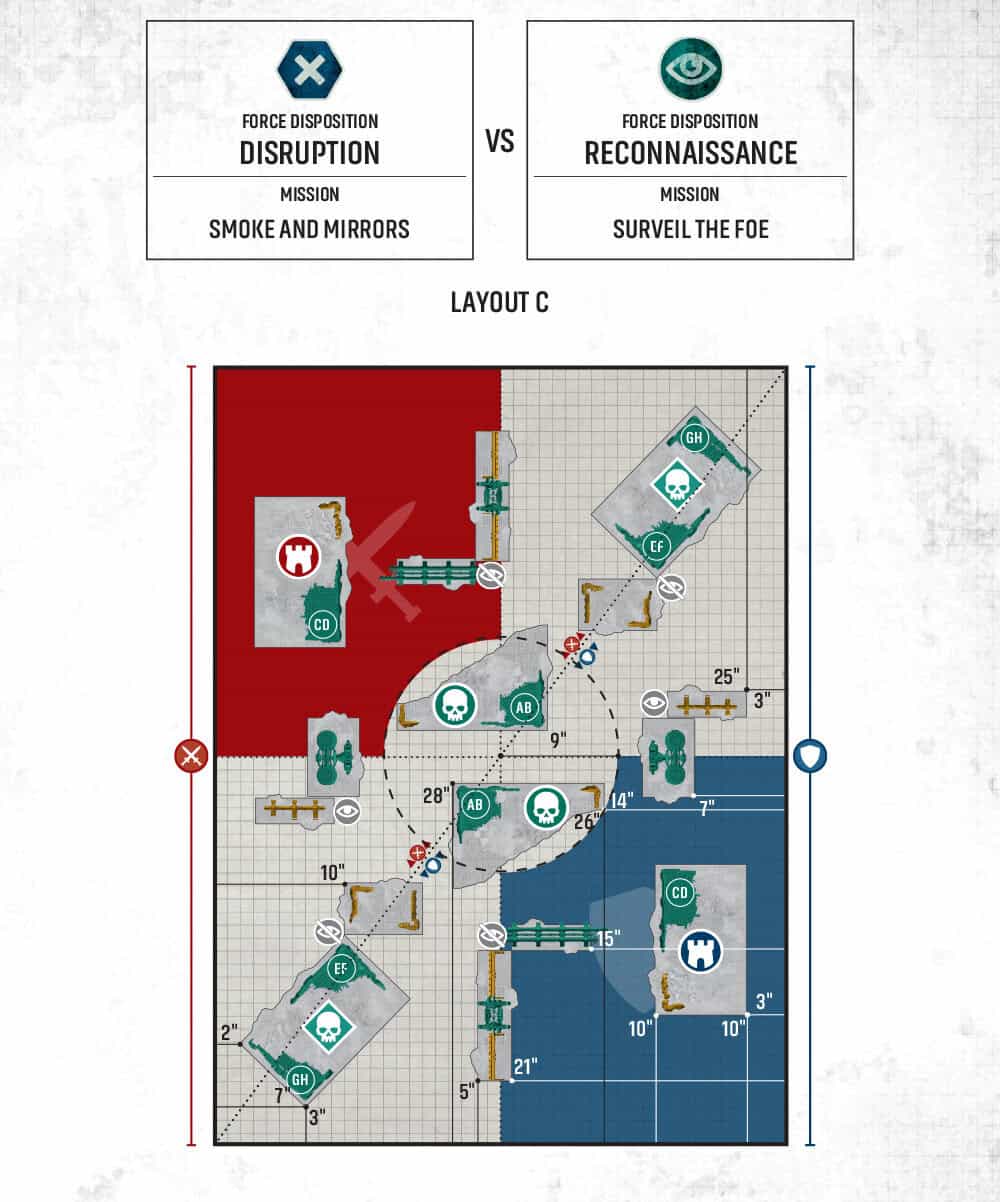
If you are playing a five-round event and the organizer rotates A, B, C, then back to A, so, you’ll see the same mission play out three different ways depending on which letter your table draws.
Which may be a lot of variation to practice. The 44″ by 60″ battlefield stays the same, the common terrain area set stays the same across all the missions (four 6″x4″, two 10″x2.5″, four 6″x2″, four 7″x11.5″, two 8″x11.5″ polygon), but where the terrain goes and where the objectives sit changes between each of the selections.
The terrain area footprints download as a separate PDF from the Warhammer Community Downloads page, so you can print them and use them as templates when you are practicing at home. Mission layouts also drop into the updated Warhammer 40k app next week, which will be the main way most TOs and players actually look them up at the table.
Designer’s Notes and Mission Deck FAQs in the Event Companion
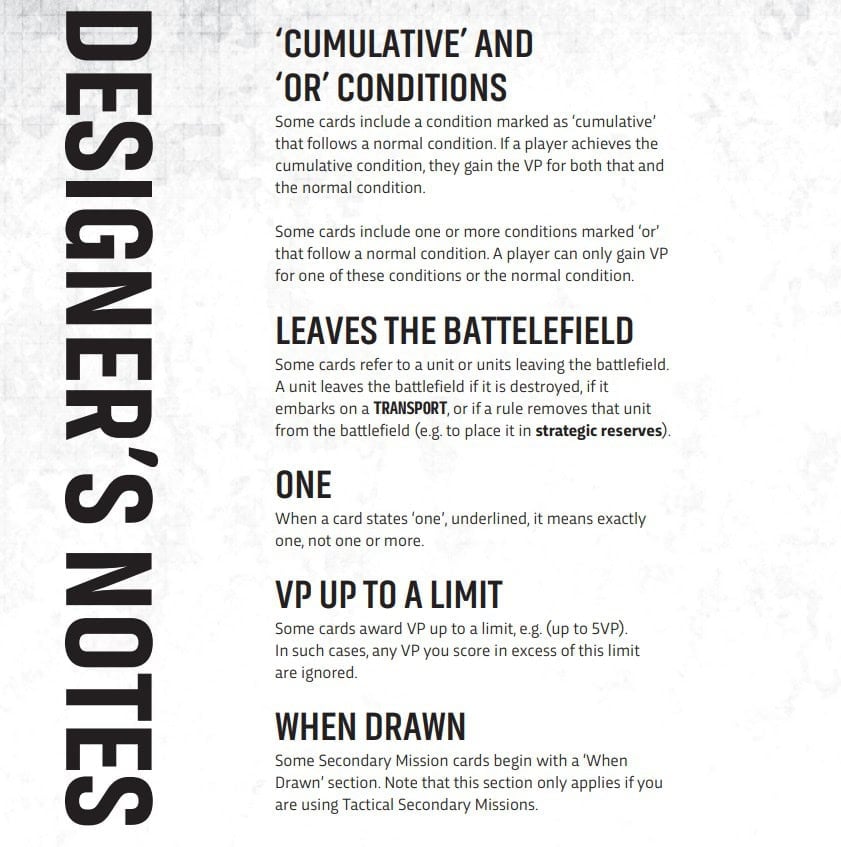 Pages 3 and 4 of the main Event Companion contain the rule clarifications that decide many close calls. Most are small text definitions, but they have all cost players VP in past tournaments, so it pays to know them off the top of your head.
- Cumulative conditions stack with the normal condition on a Secondary Mission card, so you score both. “Or” conditions only let you score one of the listed options.
- “Leaves the battlefield” now covers destroyed units, units that embarked on a Transport, and units removed by a rule (placed in strategic reserves, for example).
- “One” underlined means exactly one, not one or more.
- “When Drawn” sections on Secondary Missions only apply to Tactical Missions, not Fixed.
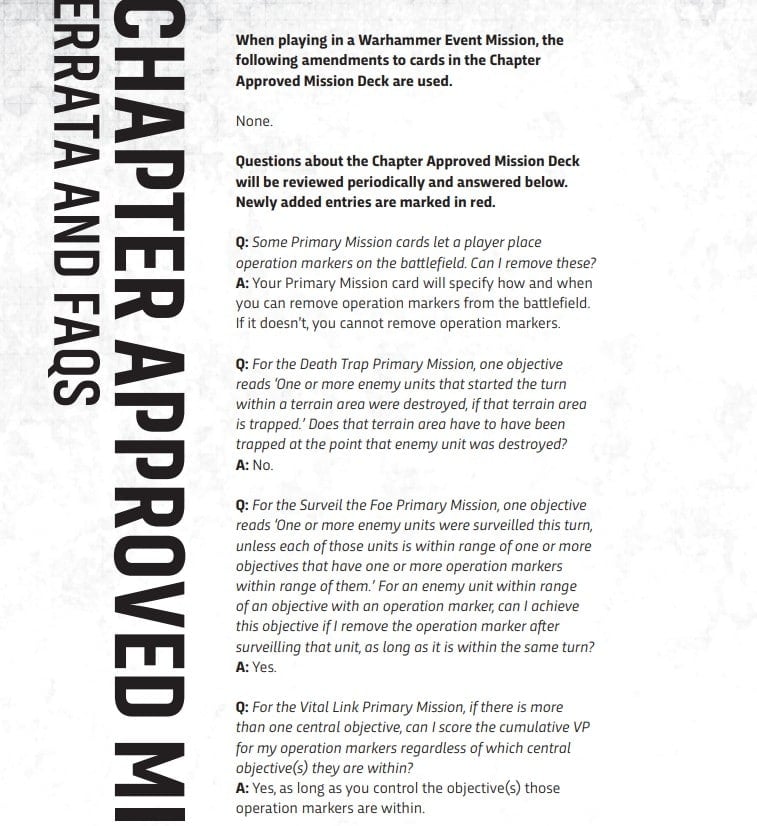 For the Chapter Approved Mission Deck v1.0 itself, the FAQ list is short, and there is no errata yet at launch:
- Operation markers can only be removed if the Primary Mission card says so.
- Death Trap does not require the terrain area to be trapped at the moment the unit dies.
- Surveil the Foe can remove the operation marker and still score on the same turn.
- Vital Link’s cumulative VP stacks across multiple central objectives if you hold them.
Expect quarterly FAQ updates once the new edition starts seeing organized play, but launch-day v1.0 is what we all have to take to the first round of every event for the next three months.
Pairings and Rankings: VP Is Officially Not the Tiebreaker
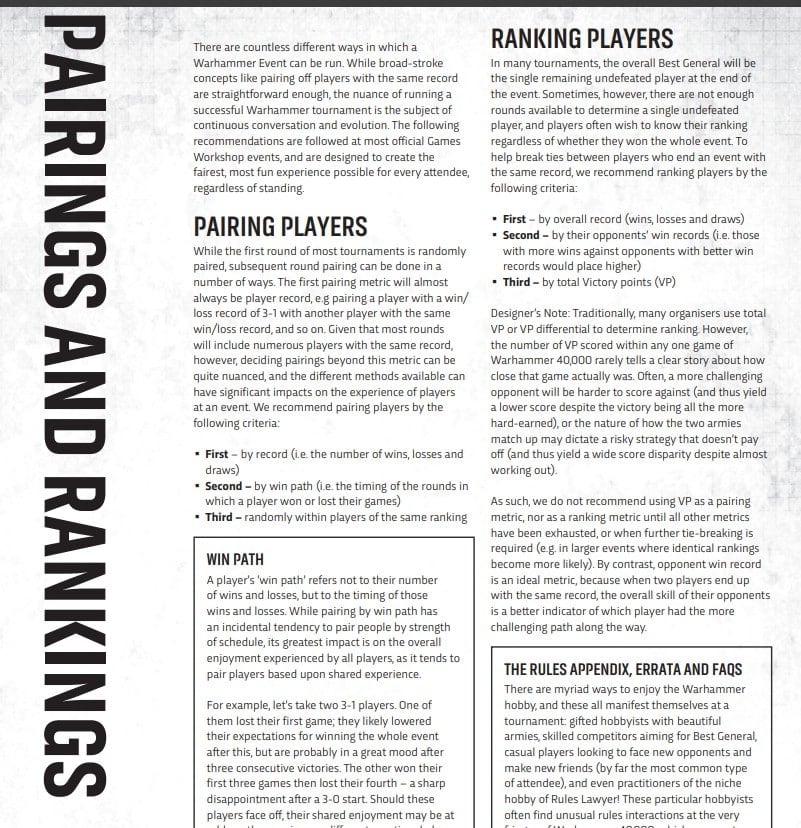 This is one of the bigger policy shifts in the new Event Companion, tucked into page 5, and it will spark debate at every TO meeting in the country. The new recommended pairing criteria, in order, are:
- First, by record (W/L/D).
- Second, by “win path,” which tracks the timing of your wins and losses rather than the raw count.
- Third, randomly within the same record and win path.
GW’s stated argument for win path is that a 3-1 player who lost their first game is in a different emotional place than a 3-1 player who lost their fourth, and pairing by win path keeps the experience consistent across both ends of the table.
That makes the recommended ranking criteria for the overall tournament, in order, are:
- First, by record.
- Second, by opponents’ win records (strength of schedule).
- Third, by total VP.
The big shift is that VP is now explicitly the third tiebreaker, not the first. GW recommends against using VP as a pairing metric at all, and only as a ranking metric after the other tiebreakers are exhausted. So, if you are a TO, that’s a significant change from how most 10th-edition GTs ran their tiebreakers, where VP was often the second metric right after record.
The Doubles Event Companion: Two Players, One Force
The Warhammer 40k Doubles Event Companion is the first time GW has given Doubles tournaments a dedicated rules document, and it lives alongside the main Event Companion rather than replacing any of it.
You and your teammate each muster a 1000-point army, and together you form a single “force” that fights as one side against another two-player team.
One of the new changes is the Unified Force versus Force of Convenience distinction, and the rules differ between them:
- Unified Force is two armies that share faction keywords (both Adeptus Astartes, both Aeldari, both Tyranids). Units in both armies count as friendly to each other for everything, which includes aura abilities, Transport embarks, army rule pools (a Drukhari Unified Force shares one pain token pool, not two), and detachment rules if both players picked the same detachment.
- Force of Convenience is two armies that do not share faction keywords. Detachment rules and most “friendly faction” abilities only affect your own army.
- CP is shared at the force level either way, with one extra CP per round, and one Warlord per team.
- Each team picks a single Force Disposition from either army’s detachments, so the Disposition lock from the main Event Companion still applies at the team level.
GW also cleared up one of the launch-day questions in the article: yes, you can use a single 3DP detachment as your only detachment at 1000 points, even if that detachment normally costs more Detachment Points than the mission size technically allows.
They will update Muster Army rules to make that explicit in the first post-launch patch.
The Teams Event Companion: One-on-One, but the Team Scores
 The Warhammer 40k Teams Event Companion handles the larger-team format, where multiple players on each side play individual one-on-one games, and cumulative scores decide the round. Team sizes from 3 to 8 are explicitly supported, and pairing rules vary by team size.
For every five players on a team (rounded up), only one player can pick each Force Disposition. So a 5-player team has all five Dispositions represented exactly once, and an 8-player team has every Disposition once plus three players doubling up. Overall, that forces the team to master different mission types instead of stacking the strongest Disposition.
The pairing system runs through three modules, and which modules you use depends on team size:
- 3-player teams use Main Engagement.
- 4-player teams use Main Engagement plus Champion System.
- 5-player teams use Initial Skirmish plus Main Engagement.
- 6-player teams use Initial Skirmish, Main Engagement plus Champion System.
- 7-player teams use Initial Skirmish twice plus Main Engagement.
- 8-player teams use Initial Skirmish twice, plus Main Engagement, plus Champion System.
Each section of the event module is a blind-selection round: every team picks a Defender, both Defenders reveal, then both teams pick two Attackers, then both teams pick which Attacker they want their Defender to face, and the Defender chooses the layout letter (A, B, or C).
It is secretive, tactical, and nothing like the old grid-pairing system 10th ran.
Scoring rolls up through a Battle Point chart where the VP differential of each individual game converts to BP for the team:
- 0 to 5 VP differential splits 10 BP to 10 BP.
- 6 to 10 VP differential splits 11 BP to 9 BP.
- 11 to 15 VP differential splits 12 BP to 8 BP.
- 16 to 20 VP differential splits 13 BP to 7 BP.
- 21 to 25 VP differential splits 14 BP to 6 BP.
- 26 to 30 VP differential splits 15 BP to 5 BP.
- 31 to 35 VP differential splits 16 BP to 4 BP.
- 36 to 40 VP differential splits 17 BP to 3 BP.
- 41 to 45 VP differential splits 18 BP to 2 BP.
- 46 to 50 VP differential splits 19 BP to 1 BP.
- 51+ VP differential splits 20 BP to 0 BP.
So, each team adds up their BP, and the match-winning margin depends on team size (4 BP for 3-player teams, up to 12 BP for 8-player teams). A win is 3 Team Points, a draw is 2 TP each, and a loss is 1 TP.
The Dominatus Event Companion: Narrative Campaigns Are Back!
 The Warhammer 40k Dominatus Event Companion is the third supplement, built to run the Dominatus narrative deck (from the Warhammer 40,000 Armageddon boxed set) as a competitive event format. The Dominatus deck itself pre-orders separately starting tomorrow, so this companion is the one most of us will need to wait to play unitl after June 20th.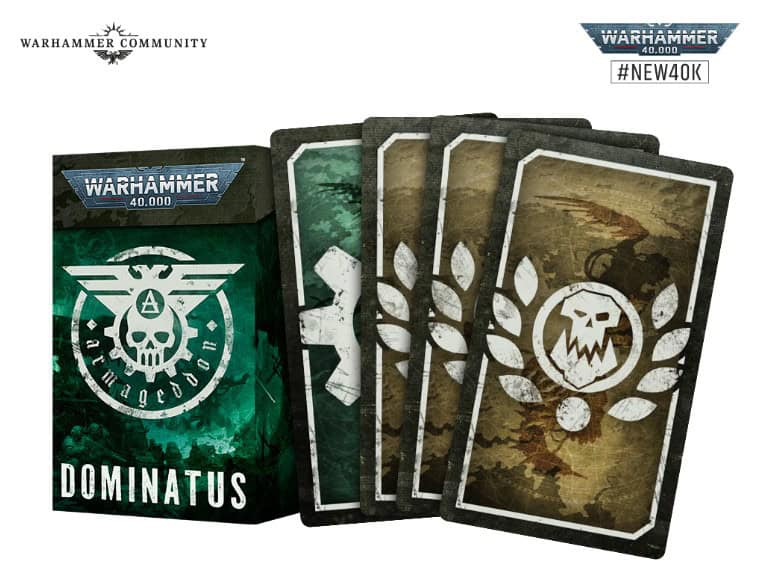
The big structural addition is the Warmaster. At a Dominatus event, the Tournament Organizer is also the Warmaster, and they get new powers that no other format gives the TO:
- Pick the campaign-phase Location card at the start of each phase, instead of rolling.
- Require players to change their Alliance if needed for pairing balance.
- Several end-of-phase steps (Acquire Relics, Discard, Fresh Supplies, Test of Mettle) get pushed forward to the start of the next phase’s first battle, which keeps the bookkeeping at the table instead of after rounds.
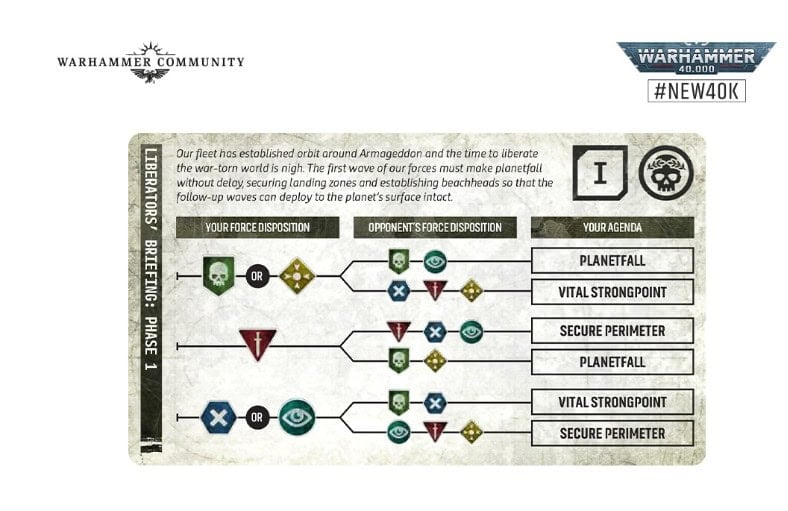
Here, each player picks one Force Disposition AND one Alliance during muster. The mission you play comes from your Alliance’s current Briefing card cross-referenced with your opponent’s Force Disposition, which generates an Agenda card that sets your Primary Mission and your scoring conditions.
Players can decline to play Agendas (defaulting to the standard Force Disposition mission), but if you do, you cannot score Agenda VP for the battle.
Plus, the win and loss draws are the most narrative-driven of the four formats:
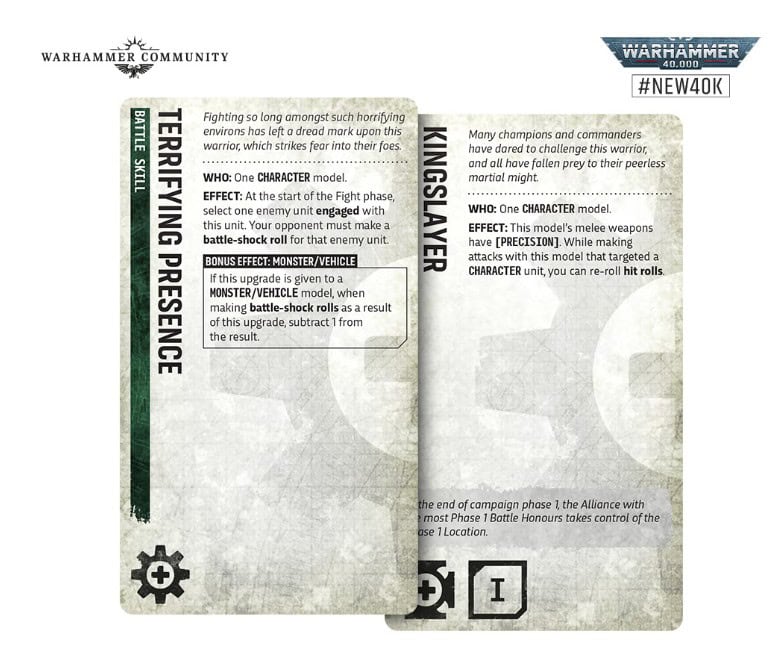
- The victor draws a Battle Honor card from the current campaign phase’s deck.
- The loser draws a Battle Skill card.
- If a player gained one or more Agenda Achieved cards from the battle, they draw one extra card of the same type and keep one of their drawn cards.
- Phase 3’s victor takes the Path to Conquest Battle Honor automatically.
Best of all the narritve-style pairing in Dominatus runs record first, win path second, random third, with the added rule that you are paired across Alliances rather than within them.
Final Thoughts on the Warhammer 40k Event Companion
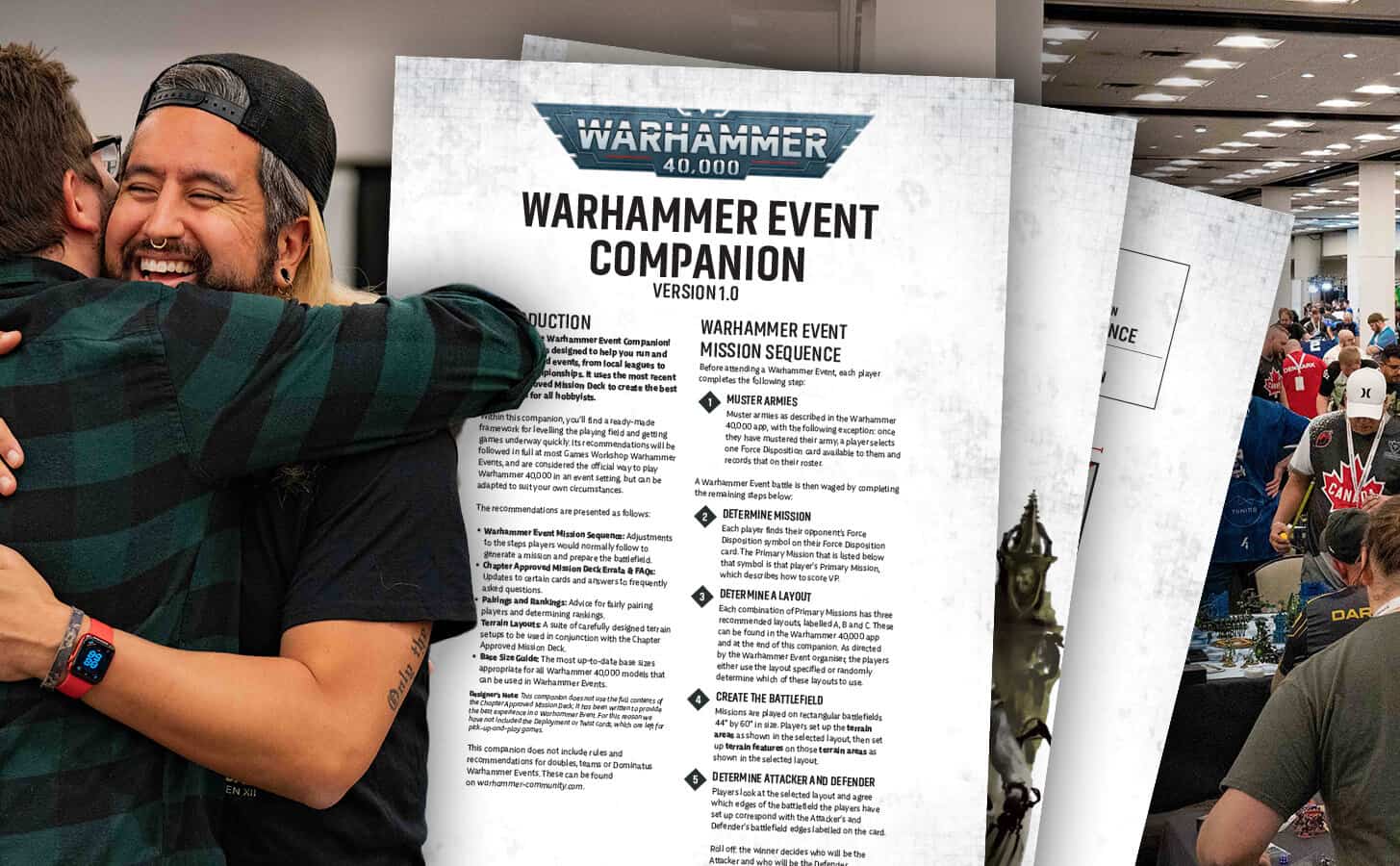
So the new Warhammer 40k Missions in the Event Companion are the largest tournament rules shift the game has had in years, but the structural change is the four-document split. The main companion handles 90% of what most tournaments will run on, and the three supplements give Doubles, Teams, and Dominatus formats their own purpose-built rules instead of patching them onto the standard rules with footnotes.
The Force Disposition lock will be the rule that might actually change competitive play the most. Locking it for the entire event means list-building decisions get made under more uncertainty than before, because you cannot pivot your Disposition after seeing the mission pack.
On the other hand, you get to practice exactly five Primary Missions for the event instead of fifteen, so the prep window is more focused.
The 14-step Warhammer 40k mission sequence will take some getting used to, especially the new step 2 Determine Mission flow that pulls Primary Missions from a cross-reference of your Force Disposition card. The terrain layout system with three letters per pairing adds variety without making practice impossible, because you can drill the A/B/C variants of your most likely Primary Missions ahead of an event.
VP getting demoted to third tiebreaker will spark the most debate among TOs, especially in regions where VP-based seeding was the default.
We’ll see how the community reacts at the first Warhammer Open in Tacoma in July, which should be the first major test of every rule in the new Event Companion all at once.
Click Here to Download All the Companions
🔗 Related Reads:
- Chapter Approved Deck 2026: Force Dispositions Decide What the Game Is About
- Warhammer 40k 11th Edition Rules: Big Reveals, Rumors + Predictions
- 2026 Warhammer Tournaments & Events Calendar Guide
- 40k 11th Edition Launch Product Lineup: Combat Patrol Companion, Terrain Area Set, Rules + More
- Return of Yarrick, 40k Armageddon Releases: Available Now
- 40k 11th Edition Rules: GW Calls It Evolution, Tournament Players Will Disagree
What do you think about the new Warhammer 40k Event Companion and the Force Disposition lock for tournaments?