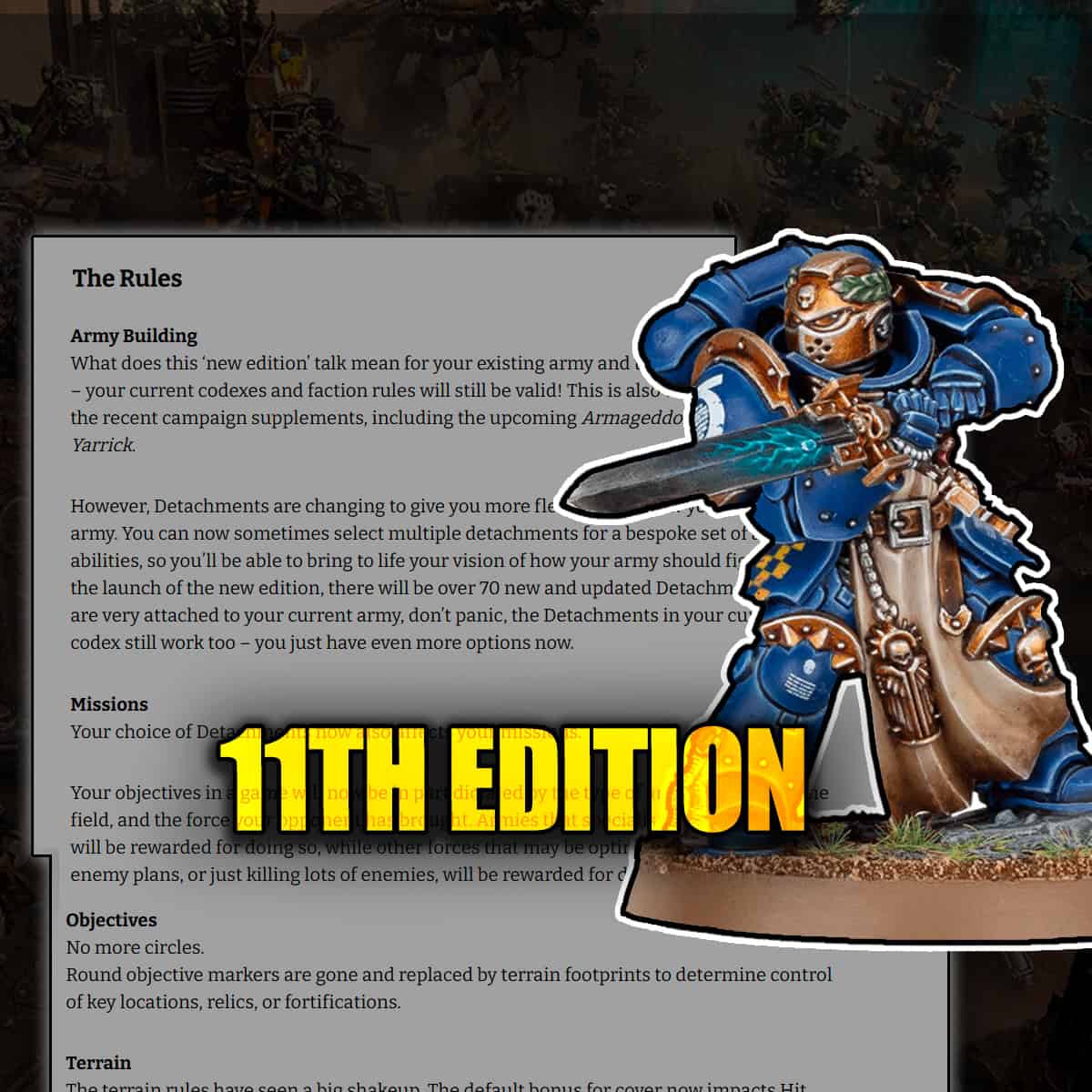
Every Warhammer 40k 11th Edition rules change and reveal in one place: the June 20, 2026 release, free Core Rules, detachments, missions and combat.
Here’s what to expect: Warhammer 40k 11th Edition is the current core edition of the game, released Saturday, June 20, 2026, and it’s more of a cleanup pass than a teardown. Your current codex stays valid, army building gets more flexible, and missions, objectives, terrain, and combat all pick up meaningful rules changes.
Games Workshop finally started peeling back the curtain on Warhammer 40k 11th Edition rules (and the Armageddon starter set), and the early picture looks pretty clear. This isn’t a hard reset; it’s more like GW taking a wrench to a bunch of systems that felt clunky and overcomplicated to try to make them flow better on the tabletop.
Probably the best news of all is that your current codex isn’t getting tossed in the trash, but the way armies are built, how missions work, controlling objectives, and even how cover and combat play out are all getting meaningful changes.
So, for anyone wondering whether 11th edition is actually bringing meaningful rules updates or just repackaging the same old stuff, there’s already been enough revealed to get a feel for the new edition.
Jump to any 11th Edition rules section:
Release Date | Armageddon Box | Codex Survival | Rumors Roundup | How to Get Started | Official Previews | Army Building | Detachment Points | Detachments by Faction | Missions | Objectives & Terrain | Movement | Attacks & Saves | 10th vs 11th Table | FAQ
Warhammer 40k 11th Edition Release Date
Updated on September 28 2026, by Rob Baer with the launch date, the free Core Rules download and a post-launch FAQ refresh.
- Not a hard reset: 11th Edition is shaping up as a systems tune-up: cleaner flow, less clunk, more table interaction.
- Your codex lives: current codexes and faction rules stay valid, including recent campaign supplements.
- Army building gets looser: detachments remain legal, but you can sometimes take multiple detachments, plus 70+ new/updated detachments at launch.
- Missions key off your army: detachments help shape objectives/scoring, pushing more thematic play—but balance will make or break it.
- Big cleanup passes: no stratagem stacking on one unit, objective “circles” are gone (terrain footprints matter), cover shifts to Hit-roll impact, hiding is easier (until you shoot or they get within 15″), and melee gets streamlining across charges/activation/pile-in/consolidation.
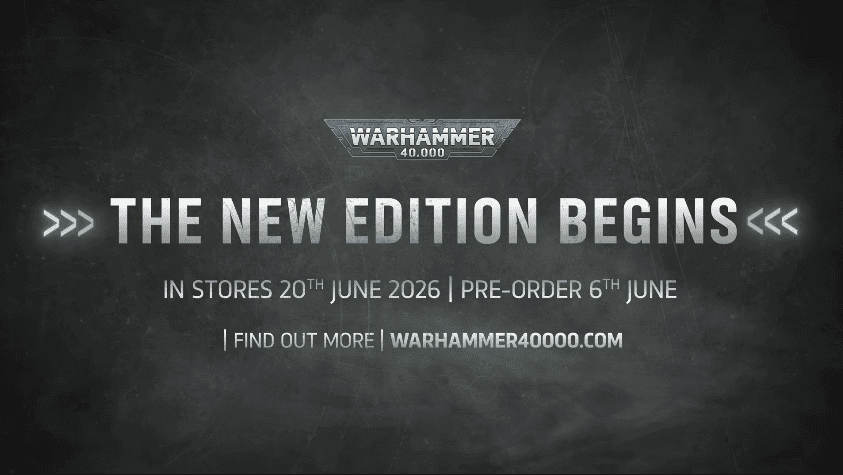
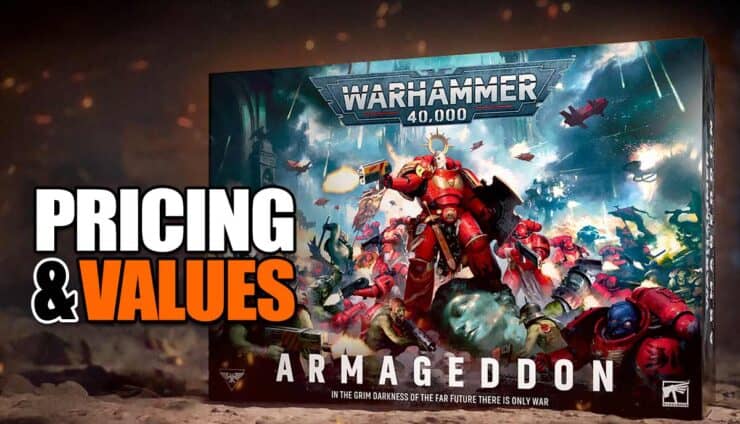
Warhammer 40k 11th Edition launched Saturday, June 20, 2026, in the Armageddon launch box, after pre-orders opened on Saturday, June 6, 2026.
Honestly, the schedule is pretty generous this time. The standalone companion gear (Combat Patrol Companion, Terrain Area Set, Chapter Approved Mission Deck 2026-27, and the Dominatus Narrative Campaign Deck: Armageddon) gets its own pre-order on Saturday, June 13, with a June 27 release. So if you’re skipping the box, you can still grab the rules and mission decks on their own a week later.
Here’s the full schedule:
- Armageddon launch box pre-order: Saturday, June 6, 2026
- Standalone companion product pre-orders: Saturday, June 13, 2026
- Armageddon launch box release: Saturday, June 20, 2026
- Standalone product release: Saturday, June 27, 2026
The good news is that you don’t actually need the box to start playing. GW dropped the full Core Rules as a free PDF on Warhammer Community and pushed them into the Warhammer 40,000 app at no cost. The Armageddon box just bundles the Core Rules booklet, mission decks, lore book, and two roughly 750-point starter armies into one shipment.
Warhammer 40k 11th Edition Rules: Keep Your Current Codex Alive
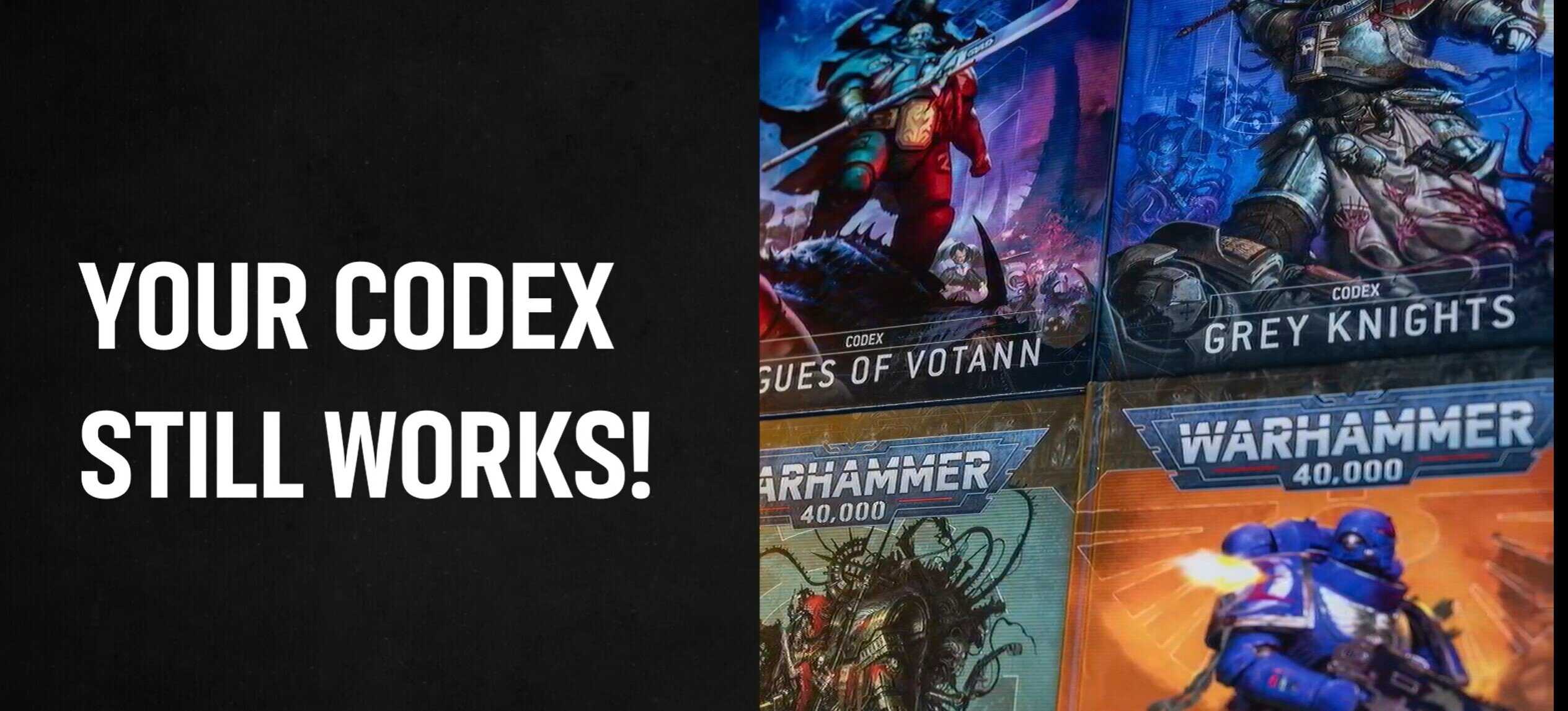 The first big win with the new Warhammer 40k 11th Edition rules is simple. Your current codexes and faction rules are still valid.
That includes recent campaign supplements, too, even the recent Armageddon: Return of Yarrick. So if you were bracing for the usual edition-change panic where books go stale overnight, this sounds a lot less painful than some past transitions.
That also means players can keep using the flavor of their existing faction rules while exploring what the new edition adds to the game now.
Confirmed vs. rumor: We label all rumors. Only items with official or major-source confirmation are treated as confirmed.
What’s in the Warhammer 40k 11th Edition Armageddon Launch Box
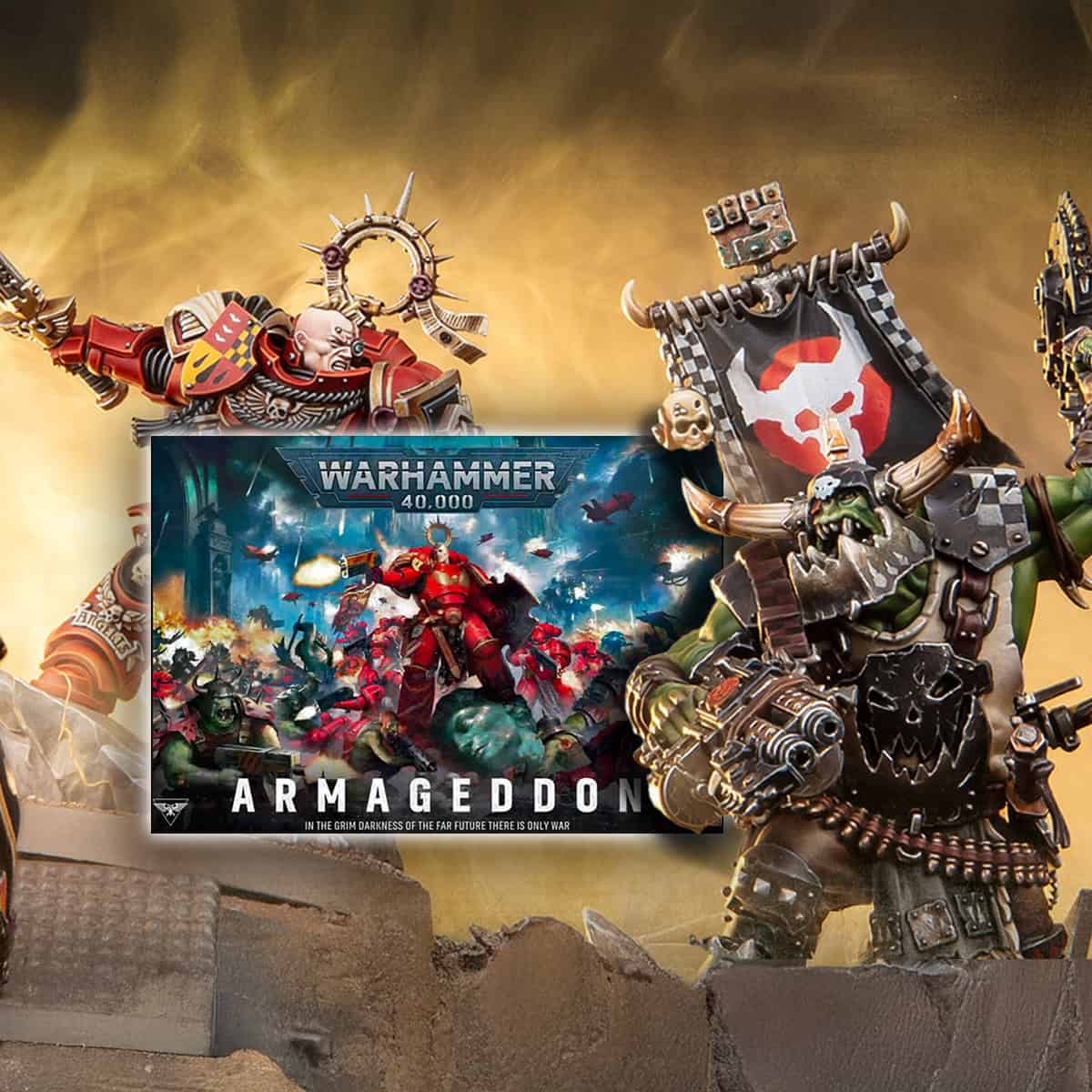
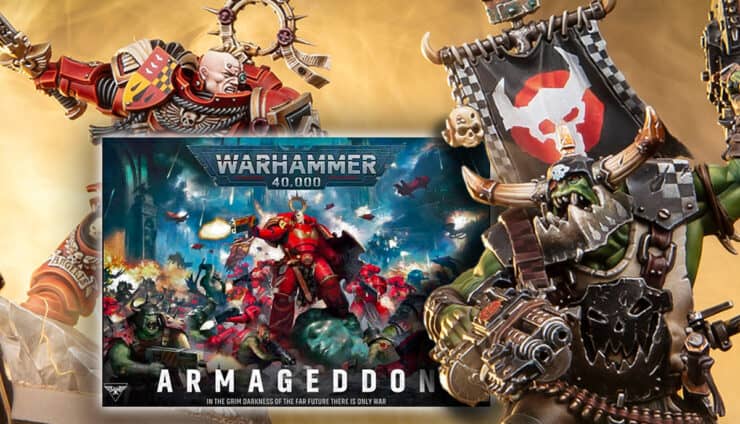
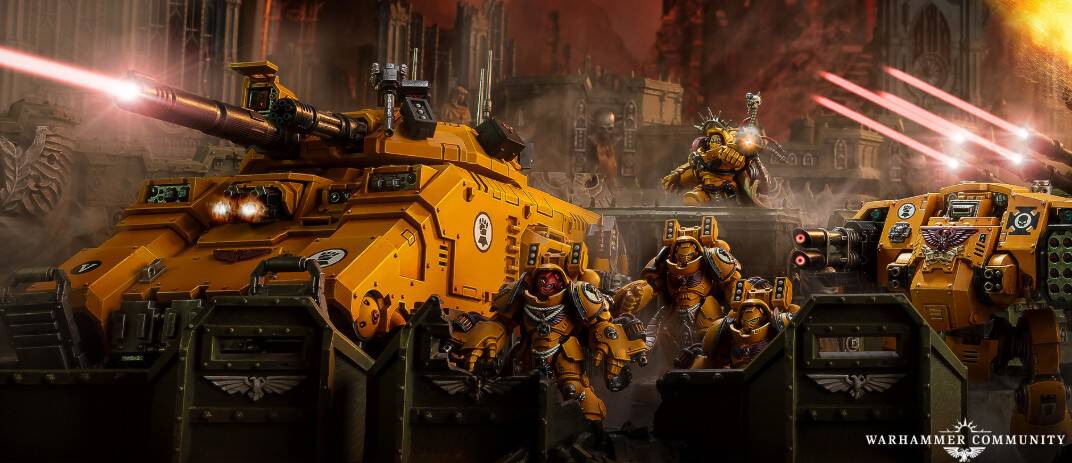
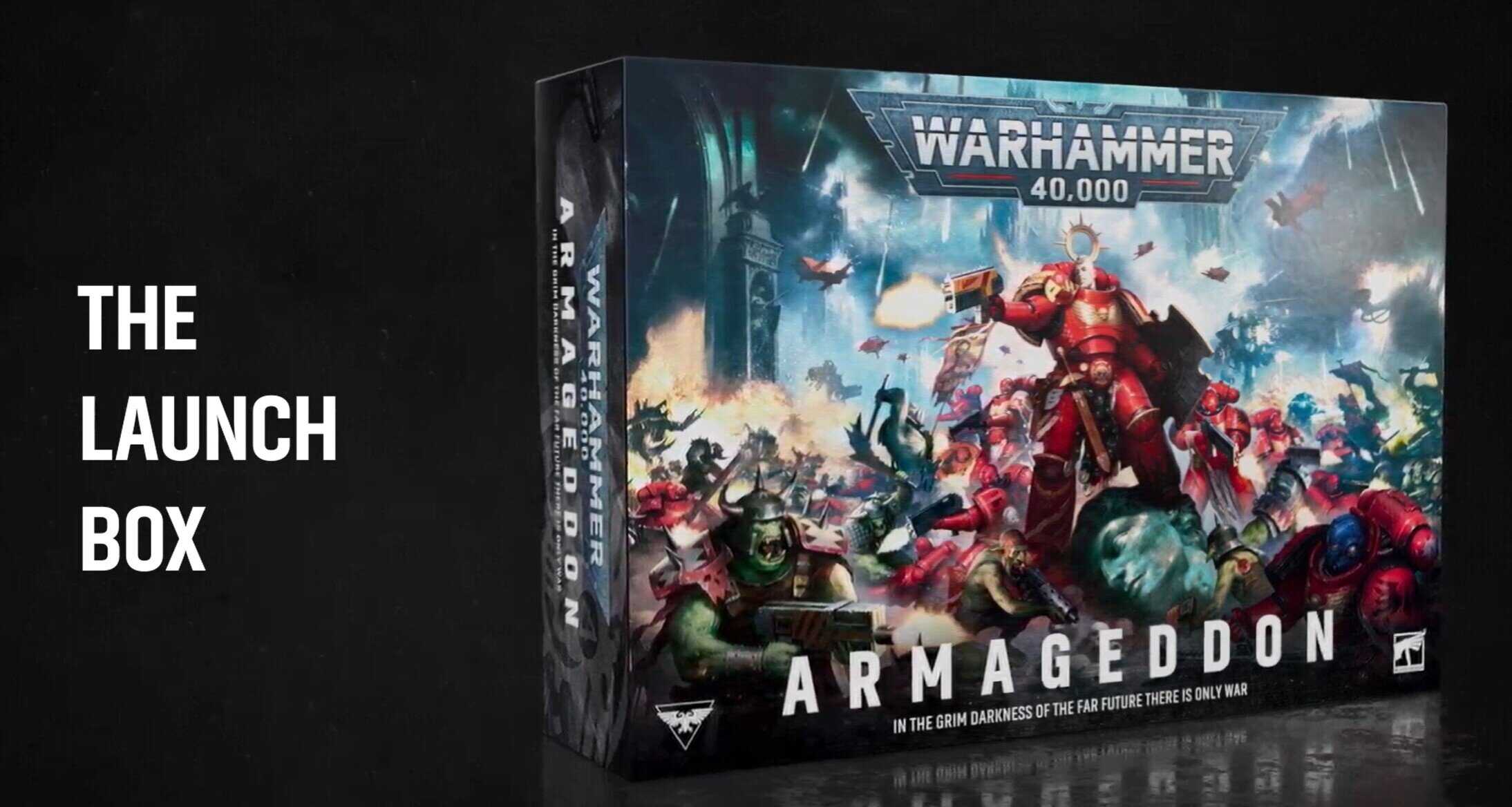
The Armageddon launch box picks up right where Return of Yarrick ended, with a fresh Ork Waaagh! crashing into the War World and a Blood Angels-led coalition of Astartes, finally answering Yarrick’s plea for aid. Wazdakka Gutsmek’s Kult of Speed is the green half of the brawl, and the whole box clocks in at roughly 750 points per side: 23 push-fit Space Marines against 38 push-fit Orks.
If you’re keeping score, that’s also more Orks than Marines in the box, which kinda makes sense if you think about it…
Armageddon Box Contents
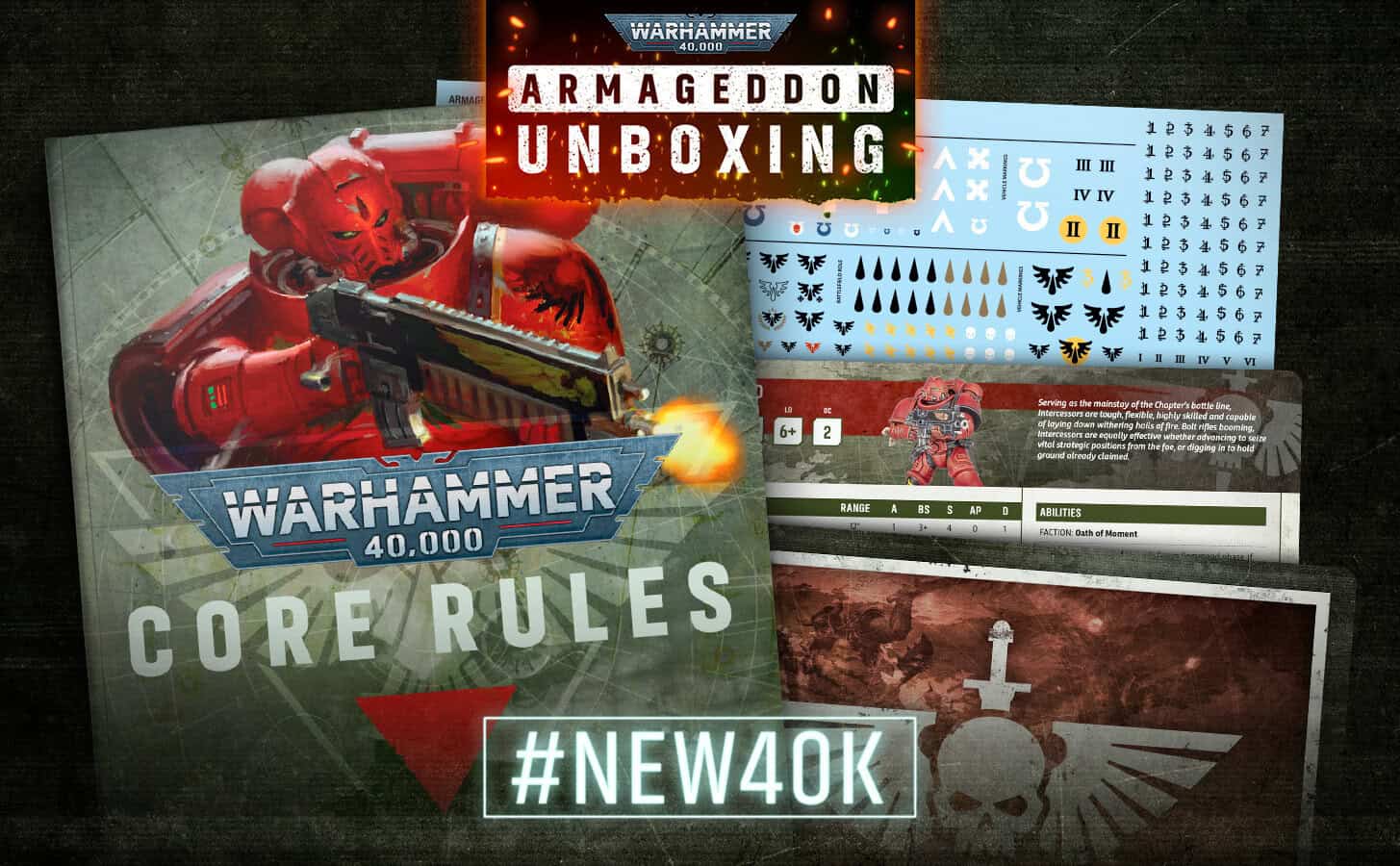
- Core Rules booklet
- Armageddon: Operation Imperator lore book
- Chapter Approved 2026-27 Mission Deck
- Dominatus Narrative Campaign Deck
- Armageddon datasheet cards
- Armageddon transfer sheet
Armageddon Launch Box Space Marine Models
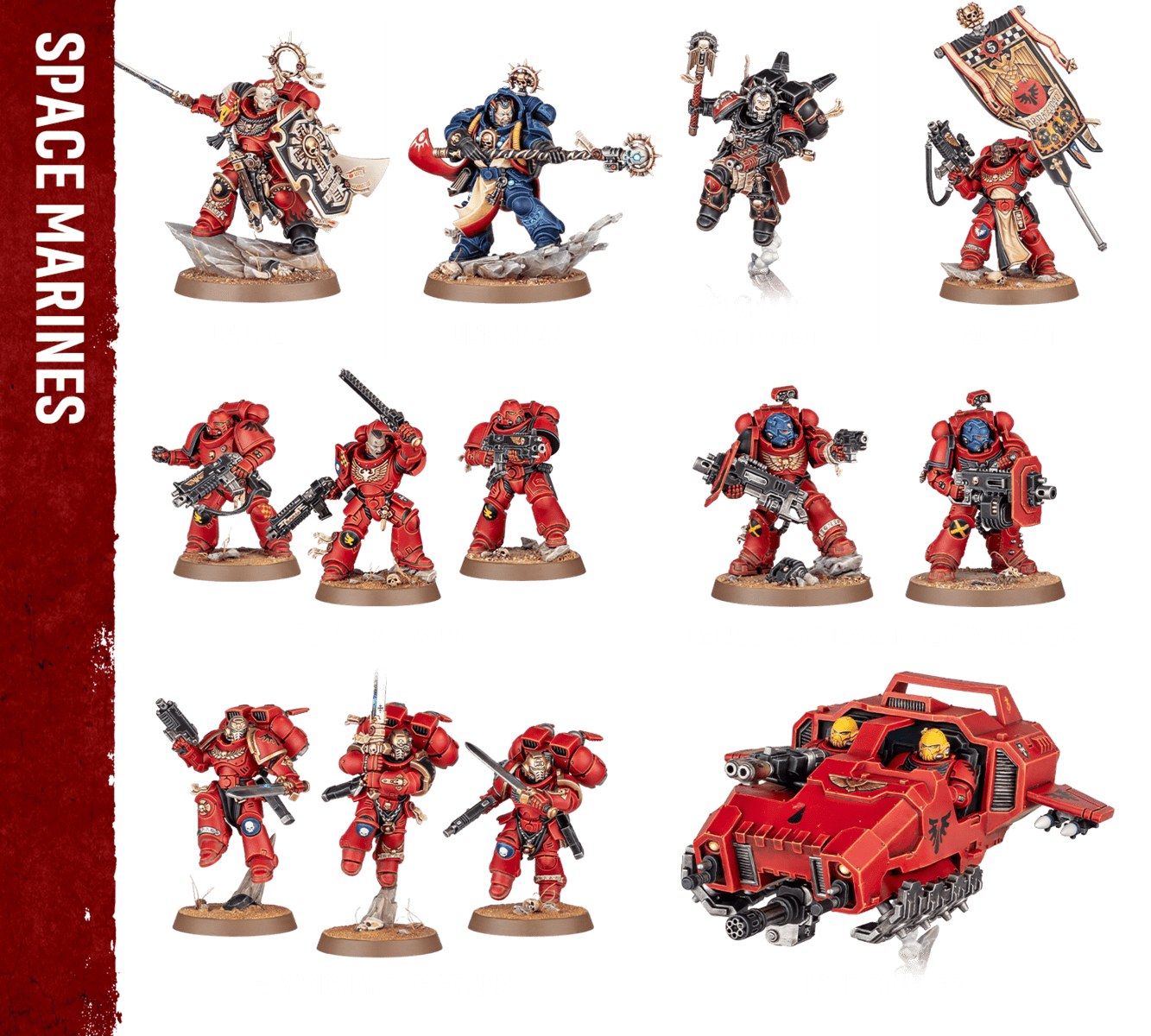
- Push-fit Intercessors wearing the Mk7 nostalgia helms
- Jump Pack Chaplain, finally replacing the 2015 Blood Angels-specific sculpt
- Primaris Captain with Relic Shield
- Company Ancient
- Librarian
- Vanguard Veterans, the last archetypal jump-troop unit to get Primarised
- Land Speeder with multimelta, gatling cannon, and missiles all on one kit
- Eradicator Squad with Heavy Bolters in the anti-infantry variant
Armageddon Launch Box Ork Models
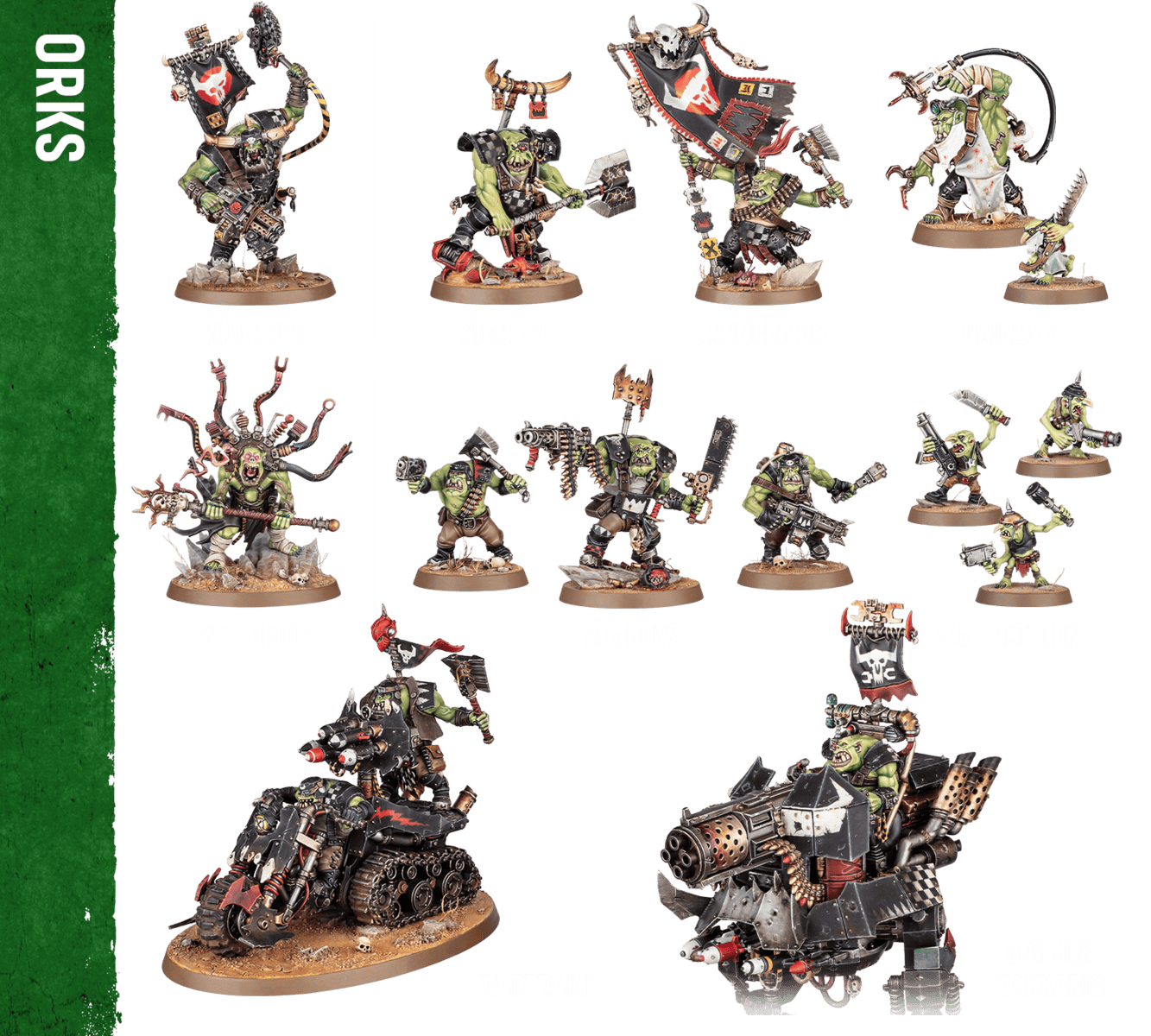
- Warboss (monopose version of the new multi-part kit)
- Bigboss, a brand new Ork character tier slotted between Nob and Warboss
- Bannernob
- Painboy
- Ork Boyz carrying a shoota plus slugga and choppa on the same model
- Gretchin
- Weirdboy, finally replacing the 18-year-old Finecast resin sculpt
- Wartrakk, a Gorkamorka-era deep cut nobody saw coming
- Big Mek Dakkarig, a two-legged Mek walker draped in seven rokkits
And the thing missing from the box? The Big Fat Rulebook. GW is sunsetting the hardback in favor of the smaller Core Rules booklet plus a standalone Combat Patrol Companion, which carries the lore guides and beginner advice that normally lived inside the main rulebook. Honestly, it’s a smart split, but it’s also one more product line landing on pre-order day.
How to Get Started With 11th Edition Warhammer 40k
Warhammer 40k 11th Edition has a lot going on at once: new points, app changes, mission updates, faction packs, product releases, and enough rules confusion to make a Tech-Priest start unplugging things. So, before you start to play a game and discover your army list is suddenly illegal, start with these key 11th Edition Warhammer 40k rules updates and resources.
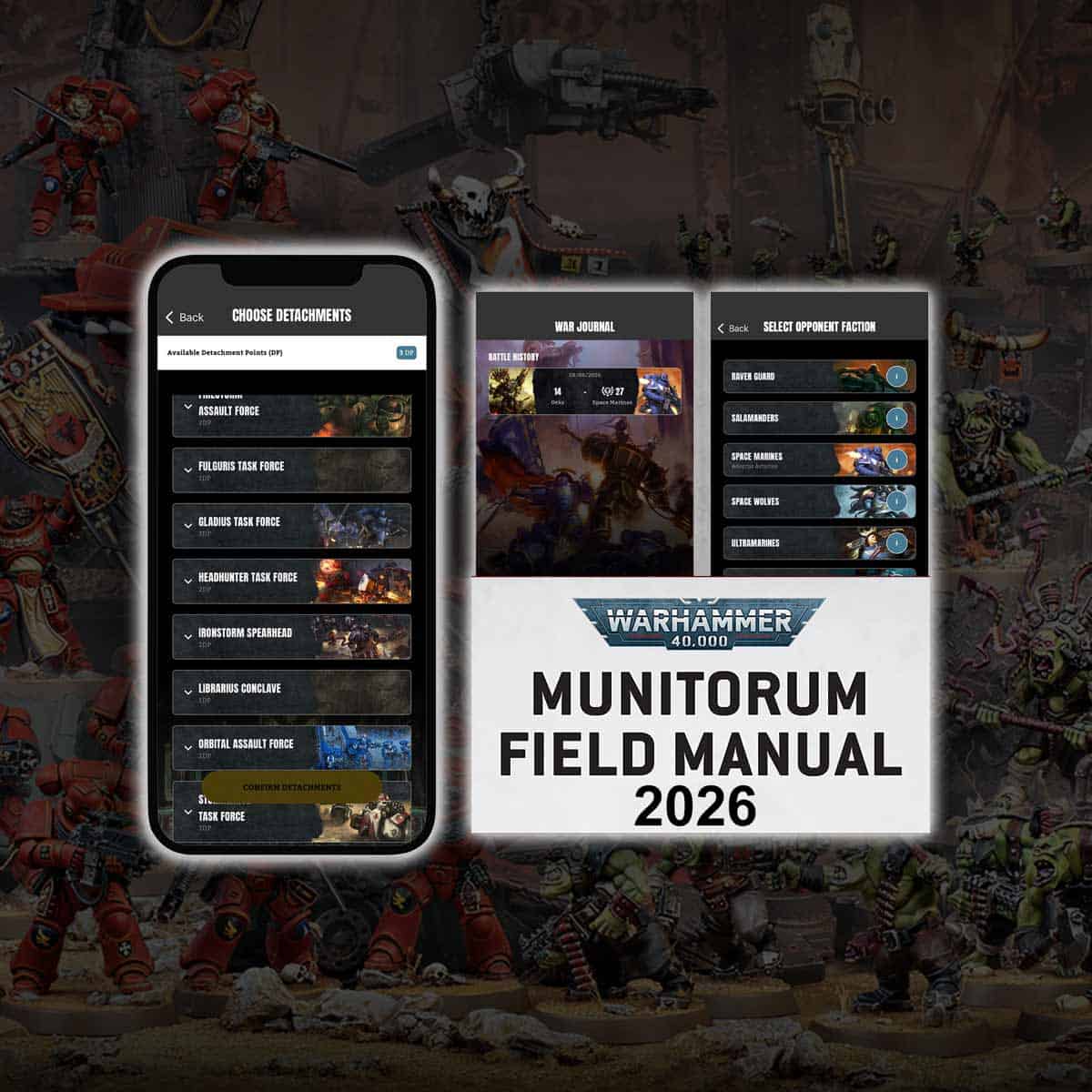
- Get the new points: Start here before building or rebuilding any army list. The latest Munitorum Field Manual points update shows what your units actually cost now, which is pretty important unless you enjoy explaining “old points” to your opponent like it’s a valid strategy.
- Get the new Warhammer 40k app: In 11th, llist-building, points checks, and rules updates should be easier to track. Use it to keep your army up to date now.
- Use the Chapter Approved Tournament Companion: This is the one you want for mission layouts, tournament setup, and pickup games that need a real structure. It helps keep the game moving instead of spending 20 minutes arguing over terrain.
- Check the 11th Edition product releases: If you didn’t buy Armageddon, this breaks down the new 11th Edition releases and launch products. It’s a handy way to see what books, boxes, and accessories are actually hitting shelves for the release.
- Learn how missions work now: Missions are doing a lot of heavy lifting in 11th Edition, and the Chapter Approved deck changes how games are framed from the start. This guide explains Force Dispositions and how they help decide what the battle is really about.
- Review the new Space Marines rules: Space Marines got fresh 11th Edition rules, and this helps you sort out what changed before your Astartes hit the table.
- Review the new Imperial faction rules: Imperial players should start here for faction packs, detachment updates, and new rules across the loyalist side of the galaxy.
- Review the new Xenos faction rules: Xenos armies have their own pile of faction packs, detachments, and rules updates to sort through.
- Review the new Chaos faction rules: Chaos players can use this to track new faction packs, detachments, and rules changes for the spikiest problem children in the galaxy.
11th Edition Warhammer 40k Q&A FAQ Reveals Big Changes for 2026
Instead of making players piece 11th Edition together from blurry screenshots and one guy’s local store Discord, GW dropped a full pre-launch Q&A covering everything from access to rules changes: core rules will be free via the Warhammer 40,000 app (so you don’t need the Armageddon box to play), Deathwatch, Grey Knights, Chaos Daemons, and Imperial Agents are all still playable, with big changes coming to to aircraft
Read the full 11th Edition Q&A breakdown here.
Latest Warhammer 40k 11th Edition Rumors Roundup
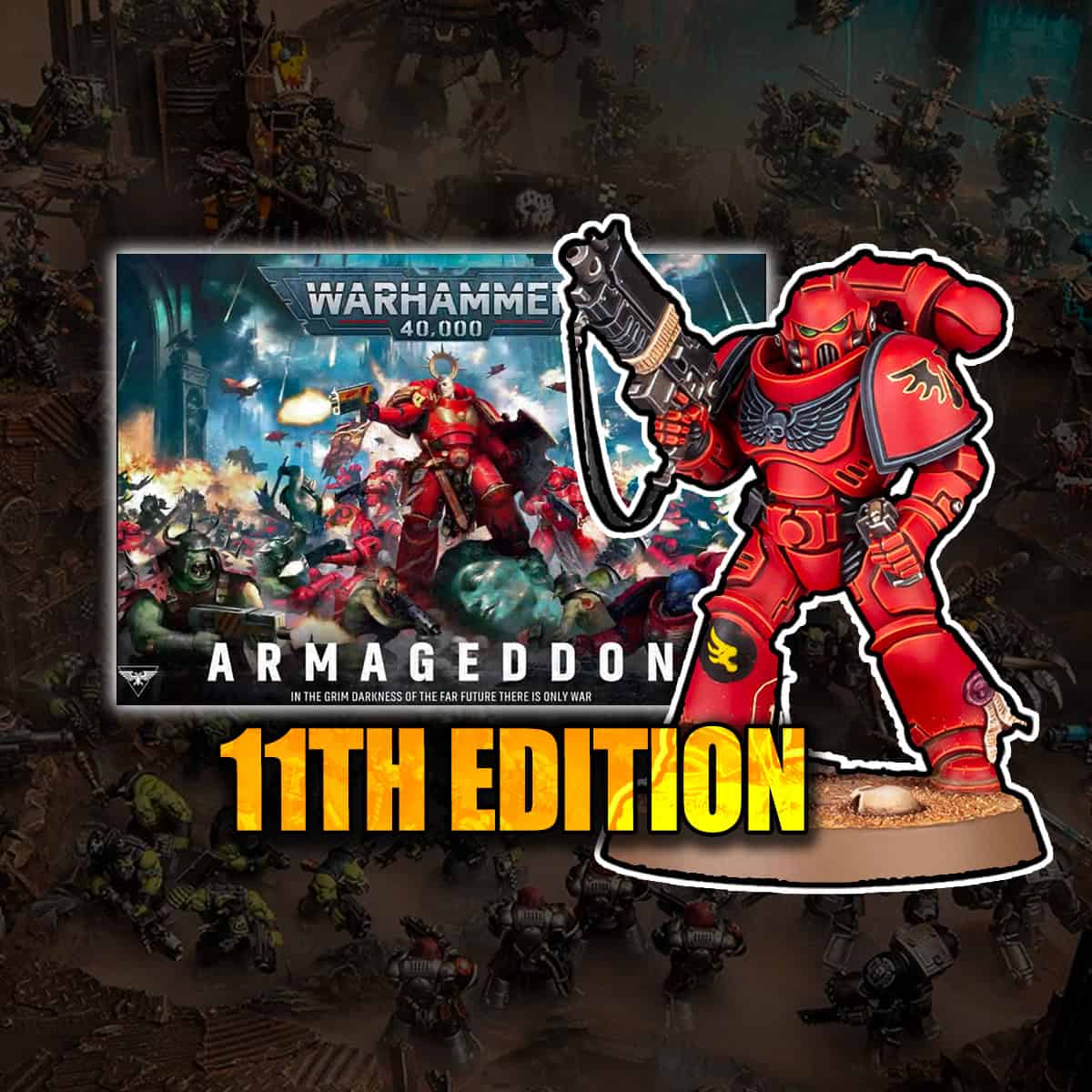
These are the rumors as they stood before launch, and are below so you can see what panned out. Games Workshop has since put the full Core Rules up as a free download, so check the confirmed sections below before you build a list around anything still tagged as a rumor.
Missions & Layouts: (rumors, partially confirmed)
- Five primary mission types at launch.
- Each mission has three layouts. That’s fifteen total configurations.
- Secondaries stay mostly the same, but detachments may influence mission selection.
- Mission layout could be determined by your detachment keywords versus your opponent’s.
If true, matchups matter more. Your list choice could directly impact how the table plays before a single dice roll.
Detachments Get Reworked: (rumors, partially confirmed)
- Detachments may have a “build value” attached to them. (confirmed)
- Stronger, more flexible detachments cost more. (partially confirmed)
- Narrow or unit-specific detachments cost less.
- You can combine detachments up to a total cap. (confirmed)
So instead of one locked-in army rule structure, you’re balancing power versus flexibility during list building. That’s a big shift in how competitive builds might shake out.
Faction Rules Shakeup: (rumors, partially confirmed)
- Every faction is rumored to receive a PDF update at launch.
- These updates modify current codex rules to function in 11th.
- Your existing codex stays valid until your proper 11th edition book drops.
PDF Updates, Not a Full Index Reset: (confirmed)
- This is not expected to be a full hard reset like 10th edition’s index wave.
- But it’s reportedly on a similar scale.
Think of it as a soft system-wide refresh. Armies stay playable, but core interactions get adjusted to fit the new edition framework.
Psychic Direction: (mostly confirmed)
- No massive psychic overhaul at launch.
- Expanded psychic rules likely pushed into future codexes.
So don’t expect the old psychic phase to return immediately, but psychic depth may creep back in book by book.
Core Rules Changes: (rumors)
- The engagement range is possibly shifting to two inches. (confirmed)
- Charges must end base-to-base. (confirmed)
- Fly ignores terrain, but with a minus two-inch movement penalty.
Stratagem Structure: (rumors)
- Some stratagems remain detachment-specific.
- Most may be more generic overall.
That could tone down some of the hyper-specific combo stacking and make cross-faction balance easier to manage.
Terrain & Interactive Elements: (partially confirmed)
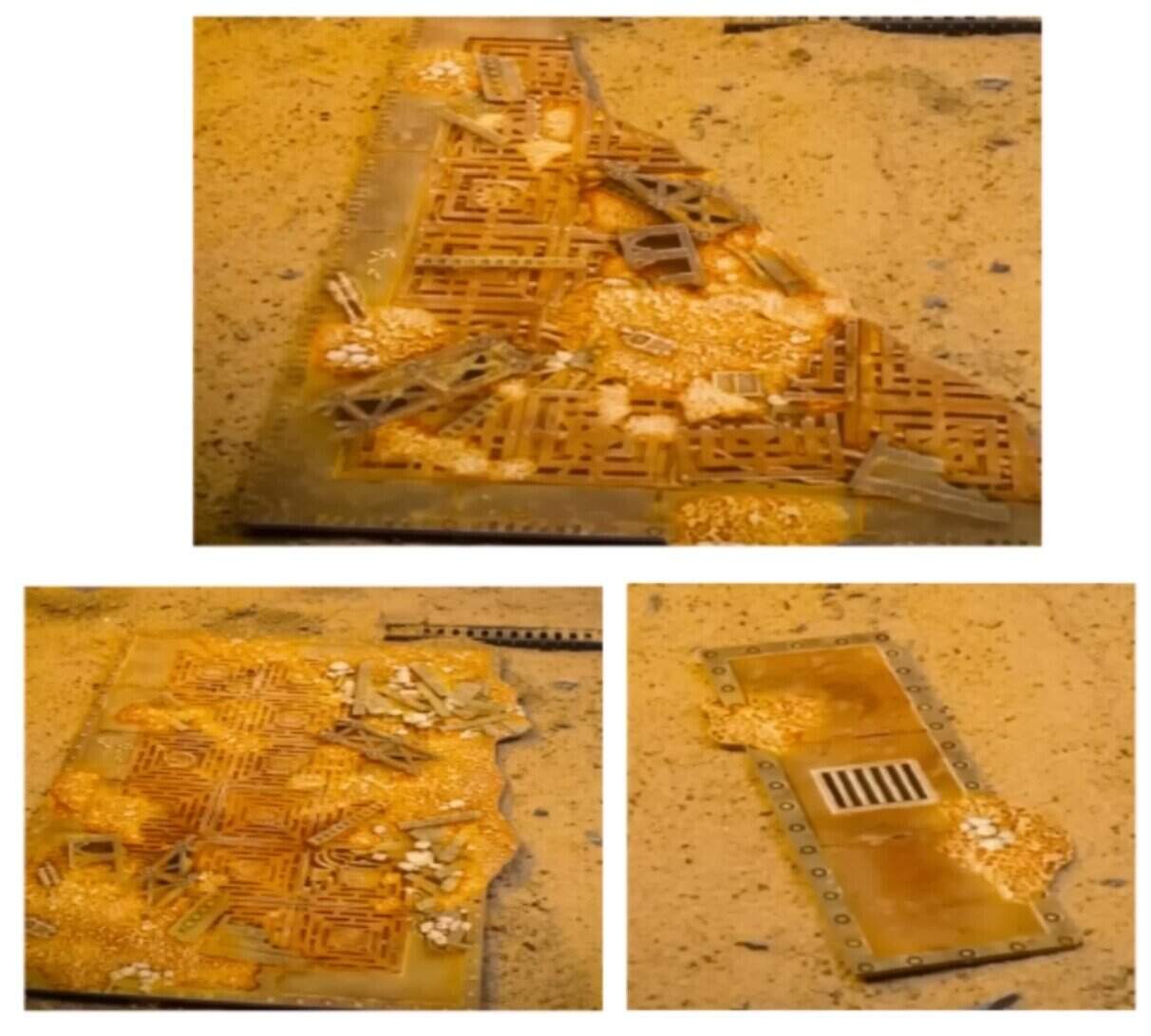
Two rumors floating around here:
- Simpler terrain options for accessibility (confirmed with only having to use footprint layouts).
- More interactive 3D elements like wrecked vehicles or bunkers. (partially confirmed with painted terrain reveal)
Again, this is all rumor territory. But if even half of this is true, 11th edition looks less like a total teardown and more like a structural rework with heavier mission influence, smarter detachment balance, and a system-wide rules tune-up instead of a full wipe.
Official Warhammer 40k 11th Edition Rules & Previews
The official Warhammer 40k 11th Edition rules previews were the first real look at how the new core rulebook actually plays, so here’s every confirmed rule Games Workshop has shown so far.
New Universal Special Rules for 11th
Psychic Ignores All Modifiers
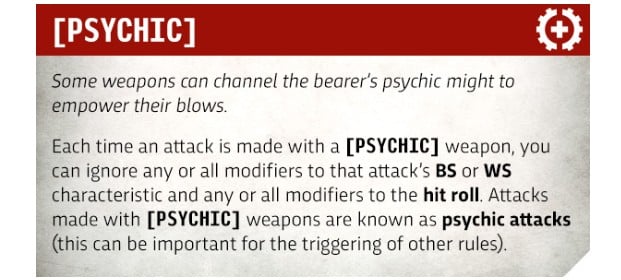
When you swing or shoot with a [PSYCHIC] weapon, you can brush off modifiers to your BS, WS, or the hit roll itself. So if your opponent was hoping a stack of hit penalties would shut you down, psychic attacks basically tell that plan to take a seat.
Fly Now Goes Over Terrain & Units Without Measuring
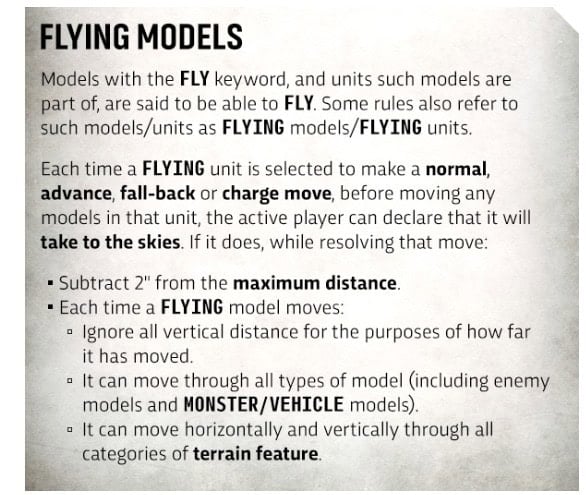 In 11th Edition, GW is cleaning up the FLY keyword so movement finally feels less like tabletop geometry homework. Flying units now subtract 2″ from their maximum move and ignore vertical distance entirely, making rooftops, ruins, and taller terrain much easier to navigate.
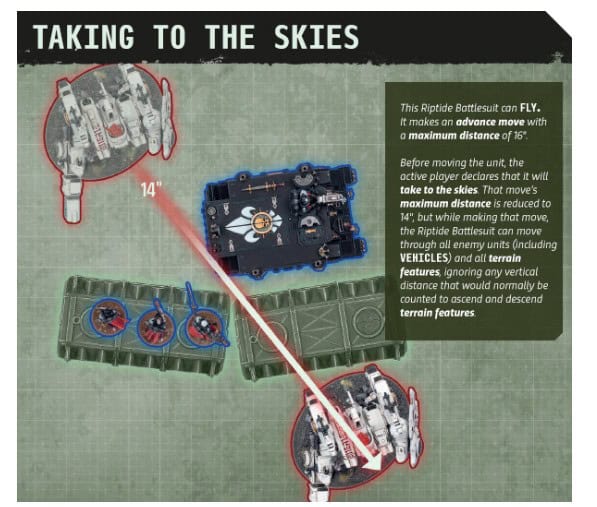 Instead of measuring every climb and drop, you’re mostly just checking the horizontal move and getting on with the game. It’s a small rules tweak on paper, but on dense city-style tables, it should make movement way smoother.
Heavy Units Can Shuffle and Get the Benefit
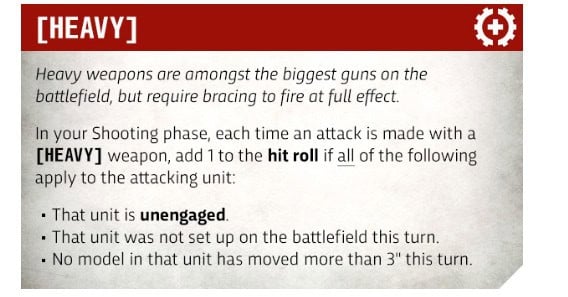
Heavy weapons are getting a little more forgiving in 11th Edition, but not free passes for every trick in the book. Units can still get the plus one to hit if they only move up to three inches, but they won’t get that bonus after disembarking, deploying, or while stuck in combat. So gunline units can shuffle for better angles, but transport hopping into perfect shots is off the menu.
Pistol Becomes Close-Quarters
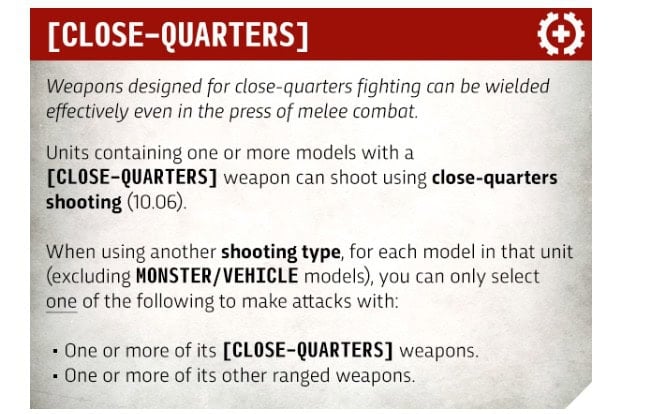 Yep, Close-Quarters is basically the new name for Pistol, and it works the way you remember: weapons with the keyword can still shoot while the model is in melee.
The bigger wrinkle is that, as the Death Guard rules show, Close-Quarters can be handed out to more than just traditional pistol-style weapons. That’s probably why the name changed, since “Pistol” didn’t really fit once the rule started showing up on other guns.
Cleave is Blast For Melee
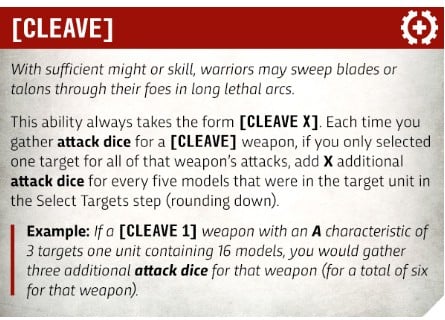
Cleave is basically the melee version of Blast in 11th Edition, letting your heavy-hitting heroes and monsters carve through chaff units like they’re not even there. It scales too, so something like Cleave 5 could dish out 10 extra attacks into a 10-model unit. That’s the wild end of the spectrum, sure, but even Cleave 1 is no joke.
Snap Shooting Is How Overwatch and More Work
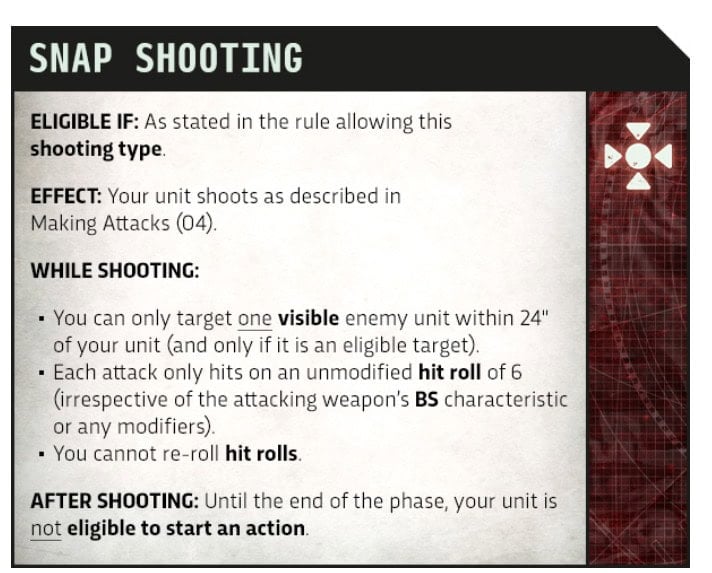
Snap shooting should feel pretty familiar if you’ve been playing 10th Edition, but now it’s got a tighter leash and more ways to show up on the table. You can only target units within 24″, and if you snap shoot, you can’t also do an action.
The interesting bit is that GW seems to be turning this into a standard rule with more ways to trigger it. We’ve already seen an Ork detachment use it after getting shot by an enemy unit, so yeah, get ready for 11th Edition to be more reactive than just yelling “Overwatch” once per turn.
Hazardous Checks Are the New Catch-All for Self-Damage
Hazardous is now the umbrella term for pretty much every way your own army hurts itself. Firing a Hazardous weapon, making a desperate fall back through an enemy unit, or piling out of a transport that just got blown up all trigger a Hazardous check. Roll a d6 per model on the hook: on a 1 or a 2, it takes damage, one for most models, a flat three for Monsters, Vehicles, and Characters.
This also means overcharging is more dangerous for 1-wound models, but better for multi-wound infantry.
Indirect Fire Runs on Three Modes
Indirect fire now splits into three settings. If the firing unit can see the target, it shoots at its normal BS. If it cannot see the target but someone else in your army can, it hits on no better than a 4+. And if nobody in your army can see the target at all, it hits on no better than a 6+. So now spotters suddenly matter a lot more for your artillery.
Infiltrators and Scouts Stop Stacking
Units that had both Infiltrate and Scout have to pick one now, which is a real hit to a few forward-deploying lists. Scout does pick up a new trick to soften the blow: instead of a pre-game move, you can hold the unit off the board and bring it on after every other unit has deployed, dropping it somewhere that your opponent cannot easily answer.
Army Building with 11th Edition Rules Looks Much More Flexible

If there’s one of the Warhammer 40k 11th Edition rules previews that jumps off the page, it’s the change to Detachments.
Current codex detachments are still legal, but Warhammer 40k 11th Edition is adding more flexibility by letting players select multiple detachments using a new Detachment Points system for a more customized mix of army abilities. Now, detachments will cost between 1 and 3 points, depending on how broad or powerful their rules are, which is a pretty big shift for list building.
Force Dispositions

Detachments will also give you Force Dispositions to pick from during army construction, which then interact with your opponent’s choice to determine the mission. So list building is not just about buffs anymore. It is tied straight into how the game gets played on the table.
Upgrade Tag
Another small but meaningful change is the new Upgrade tag on some Enhancements. If a detachment leans on a unit type without Characters, those upgrades can now be applied to up to three non-Character units while still counting as a single choice, though each one still pays its own points.
Characters
Characters are getting cleaned up, too. Units can now have one Leader and one Support attached, and you choose those pairings when you build your list instead of waiting until the game starts.
Why This Is Important for List Building
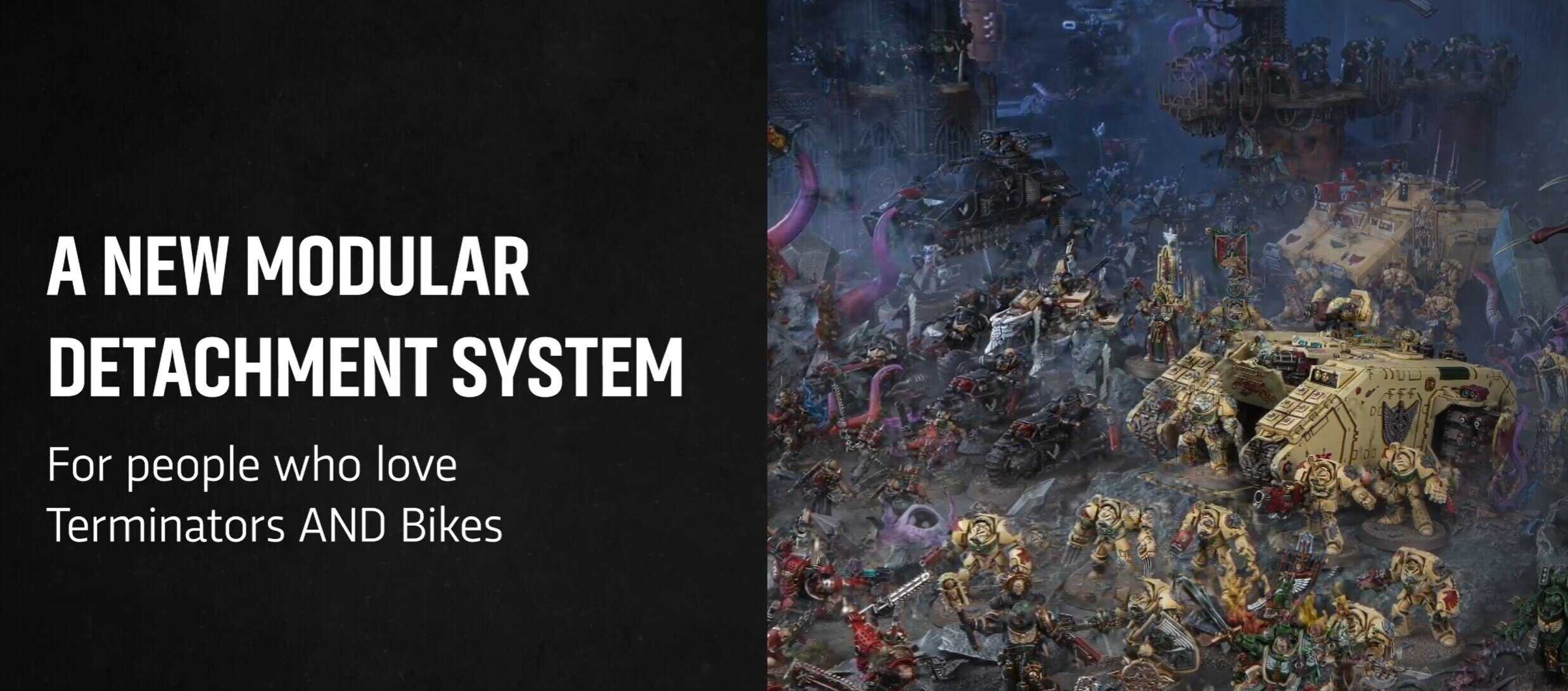
For a long time, detachments have been one of the main ways GW tells you how your army is “supposed” to play. That can be fun, but it can also box players in. If your vision for your army didn’t line up with the detachment structure, you were stuck choosing between theme and efficiency.
This new system gives players a lot more room to build around how their collection actually looks and plays. Smaller, more focused detachments can back up a broader detachment in the same list, which means themed builds do not have to give up as much raw power to stay on message.
That is a real big deal for:
- Narrative players who want their army to match the story in their head
- Competitive players hunting for layered synergies
- Hobbyists with mixed collections who hate shelving cool units because they do not fit one detachment cleanly
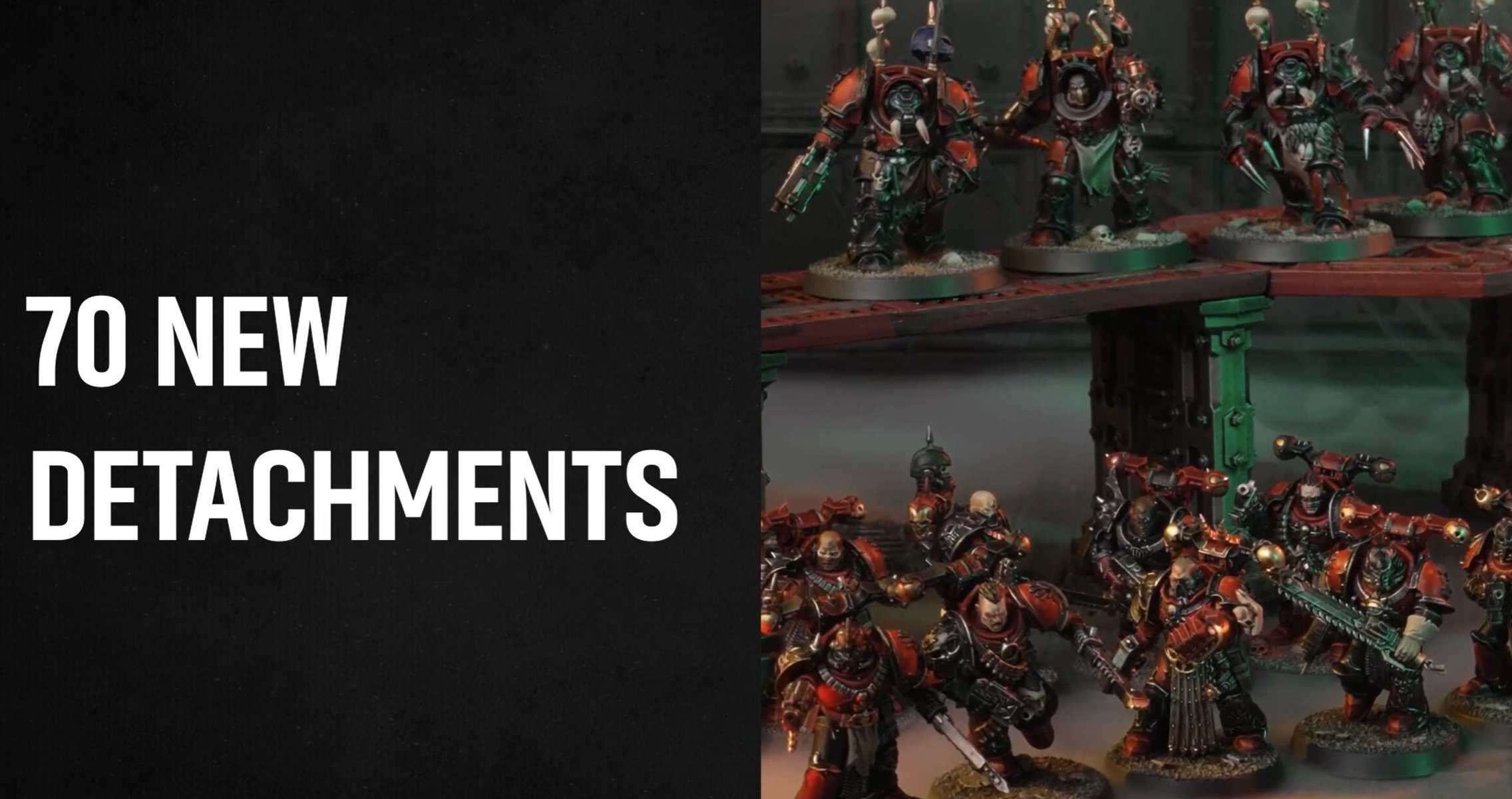
GW also confirmed there will be 70 new detachments in the new edition, on top of the current codex ones, which will still be legal at launch.
2026 Chapter Approved Mission Deck Makes Your Army’s Mission Matter
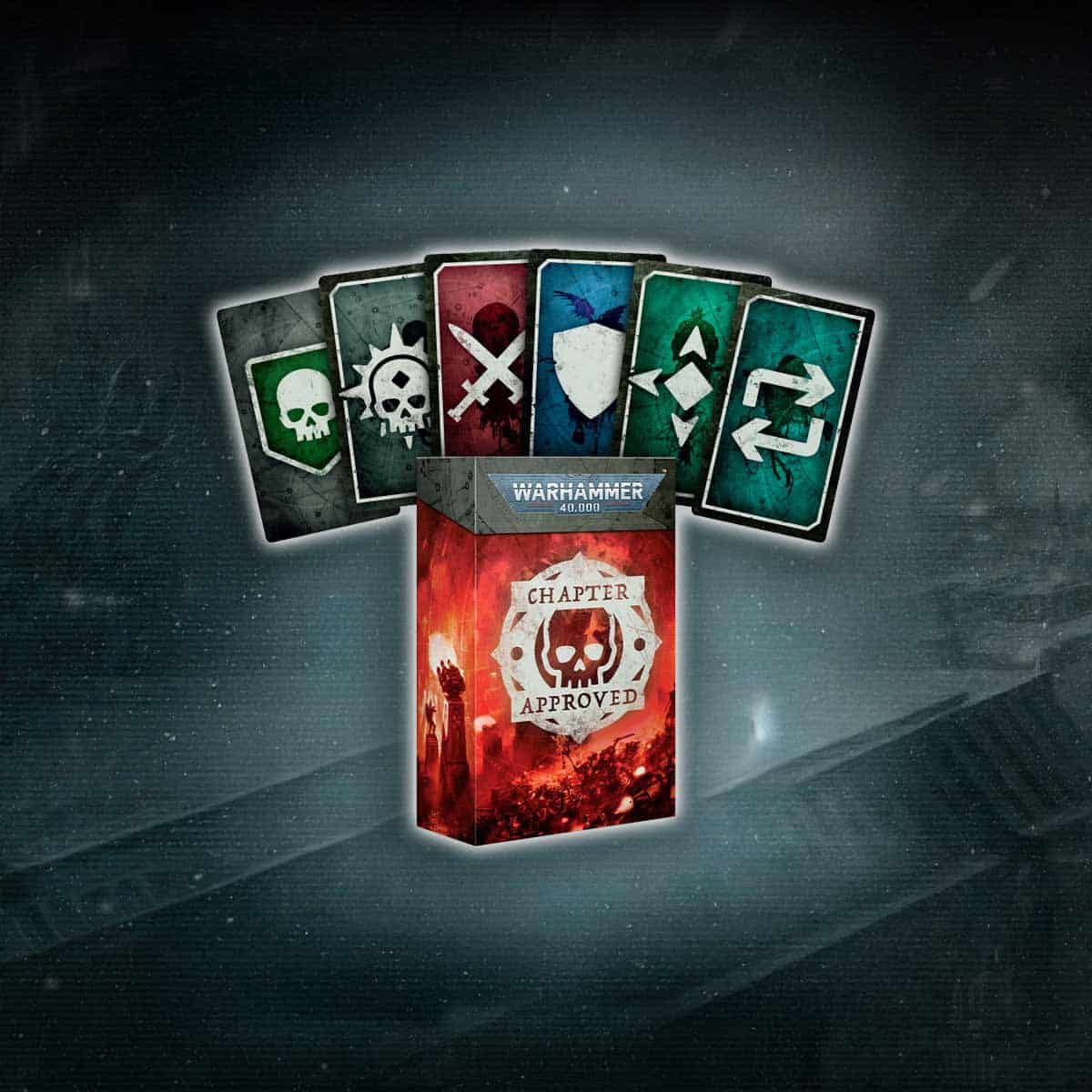 The new 2026 Chapter Approved Mission Deck is a pretty big shake-up for Warhammer 40k 11th Edition, because your army’s orders now help shape the mission matchup, which should make games feel a lot more varied from the first roll.
Casual play gets 15 mission matchups, new Twist cards, and cleaner Secondary Mission rules where you draw two each Command Phase and aren’t forced to score a half-finished card. For tournament play, the Event Companion will lock each player into a single Disposition for the event as well.
11th Edition Detachment Points Quick Reference
Now in 11th Edition, each detachment costs 1 to 3 Detachment Points, and your army gets a DP budget based on points. That works out to 2 DP at 1,000 points and 3 DP at 2,000 points. So a 2,000-point Strike Force can stack up to three of the new detachments, and your current codex detachments get to stay legal alongside them.
Per Eddie Eccles in the GW FAQ video, expect “six or nine stratagems in a 2,000-point game” once you stack three DPs worth of detachments. Every Faction Focus detachment GW has revealed so far costs exactly 1 DP, which means right now a 2,000-point list can run three separate detachments side by side.
| DP Cost | What You Get | How It Stacks at 2,000 pts |
| 1 DP | Narrow, unit-specific detachment. Tight rule focused on a single keyword or unit type. | Stack three for a layered, themed list. Every Faction Focus detachment GW has shown so far costs 1 DP. |
| 2 DP | Mid-strength detachment with broader rule coverage and bigger buffs. | Pair a 2 DP detachment with a 1 DP support detachment. |
| 3 DP | Codex-wide, highest-impact detachment. Whole-army rules and the deepest stratagem lists. | Single-detachment army. Your entire DP budget goes to one big rule. |
| 11th Edition Detachment Points Budget | ||
| 1,000 pts | Total DP Budget: | 2 DP |
| 2,000 pts | Total DP Budget: | 3 DP |
For the full faction-by-faction breakdown on every detachment, jump down to Detachments by Faction.
New 11th Edition Detachments: Rules By Faction
GW is moving fast on the 11th Edition Faction Focus rollout, and the math on how to make your army has changed a bit.
Now, every new detachment costs 1 DP, so a 2,000-point Strike Force has three open slots, and you can stack three different detachments inside one army, which is pretty interesting.
Here are all the reveals so far, along with the link to each full breakdown.
Necrons New Detachments Just Broke the Faction’s Speed Limit for 11th Edition
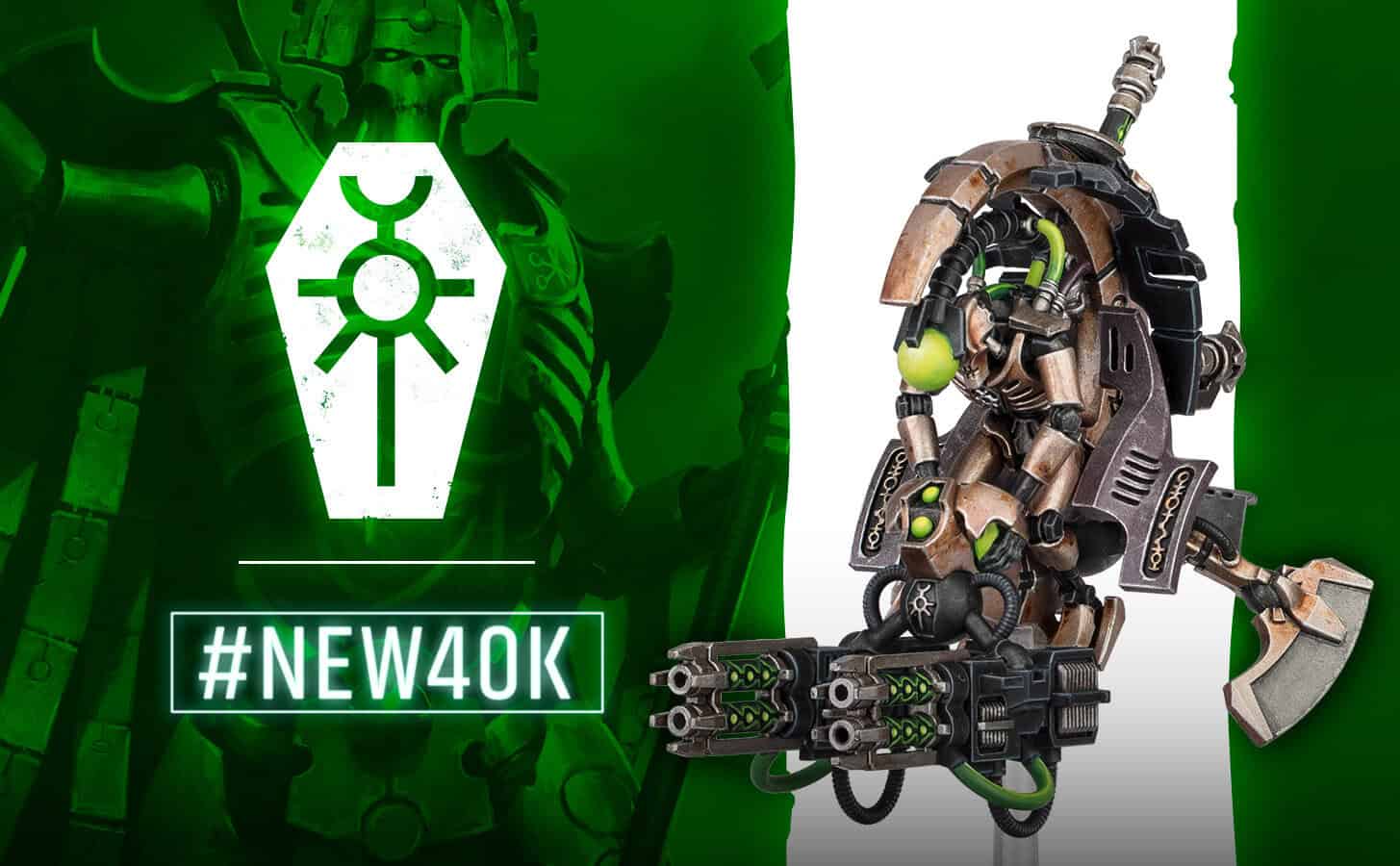
Three new 11th Edition detachments arrived, in the Necrons Faction Focus, featuring Hand of the Dynasty for Silver Tide Advance, shoot, and action tricks, Skyshroud Spearhead for Deep Striking Tomb Blades and mobile Destroyer firepower, and Phaeron’s Armory for faster Monoliths, Obelisks, and Tesseract Vaults crashing into the midfield.
Read the full Necrons 11th Edition detachments guide here.
11th Edition Adeptus Mechanicus Detachments Turn Electro-Priests Into an Overwatch-Proof Buzzsaw
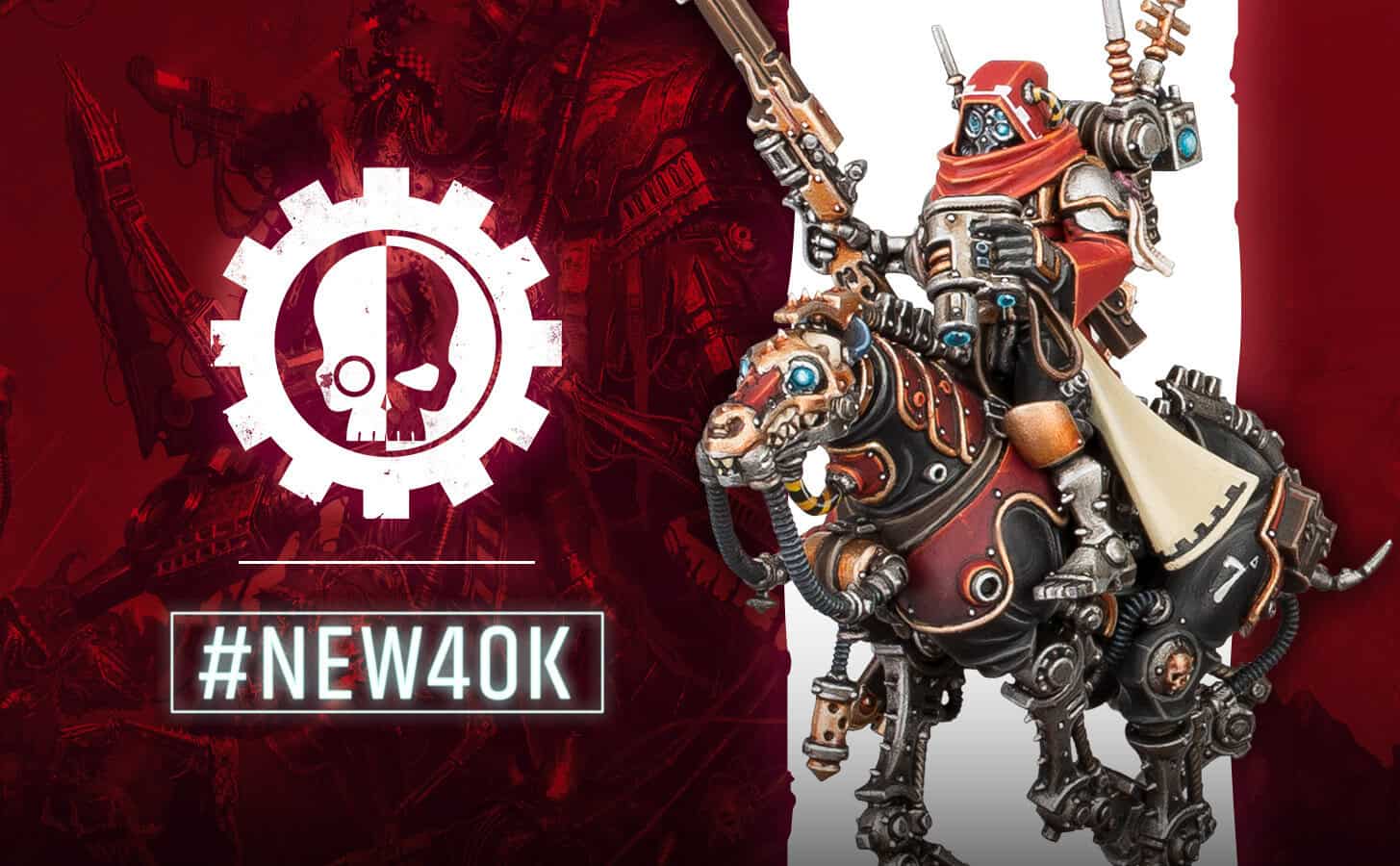 In the Adeptus Mechanicus Faction Focus, three new 11th Edition detachments arrived featuring the Cohort Acquisitus for Skitarii recon and Ignores Cover tricks, Lords of the Forge for tougher Tech-Priests with vehicle disruption, and Luminen Auto-choir for Electro-Priests that heal, hit back, and shut off Overwatch.
Read the full Adeptus Mechanicus 11th Edition detachments guide here.
11th Edition Leagues of Votann Detachments Turn the Kin Into a Turn 1 Problem
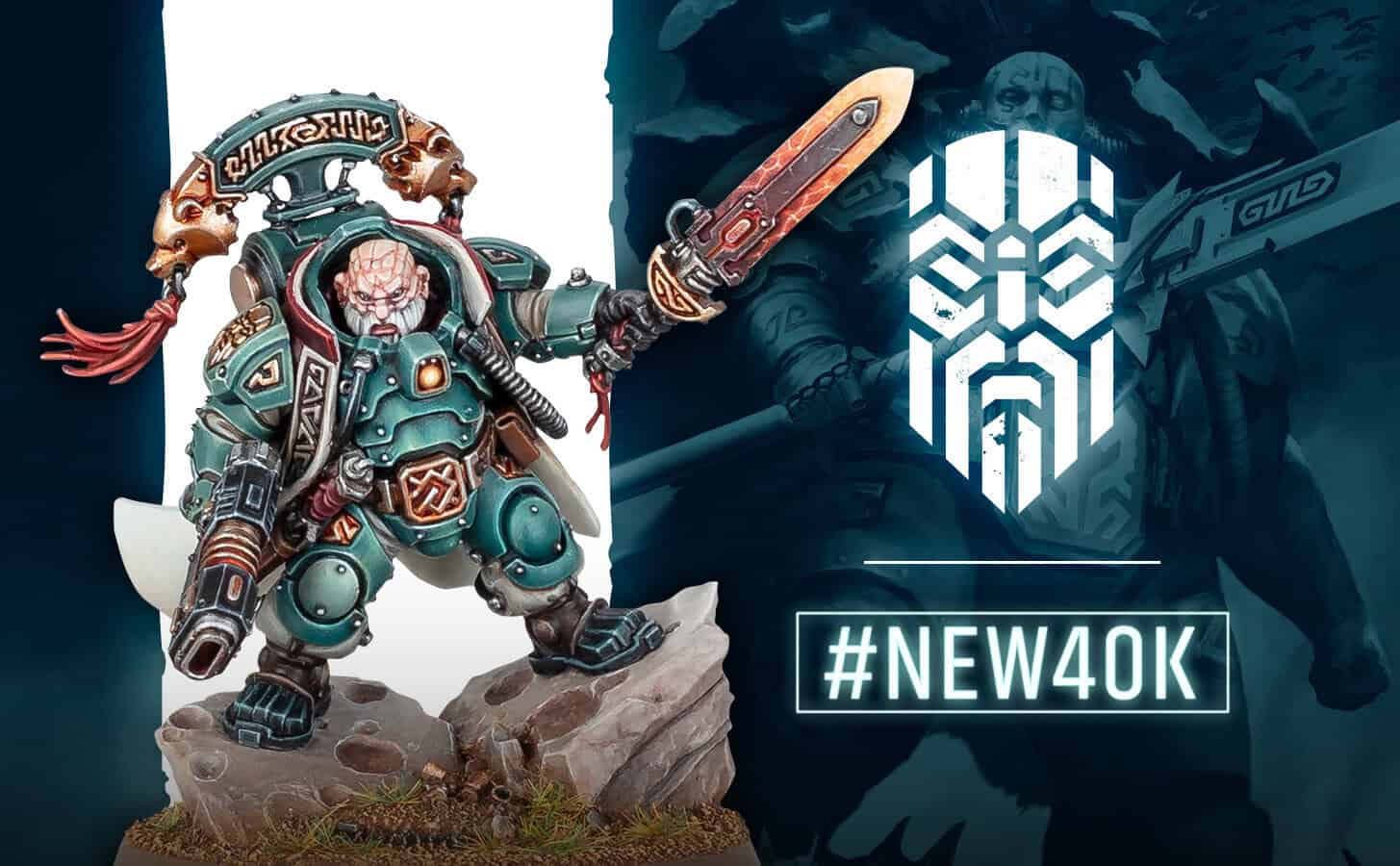 Three new detachments arrived in the 11th Edition Leagues of Votann Faction Focus. Armored Trailblazers for Sagitaurs making a nasty turn one push, Farseekers for Hernkyn scouts exposing hidden units and cracking cover, and Hearthguard Covenant for Einhyr Hearthguard re-rolling wounds and turning point-blank shooting into a real problem.
Read the full Leagues of Votann 11th Edition detachments guide here.
Four New 11th Edition Aeldari Detachments: GW Drops Four New Ways to Play Fast
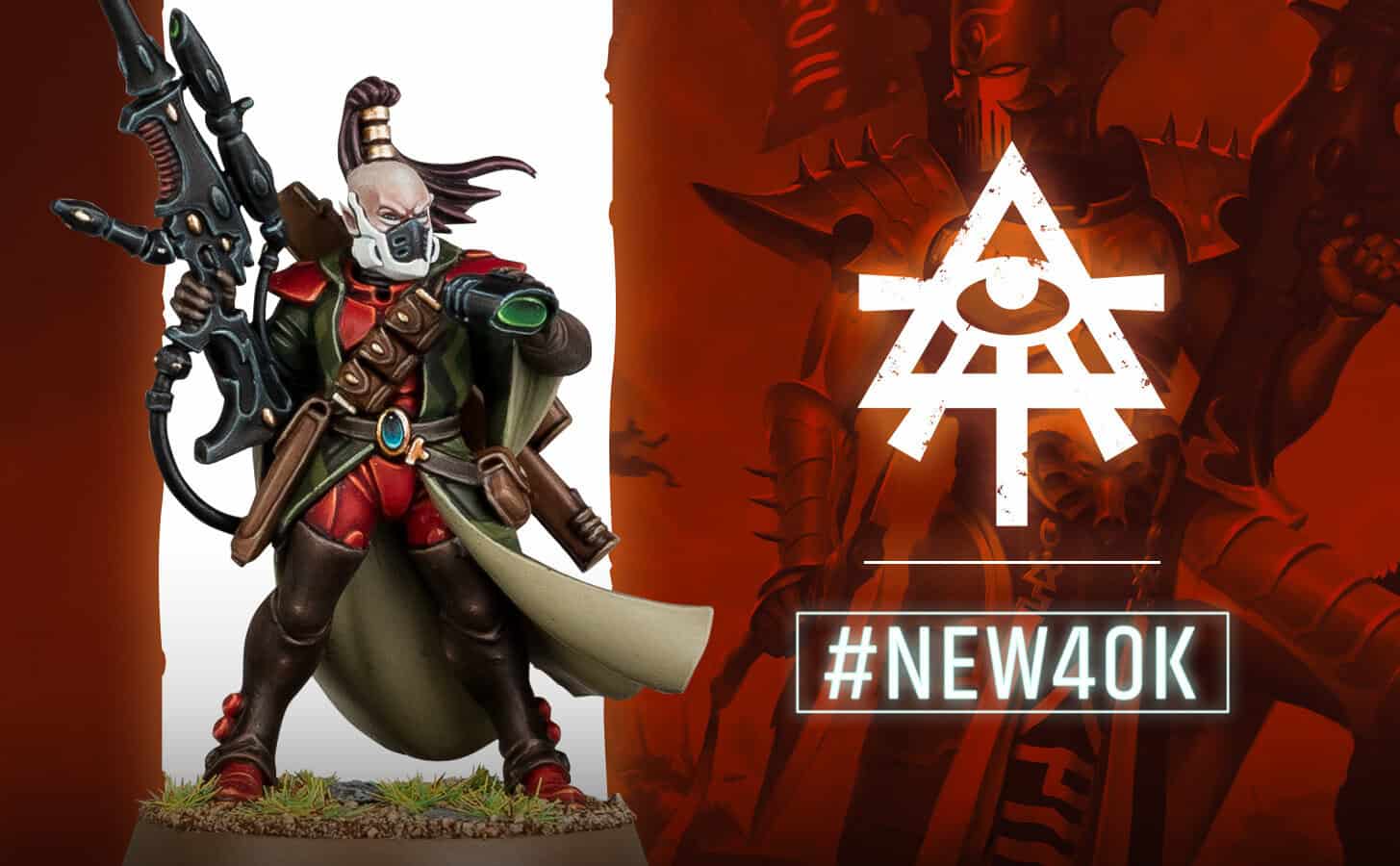 In the Aeldari Faction Focus, four new 11th Edition detachments arrived. Armored Warhost for grav-tanks that can advance and keep shooting, Fateful Performance for Harlequins picking their melee fights, Path of the Outcast for Rangers and Corsairs acting as long-range spotters, and Twilight Flickers for Harlequins grabbing objectives with extra movement tricks.
Read the full Aeldari 11th Edition detachments guide here.
3 New 11th Edition Genestealer Cults Detachments Sharpen Assassins, Genestealers & Hybrid Hordes
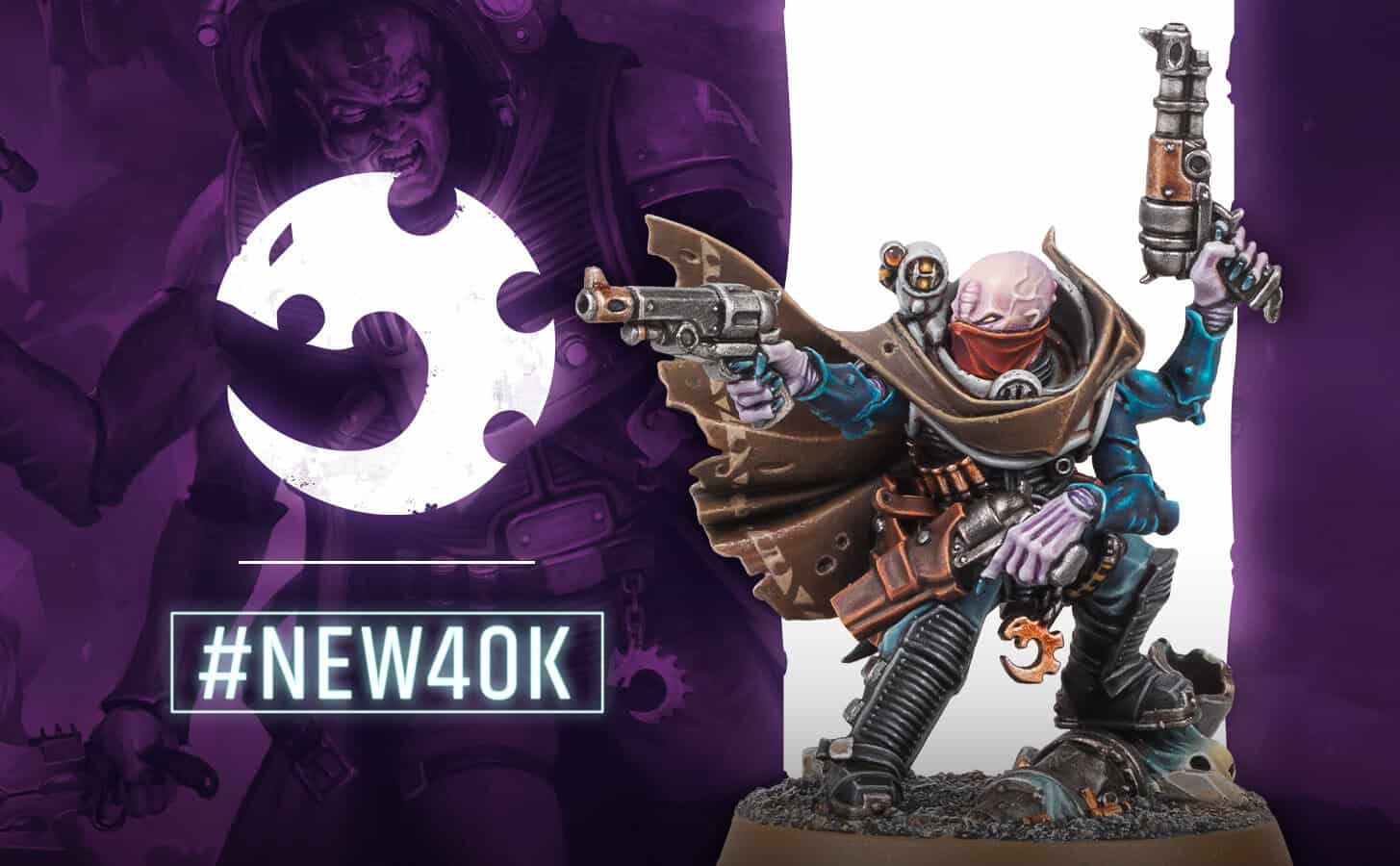 In the Genestealer Cults Faction Focus, three new 11th Edition detachments arrived: Heroes of the Uprising for assassin-style Killer characters, Purestrain Broodswarm for Genestealers using reserve tricks and ambush pressure, and Xenocult Masses for self-replenishing Neophyte Hybrid hordes that melt into terrain like absolute creeps.
Read the full Genestealer Cults 11th Edition detachments guide here.
11th Edition Thousand Sons Detachments Makes Rubrics Nearly Unkillable
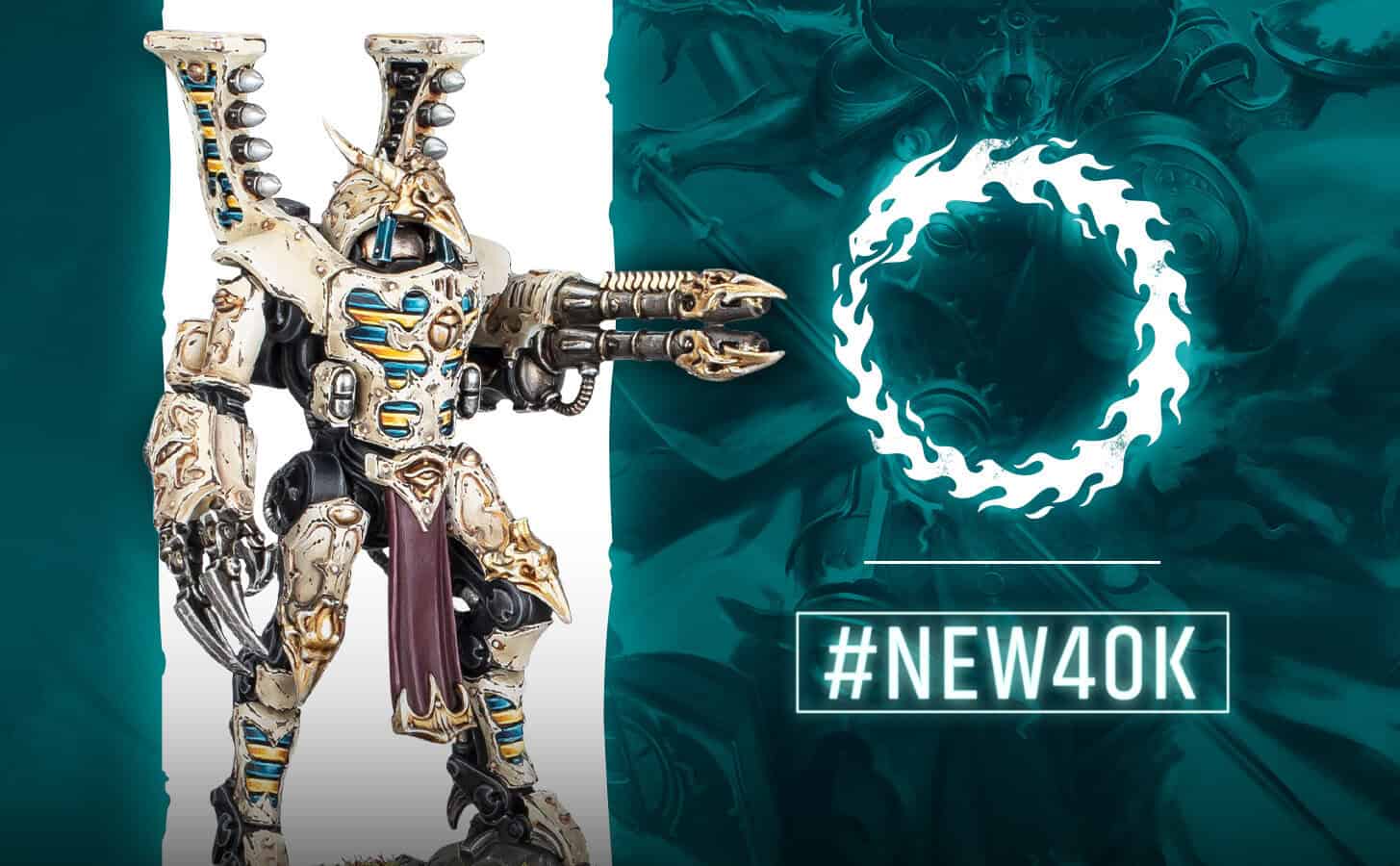 In the Thousand Sons Faction Focus, three new 11th Edition detachments arrived: Ritual of Regeneration for Rubric Marines and Psykers that keep healing, Sekhetar Cohort for Sekhetar Robots that finally hit harder with Sorcerer support, and Servants of Change for Tzaangor Battleline hordes that can move, shoot, and charge like proper Tzeentch nonsense.
Read the full Thousand Sons 11th Edition detachments guide here.
Three New Drukhari Detachments Build Around Wyches, Kabalites, and Coven
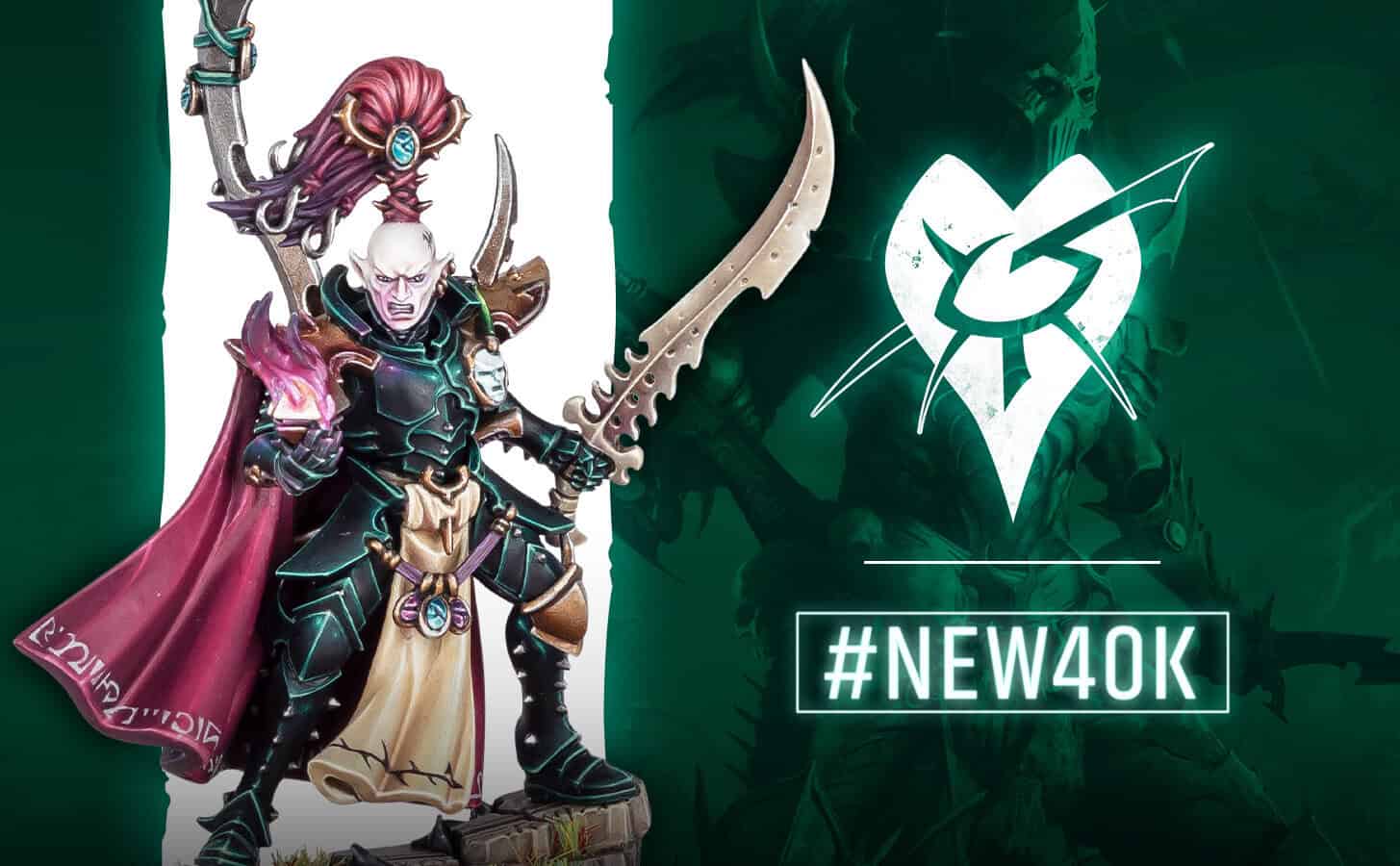 More new 11th Edition detachments for the Dark Eldar are here: Exhibition of Slaughter for Wych Cult melee pressure, Kabalite Agonysts for Kabal and Blades for Hire shooting, and Tools of Torment for Cronos and Talos units that are suddenly much harder to put down. Realspace raids are also back in a more narrative way, with Cult, Kabal, and Coven detachments able to mix in the same army.
Read the full Drukhari 11th Edition detachments guide here.
11th Edition Grey Knights Detachments: Paladins, Purgation & Interceptors Get New Rules
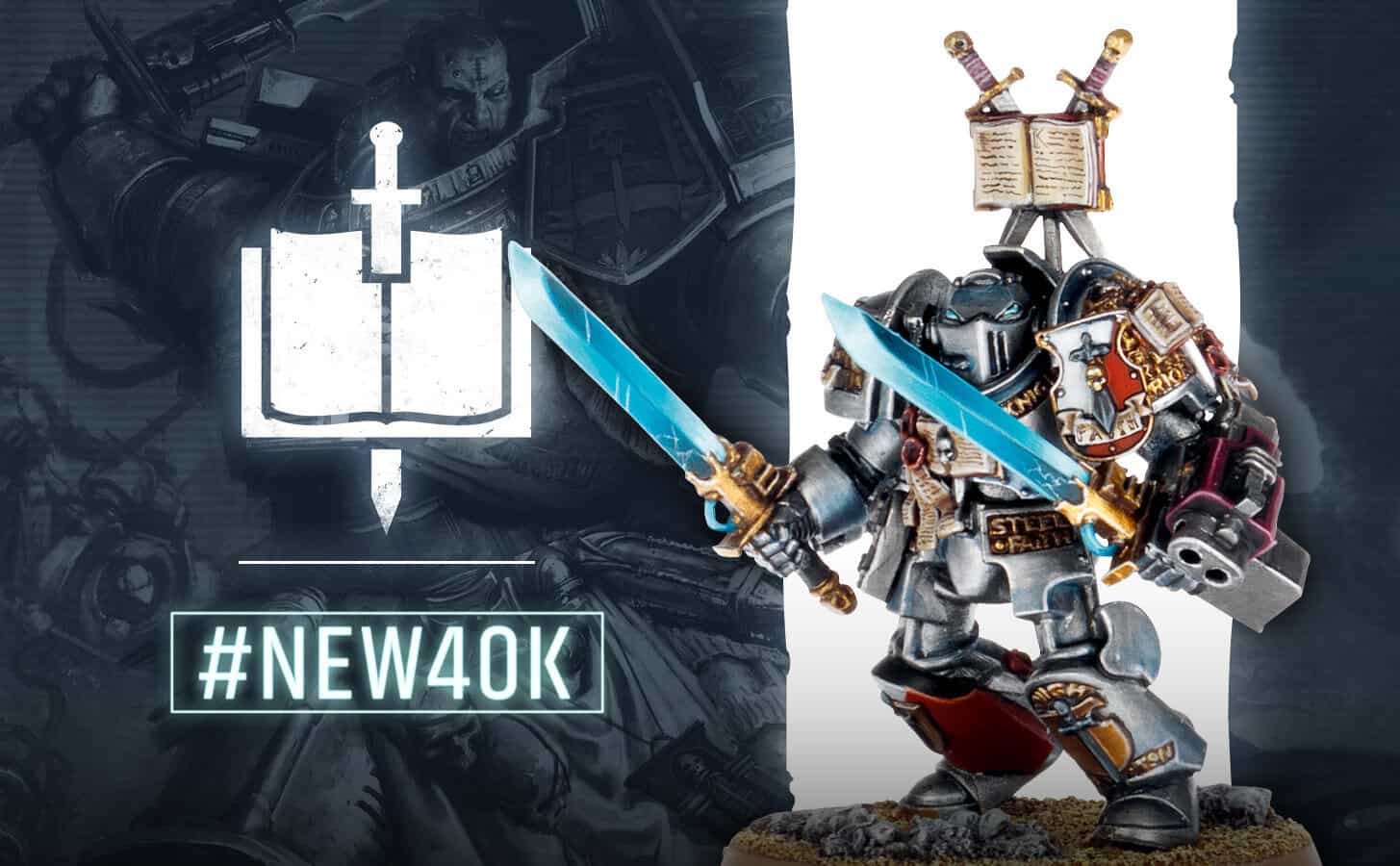
In the Grey Knights Faction Focus, three new 11th Edition detachments arrived: Argent Assault for Paladin monster-hunting, Fires of Purgation for Purgation Squad shooting, and Immaterial Interdiction for Interceptors that can finally shoot, teleport, and still charge.
Read the full Grey Knights 11th Edition detachments guide here.
Three New Emperor’s Children Detachments Turn 11th Edition Into a Stackable Chaos Buffet
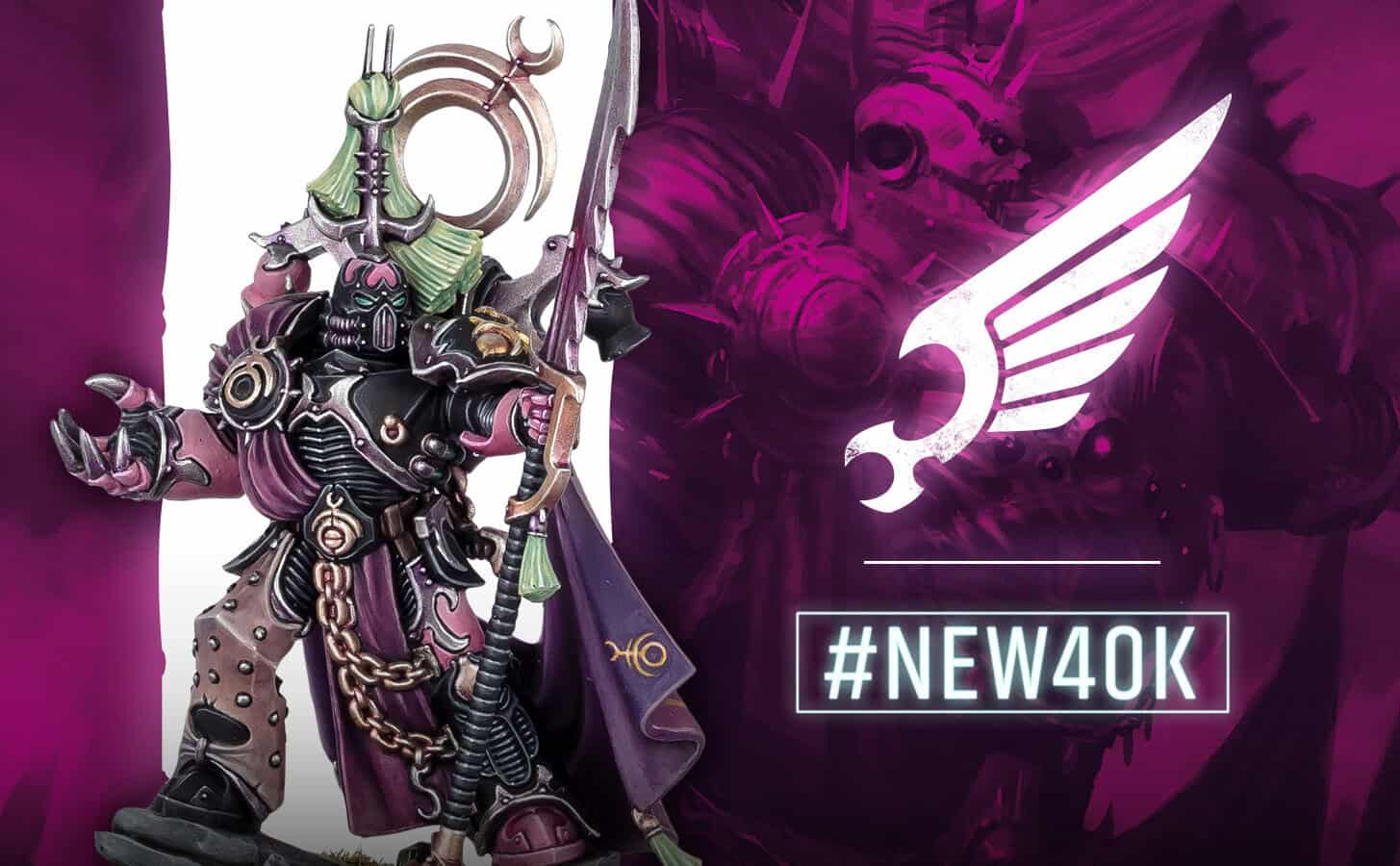
Emperor’s Children also got three new 11th Edition detachments: Elegant Brutes for Terminator deep strike pressure, Frenzied Host for Battleline brawlers, and Spectacle of Slaughter for Flawless Blades with baked-in Fights First. Each costs 1 Detachment Point, which means all three can stack into a Strike Force without replacing the original six codex detachments.
Read the full Emperor’s Children 11th Edition detachments guide here.
Both Knight Ranges Walk Away With Three Detachments
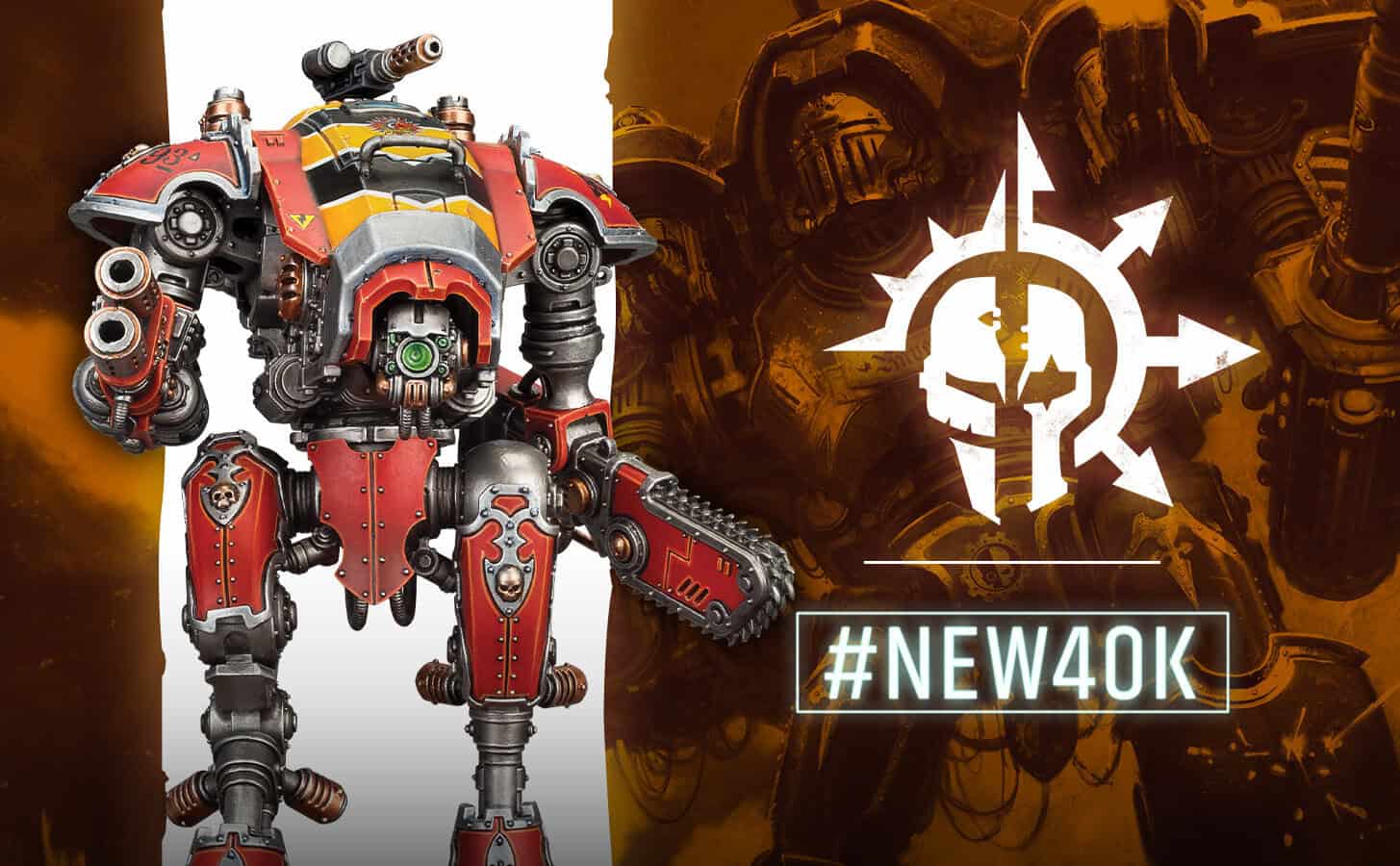
Both Knight ranges got their Faction Focus on the same day, and six new detachments dropped between them: Imperial Knights got Dominus Foebreakers, Questor Forgepact (up to 500 points of Adeptus Mechanicus tagging along), and Throne-bonded Outriders for Armiger bodyguard plans; Chaos Knights got Bastions of Tyranny, Hunting Warpack, and the wild Iconoclast Fiefdom that brings 500 points of DAMNED cultists for objective-sitting plus a Dark Sacrifice strat that heals a Chaos Knight by killing them off.
Read the full Imperial Knights and Chaos Knights 11th Edition detachments guide here.
Death Guard Detachments Trade The Grind For Real Speed
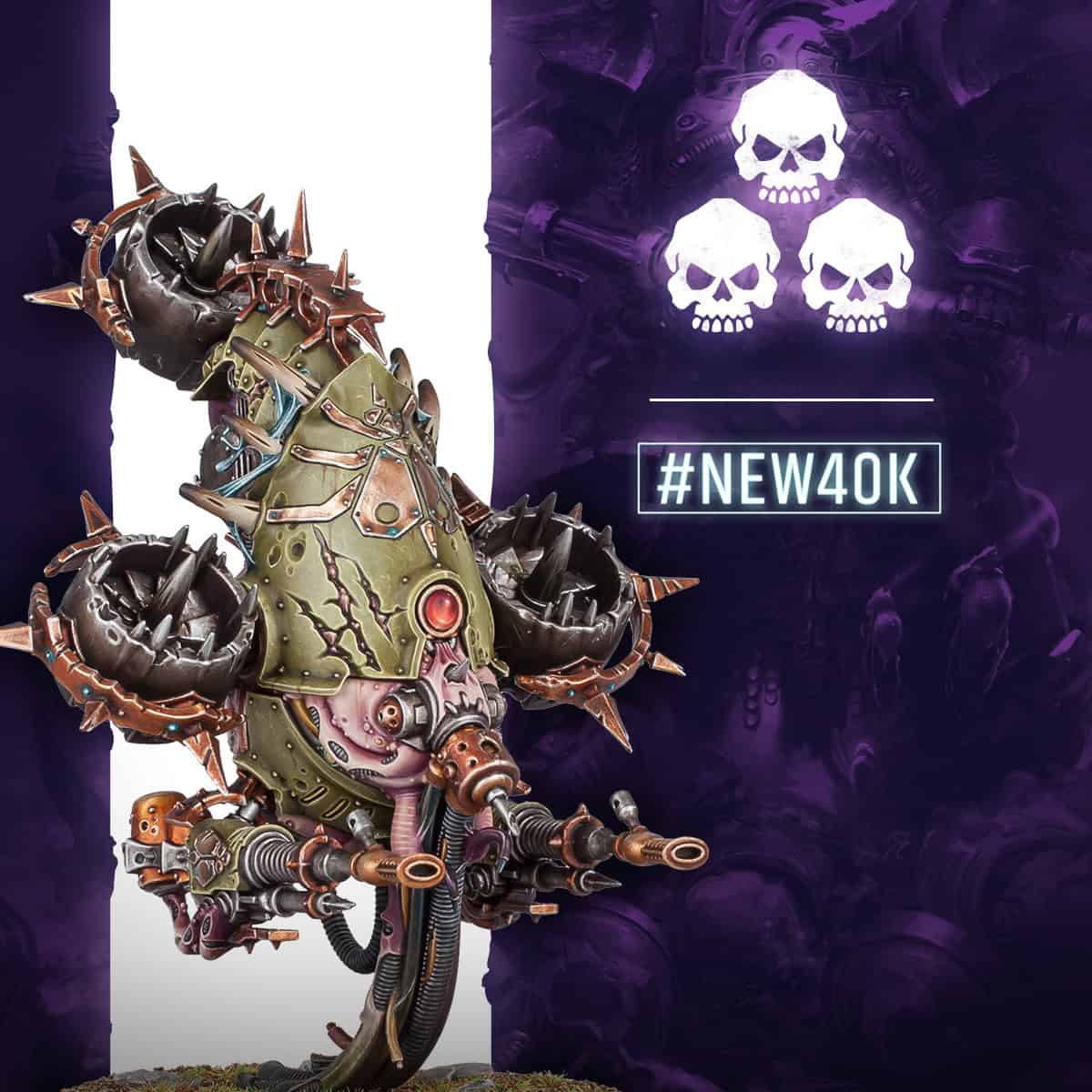
Death Guard finally stops being the slow plague army: Contagion Engines hands Bloat-Drones, Helbrutes, and Blight-Haulers Assault on every ranged weapon so the plague wagons shoot at full volume after advancing, Flyblown Host gives two Plague Marines units Infiltrators (a sentence nobody expected to write about Death Guard this edition), and Paragons of Putrescence stretches every Death Guard Character’s Contagion Range out to a 12″ cap for Mortarion, Typhus, and the Lord of Poxes.
Read the full Death Guard 11th Edition detachments guide here.
New 40k 11th Edition Adeptus Custodes Detachments Put Dreadnoughts, Sisters, and Terminators back on the Table
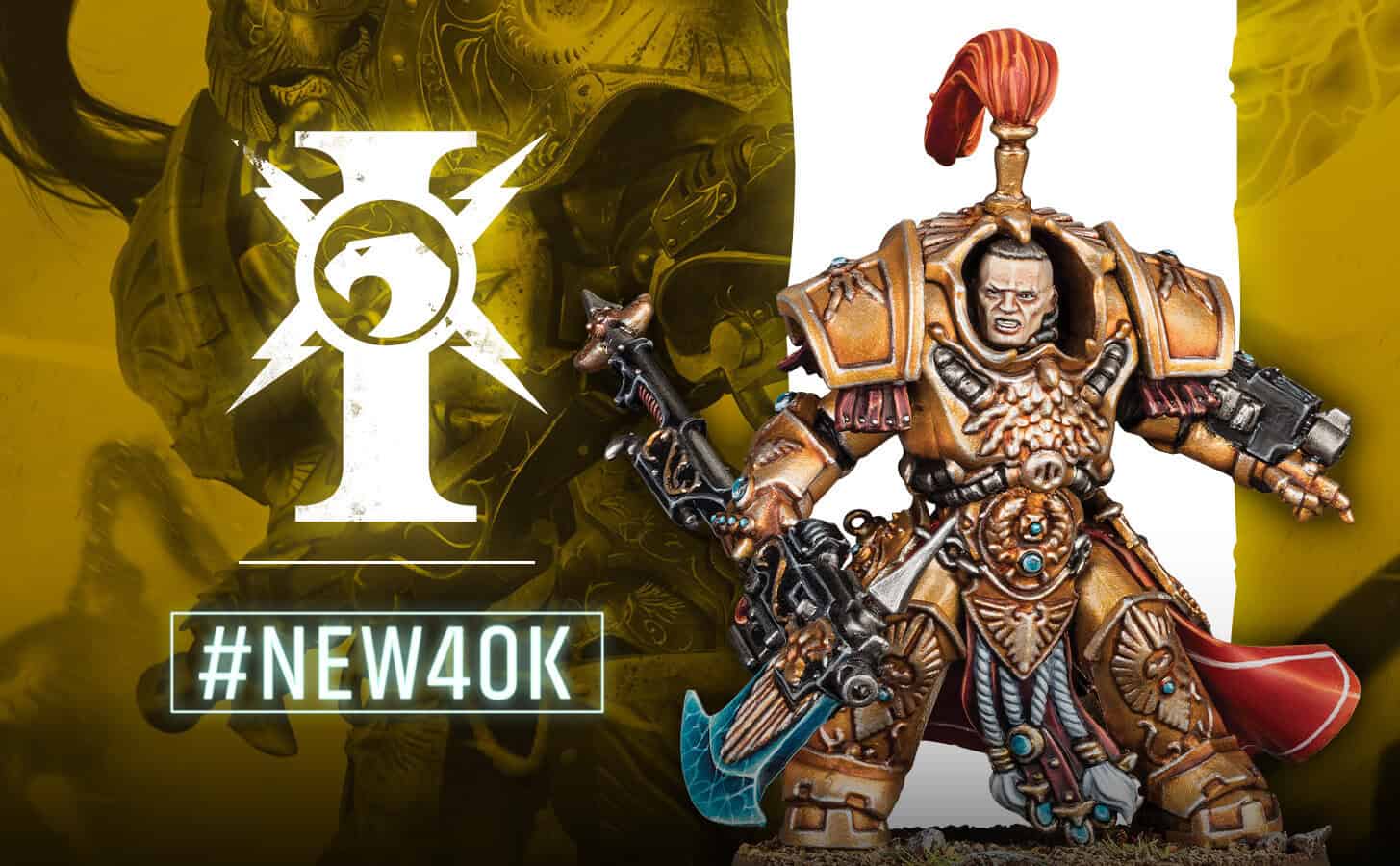
Three Custodes detachments built around elite unit players already have on the shelf: Might of the Moritoi turns Dreadnoughts into a battering ram with +2″ M and +1 to advance and charge always on, Silent Hunters gives Sisters of Silence a real job by letting them act while advancing and null Hidden enemy units within 12″, and Tharanatoi Hammerblow puts Allarus Terminators in your opponent’s deployment zone on Turn 1 with a re-roll on the charge.
Read the full Custodes 11th Edition detachments guide here.
New Tau Empire 11th Edition Detachment Rules Weaponize Hidden Units
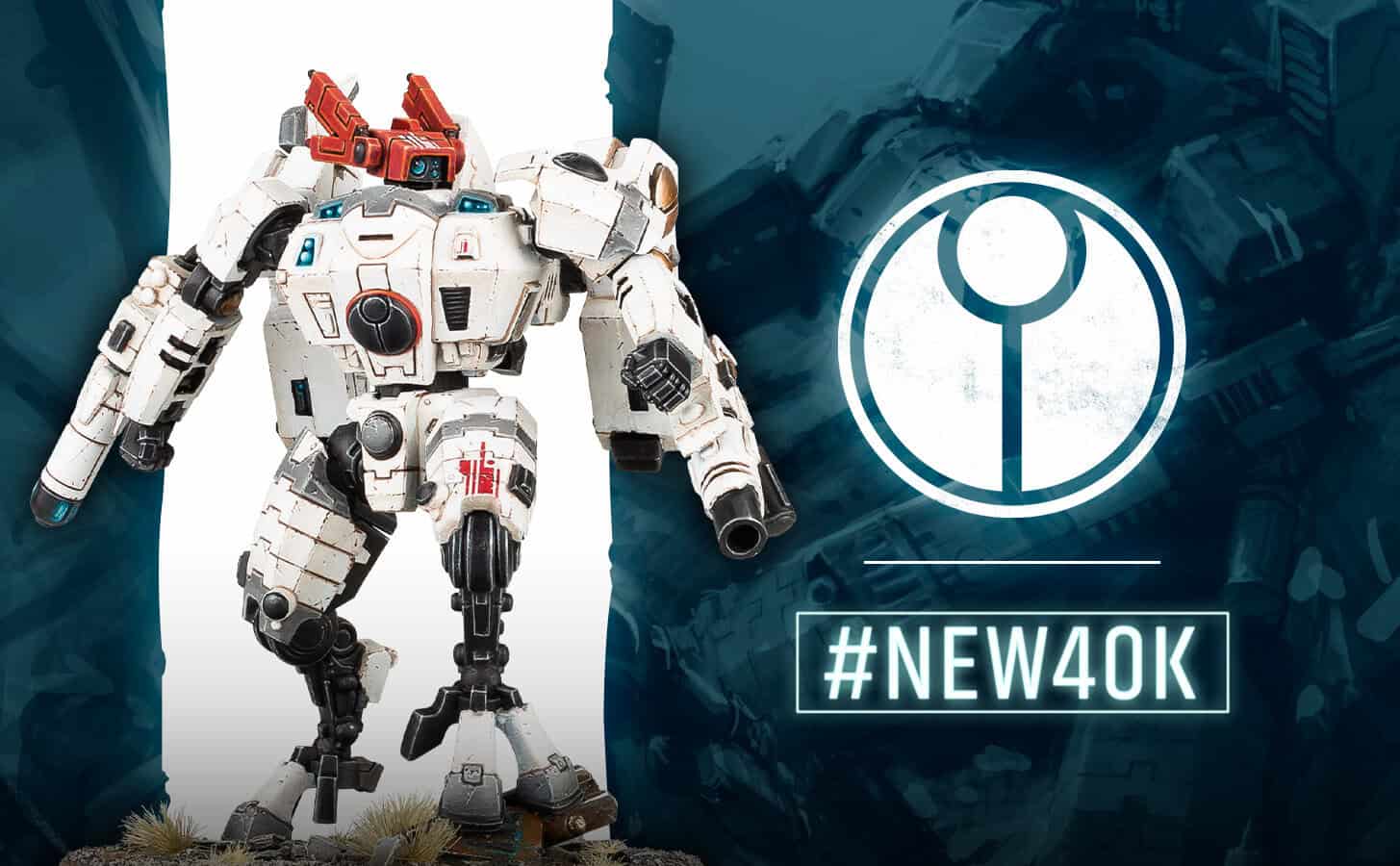
T’au were already the army that didn’t want to be shot at, and now they don’t want to be seen either: Advanced Acquisition Cadre lets Pathfinders and Stealth Battlesuits shoot without losing Hidden, Auxiliary Cadre Deep Strikes up to three Kroot Carnivore units as a Kauyon screen for your gunline, and Experimental Prototype Cadre stretches every BATTLESUIT CHARACTER’s ranged attacks by +6″ Range with an optional spicy [HAZARDOUS] +1 S/+1 AP ammo upgrade.
Read the full T’au 11th Edition detachments guide here.
Brazen Engines Gives the New Defiler Kit Somewhere to Belong
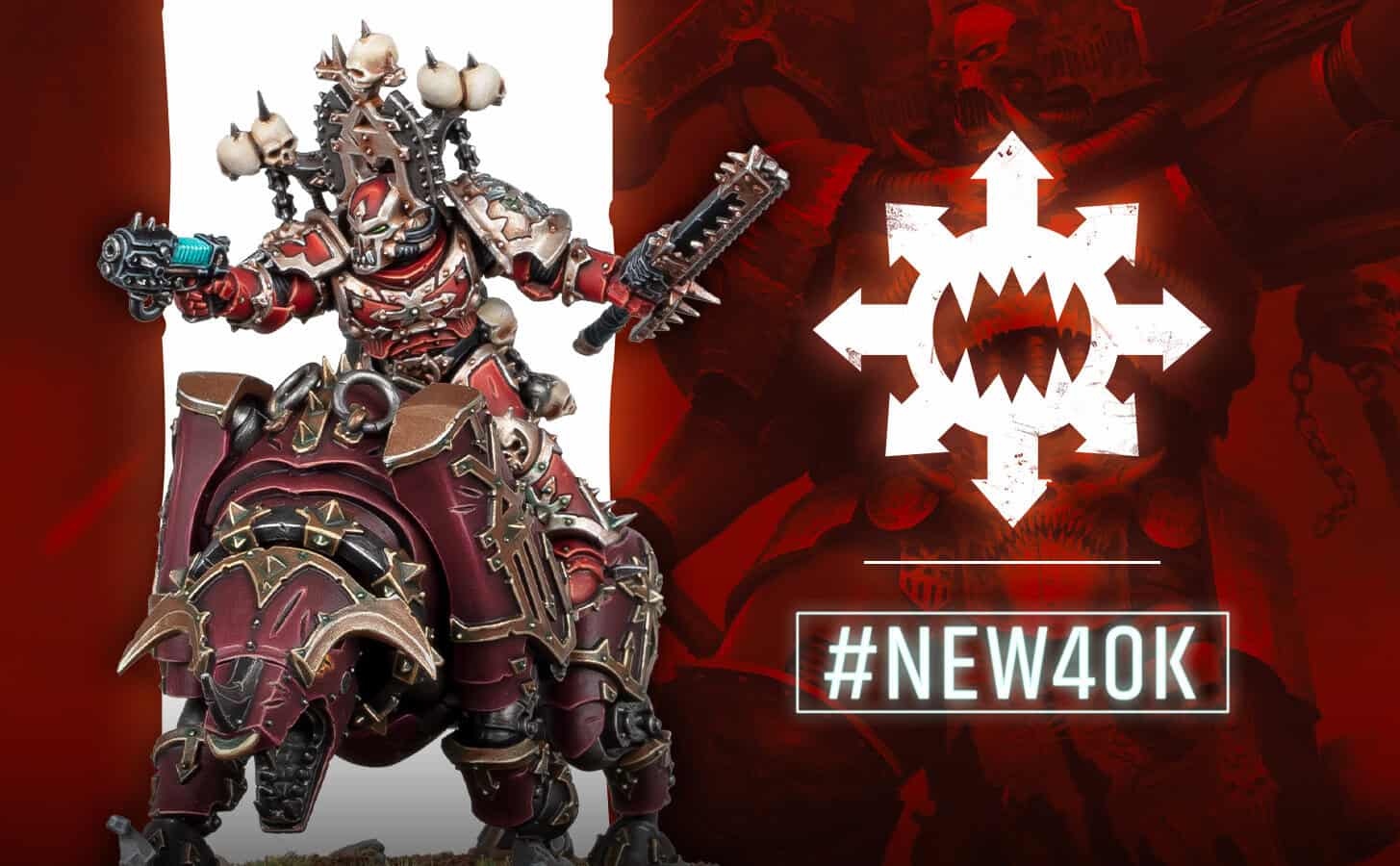
Brazen Engines turns Defilers and Maulerfiends into strat-locking bulldozers (a -1 battle-shock that shuts off enemy CP right before your engine swings), Butchers of Khorne pile a third Blessing of Khorne onto Chaos Terminator chainfists for Sustained Hits, Lethal Hits, and Devastating Wounds all on one activation. Finally, Vessels of Wrath lets Khornate Characters blend hordes with [CLEAVE 1] or crack armor with +1 AP on the swing.
Read the full World Eaters 11th Edition detachments guide here.
Adepta Sororitas Get Three Detachments That Pull The Faction Out Of One-Trick Mode
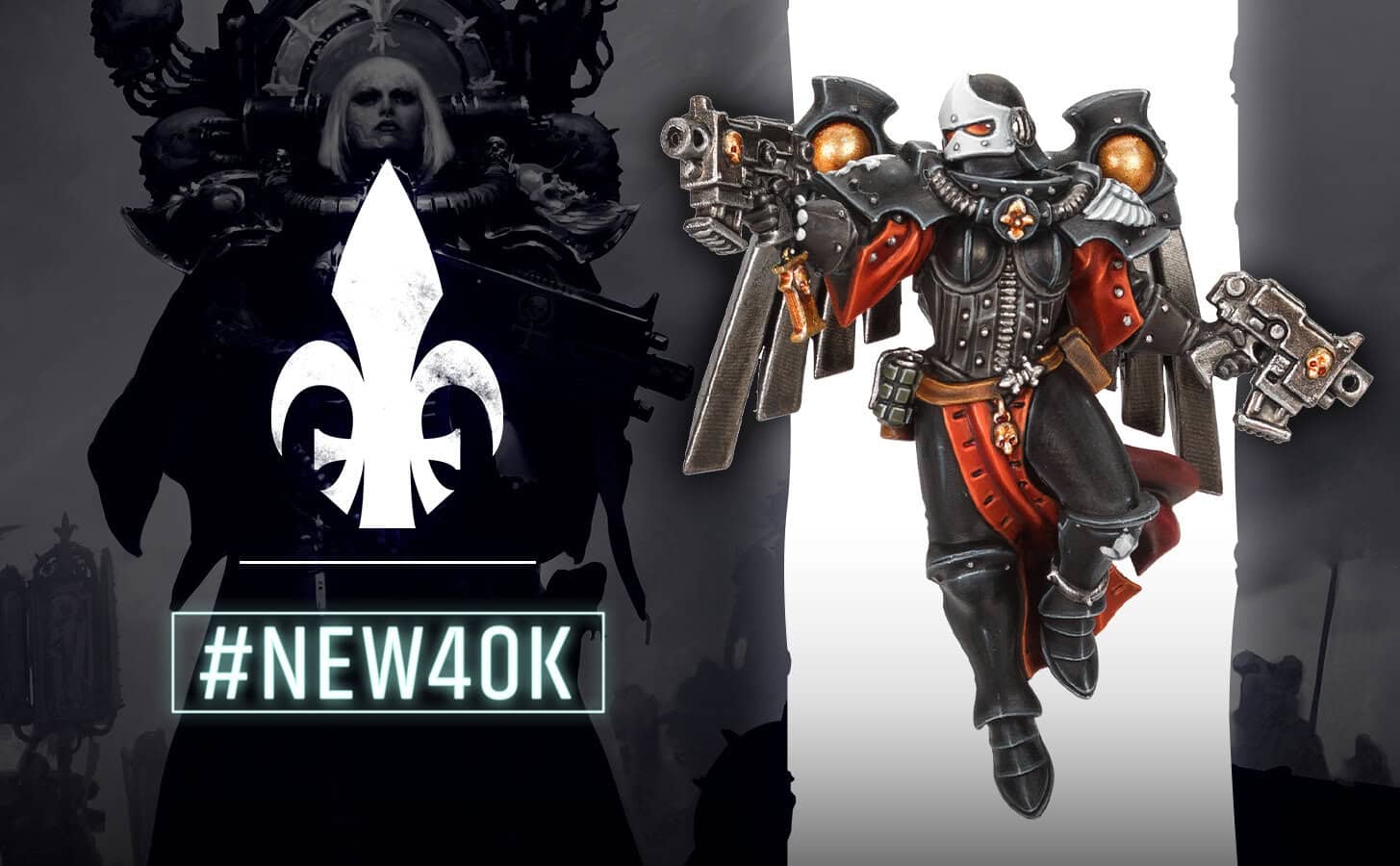
Chorus of Condemnation is the standout here, with Seraphim painting enemy units for a +3″ detection range bump that drags them straight into multi-melta and Exorcist range. Sacred Champions pushes Celestian Sacresants to 2s-to-hit in both phases, and Sanctified Orators just hands out free Character enhancements that don’t count against the army cap.
Read the full Sororitas 11th Edition detachments guide here.
Chaos’s Six New Detachments Bake Legion Identity Right Into The Rules
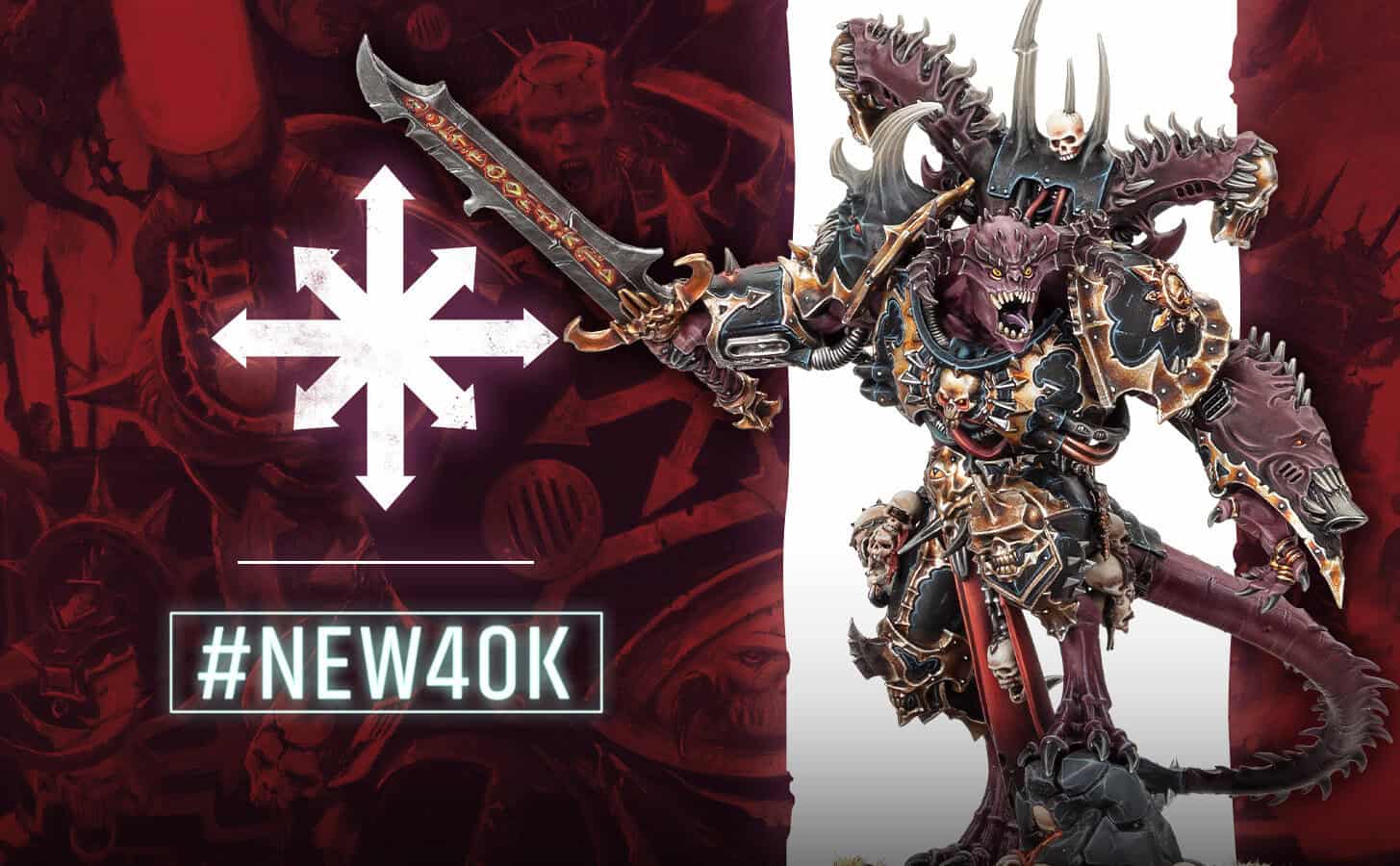
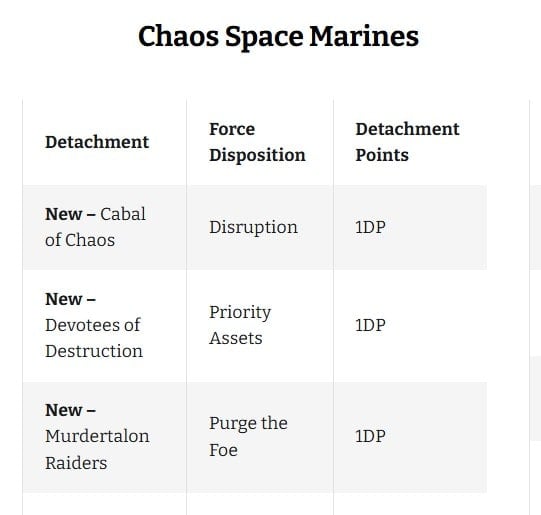
It’s the biggest single Chaos rules dump in a while: three CSM detachments (Cabal of Chaos, Devotees of Destruction, Murdertalon Raiders) and three Daemon detachments (Cavalcade of Chaos, Lords of the Warp, Warptide), with stratagems like Plunging Talons handing [LANCE] on the charge, Carnival of Excess flipping Slaanesh Characters into Fights First, and Daemonic Infestation healing 3 wounds in your Command phase.
Read the full Chaos 11th Edition detachments guide here.
Tyranid Detachments Make Lictors And Warriors Worth Bringing Again
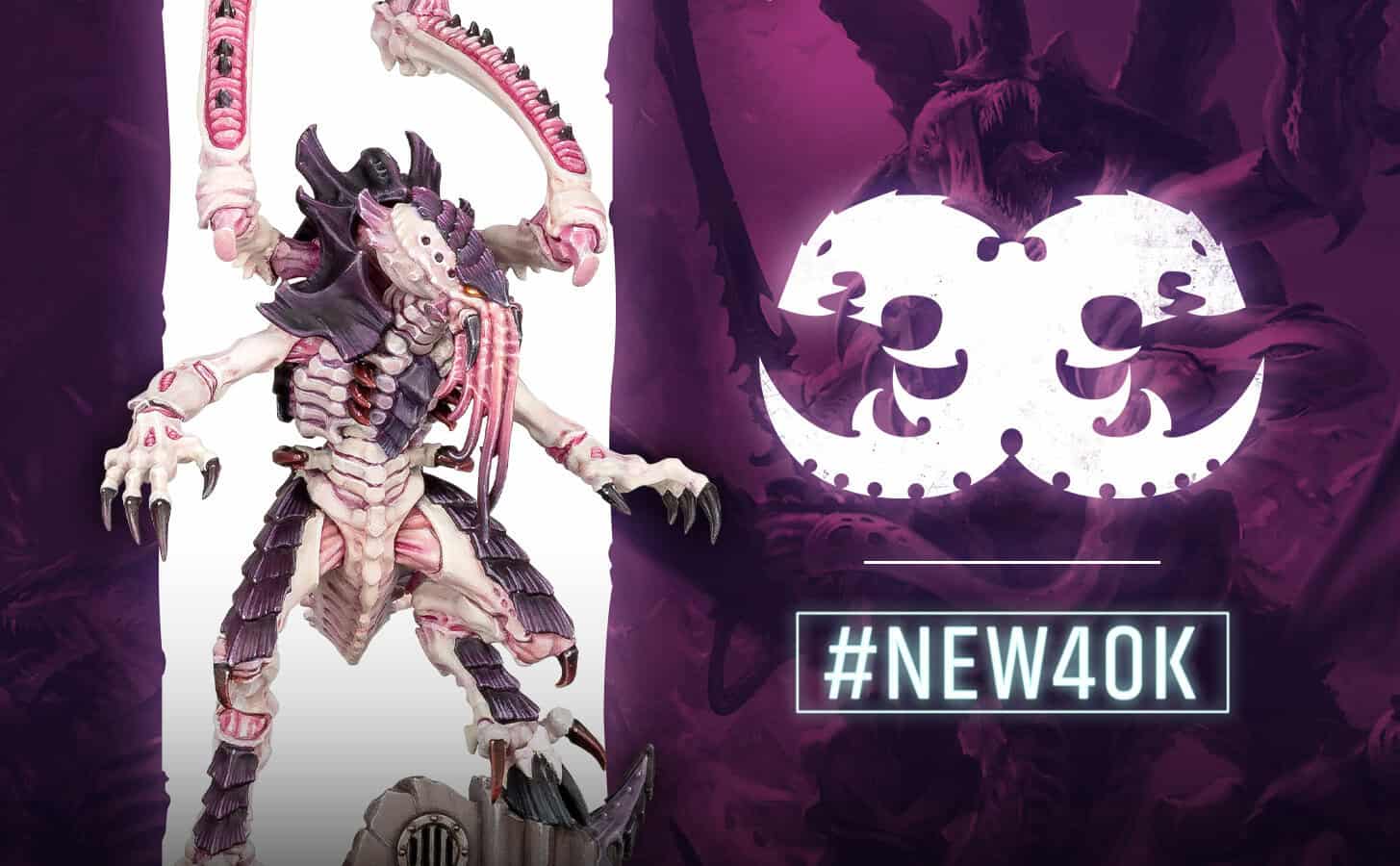
Ambush Predators finally puts Deep Strike on every Lictor, Neurolictor, and Deathleaper. Talons of the Norn Queen lets Norn Emissaries re-pick their Singular Purpose mid-game, and Warrior Bioform Onslaught makes Tyranid Warriors BATTLELINE with a 5+ invulnerable save on every Tyranid Prime.
Read the full Tyranid 11th Edition detachments guide here.
Astra Militarum Fills In The Gaps Armageddon’s Tank Wave Left Behind
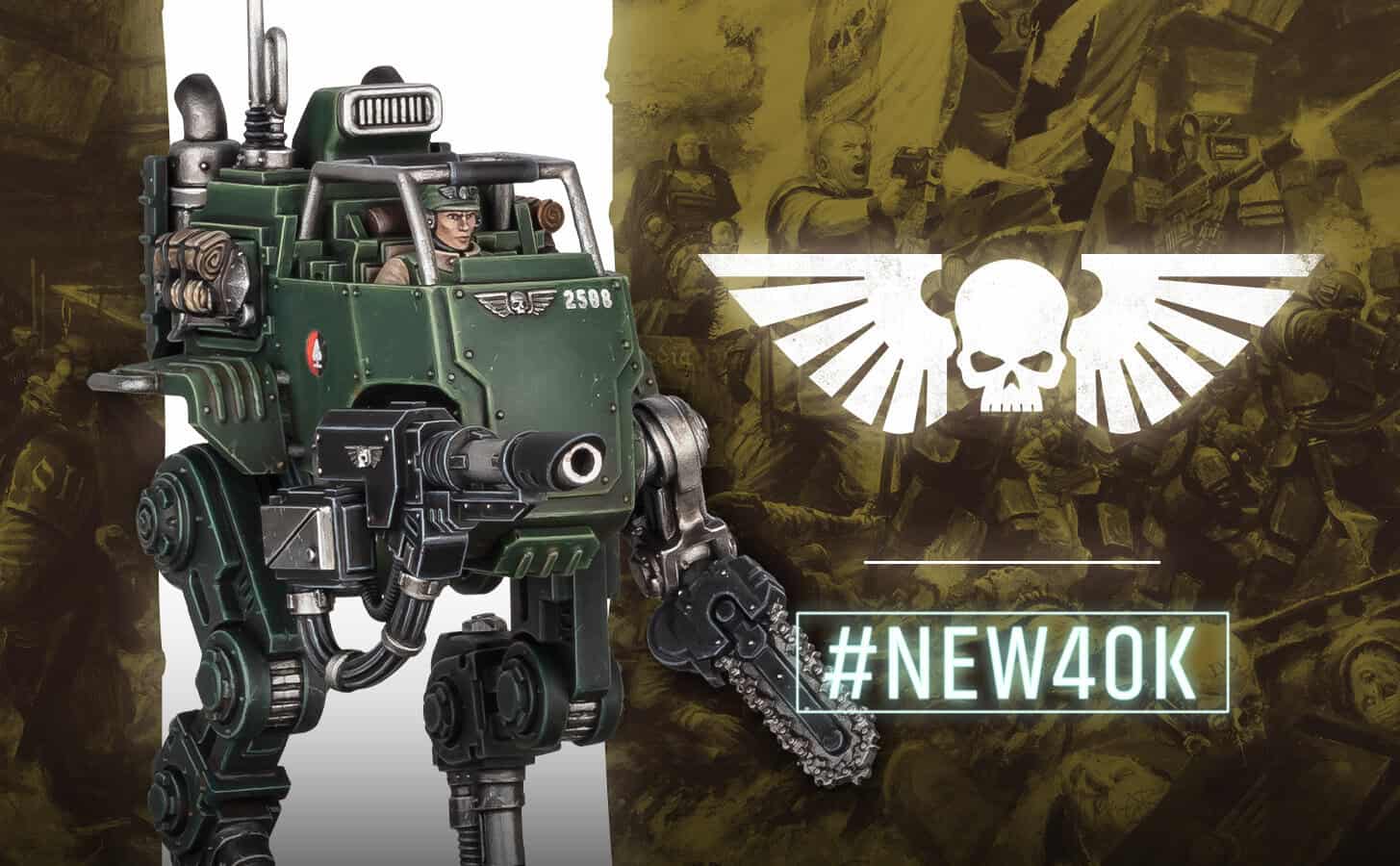
Abhuman Auxiliaries gives Bullgryns, Ogryns, and Ratlings the ABHUMAN keyword, Bridgehead Strike (a Grotmas refresh) hands Tempestus Scions BATTLELINE plus a turn-one to-hit buff for the whole detachment, and Designation Force turns Scout Sentinels into Signal Flare spotters with a +3″ detection bubble aimed straight at the new Hidden rule.
Read the full Astra Militarum 11th Edition detachments guide here.
Space Marines Got The Deepest Detachment Reveal Of The 11th Edition Launch So Far
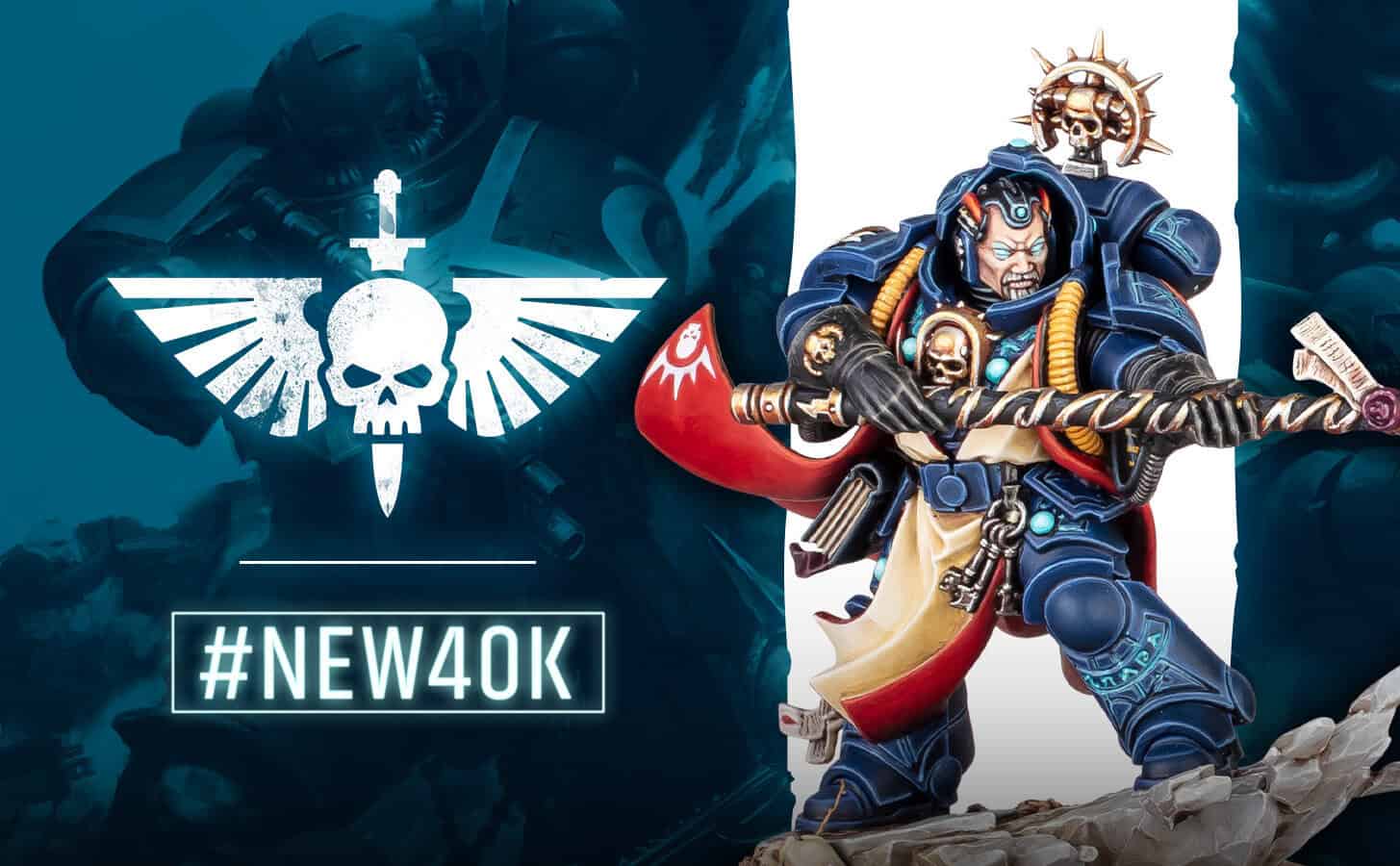
Three Codex-wide options (Fulguris Task Force, Librarius Conclave, Subversion Assets), plus four chapter detachments where Black Templars, Blood Angels, Dark Angels, and Space Wolves all got something new too. Heroic Intervention now has two modes: Leap to Defend (1 CP) and Into the Fray (2 CP, charge anything within 6″).
Read the full Space Marines 11th Edition detachments guide here.
Three Ork Detachments Pull Greenskin Lists In Three Completely Different Directions
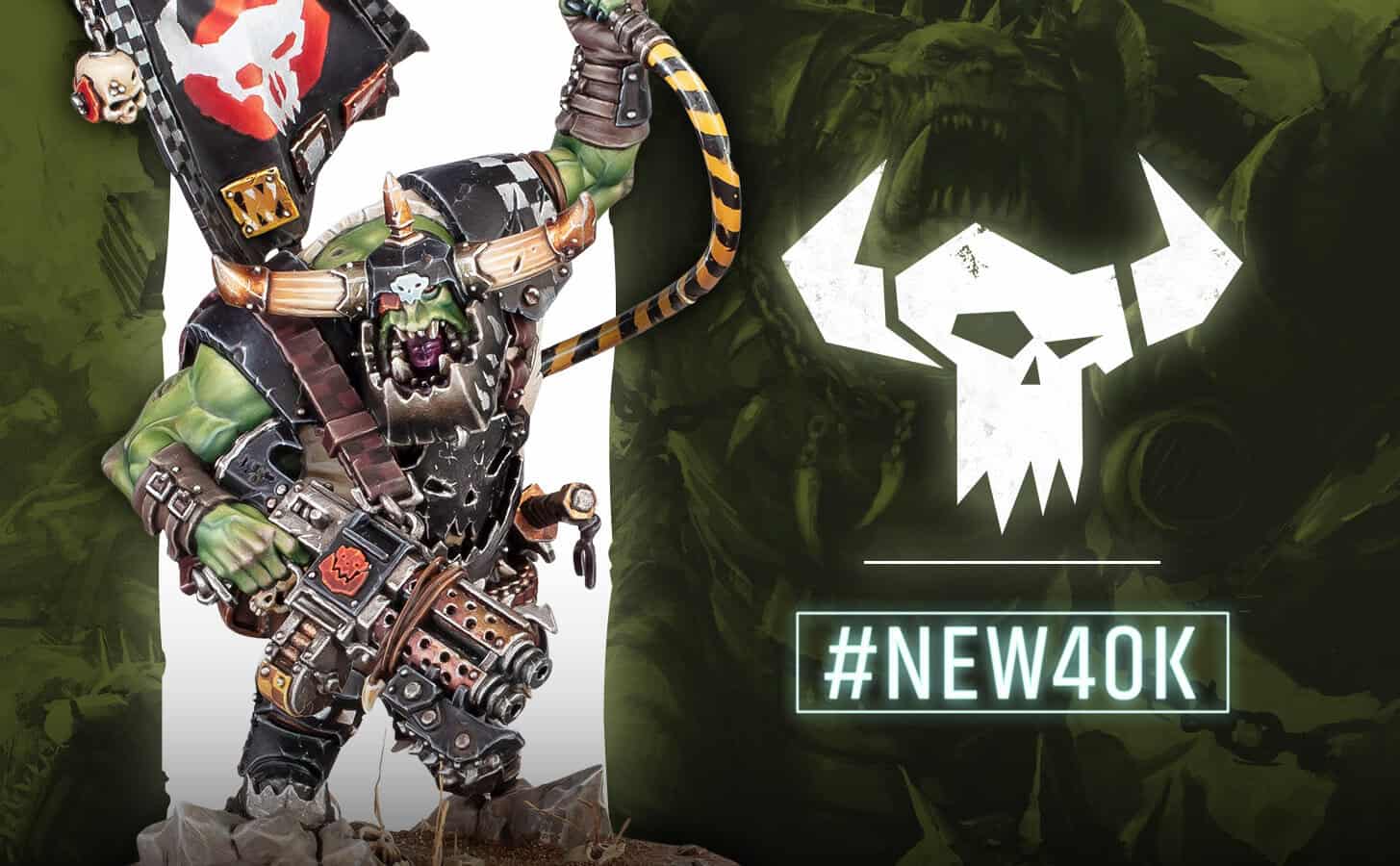
Rollin’ Deff hands Battlewagons, Hunta Rigs, and Kill Rigs auto-6″ Advances plus charge re-rolls, Taktikal Brigade goes full Blood Axe trickery on Stormboyz and Kommandos, and More Dakka turns every Ork Infantry ranged attack into [ASSAULT] with SUSTAINED HITS 1 under WAAAGH!.
Read the full Ork 11th Edition detachments guide here.
11th Edition Missions: Now React to the Army You Bring
This might be the sneaky-biggest Warhammer 40k 11th Edition rules change in the preview. According to GW, your choice of Detachment now helps determine your army’s Force Disposition, and that directly shapes the mission you play. Your objectives in a game will now be influenced by the kind of army you bring and by the Force Disposition your opponent has brought too!

That’s a pretty major philosophical shift for Warhammer 40k missions.
A More Thematic Way to Score Points
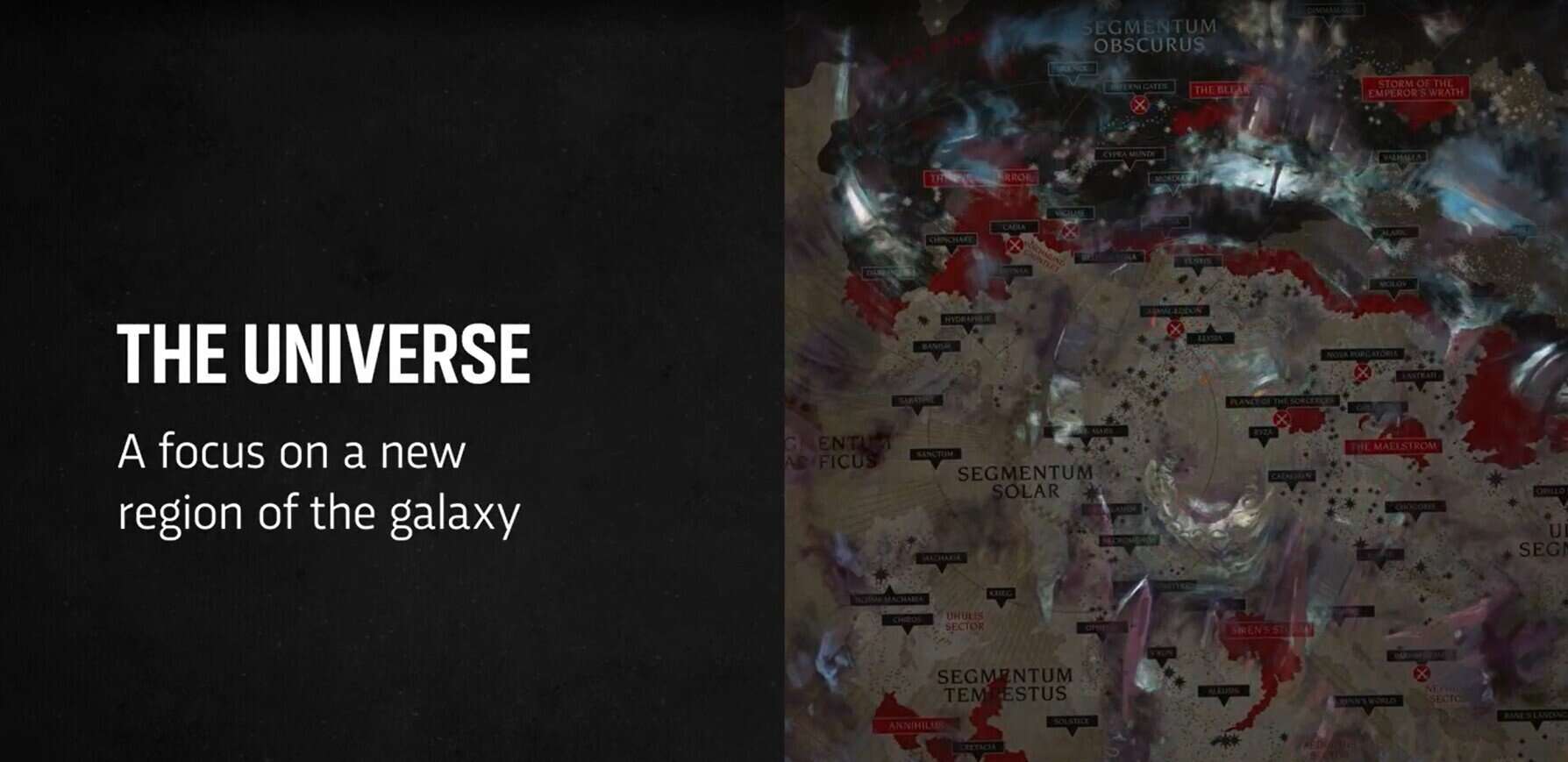
The idea here seems to be that armies should finally be rewarded for doing what they are actually built to do.
GW says there are five Force Dispositions in total: Take and Hold, Purge the Foe, Disruption, Reconnaissance, and Priority Assets. Each one is tied to a more thematic style of play, so a Purge the Foe army will often score by destroying enemy units, while a Disruption force may need to perform actions in enemy territory or control key terrain pieces.

Honestly, this makes a lot of sense because too often, 40k missions can feel like they are asking every faction to solve the same puzzle the same way. That can flatten faction identity and create weird situations where an army built to rampage across the table instead has to play like it is filing paperwork.
This new approach to Warhammer 40k 11th Edition scoring rules could make games feel more thematic and dynamic, especially because players will often have different Primary Missions unless they picked the same Force Disposition. GW says the missions are asymmetrical by design, but still intended to stay fair and balanced, with most armies still needing some level of board control to score well.
The Risk With Dynamic Mission Design

Of course, this also opens the door to balance headaches.
If one faction’s mission path is naturally easier than another’s, that will become a problem fast. So the success of this system depends on how well GW tunes those mission rewards across different Force Dispositions and matchups. Tournament players will also want to pay close attention here, because GW says your Force Disposition will usually be locked in when you submit your list for an event, while pickup games can swap between battles.
 Here is also the first full example of how the missions will work. If one army gets Death Trap, the other gets the Determined Acquisition card. Both seem plausible for a balanced game, but the initial fear remains.
From a design standpoint, this is one of the fresher ideas in the Warhammer 40k 11th Edition rules preview. It could help armies feel more distinct without relying entirely on raw stat lines or special rules bloat.

There are also a few other mission updates wrapped into the Warhammer 40k 11th edition Missions rules reveal:
- Deployment maps like Dawn of War, Hammer and Anvil, and Tipping Point are still around.
- Secondary Objectives still let players choose Fixed, or Tactical, and Tactical cards now work a little differently. Instead of holding only two at a time, players draw two every turn and keep any they have not yet scored, which should make those early dead draws feel a lot less punishing.
- Primary and Secondary scoring are also capped at 45VP total and 15VP per battle round, so players cannot just sit back and try to cash everything in at the end.
- Twists are back as well, including optional modifiers that can shake up the game, and GW says all these initial mission rules and deployment cards will be included in the new Chapter Approved mission deck inside the Armageddon launch box.
Stratagems: No More Pile-On Nonsense
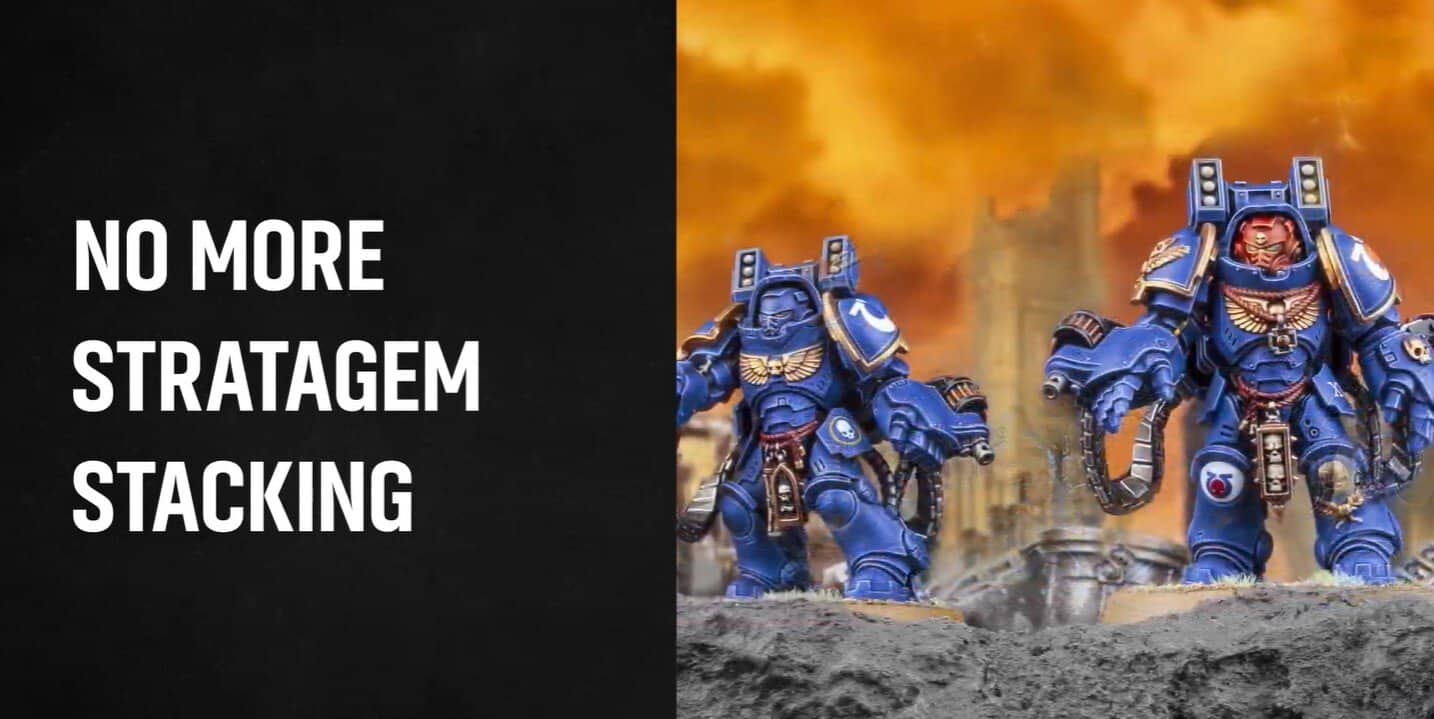 Another big cleanup for 11th is the end of stratagem stacking on one unit. Once you use a stratagem on a unit, that is it; you cannot just keep layering buffs until one squad turns into a ridiculous death machine.
That should make the game feel cleaner, cut down on some of the more annoying combo abuse, and keep players from building their whole plan around one overcooked unit doing all the work.
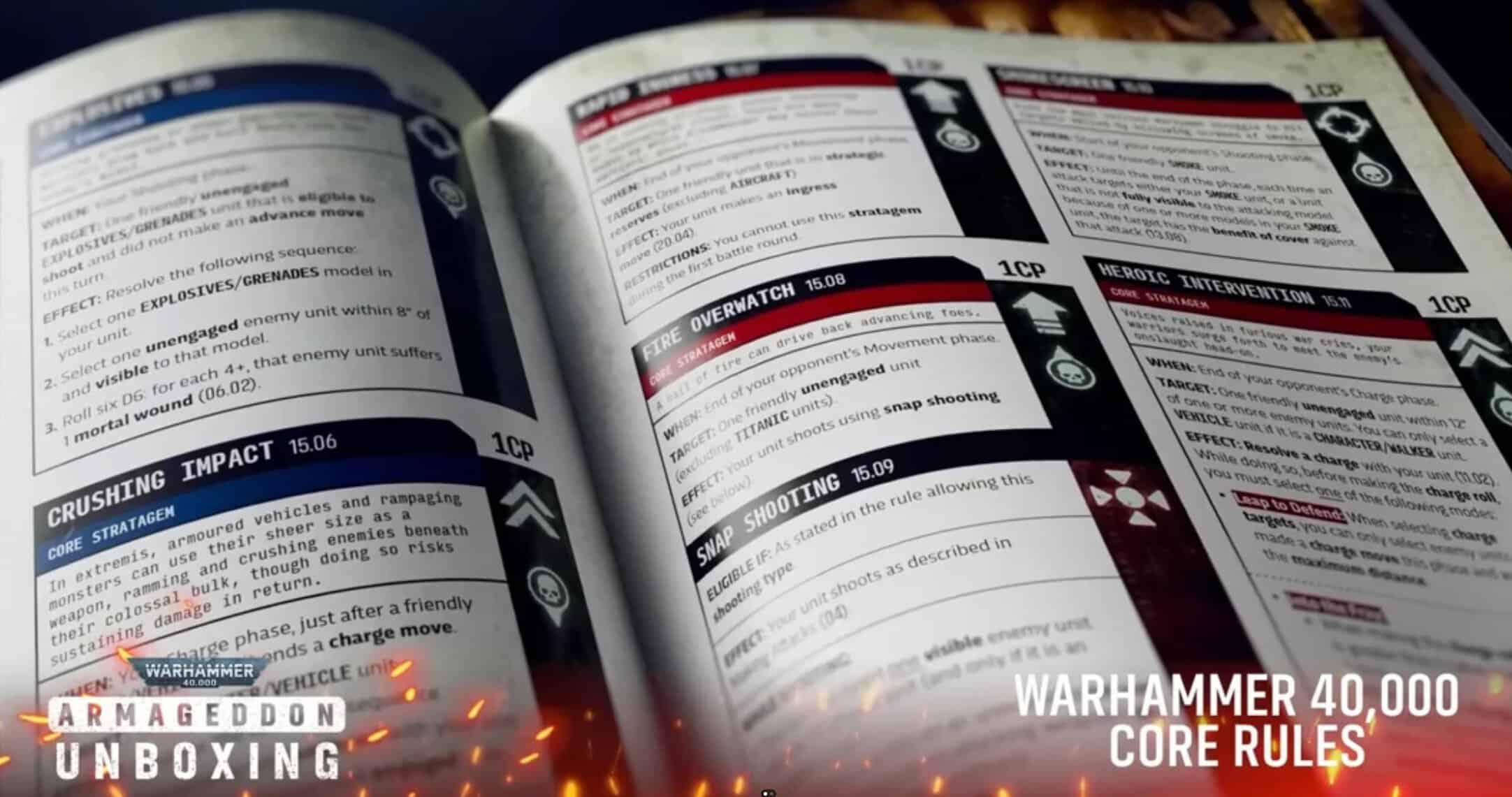
The bigger story in the new core stratagem reveal isn’t the renames, though. Sure, Tank Shock becomes Crushing Impact and Grenades becomes Explosives, but the actual editorial weight sits on Overwatch, Heroic Intervention, and Smoke Screen, which all got pushed to end-of-phase windows that kill the reactive mind games 10th Edition was built on.
And stack that on top of the no-stratagem-stacking rule GW already confirmed, and Command Reroll quietly becomes the most-nerfed strat on the whole page without anyone changing a single word in its rules.
For the full breakdown on every change to stratagems now, read the full 11th Edition core stratagems guide here.
Objective Markers Are Changing: Yes, Circles Are Gone
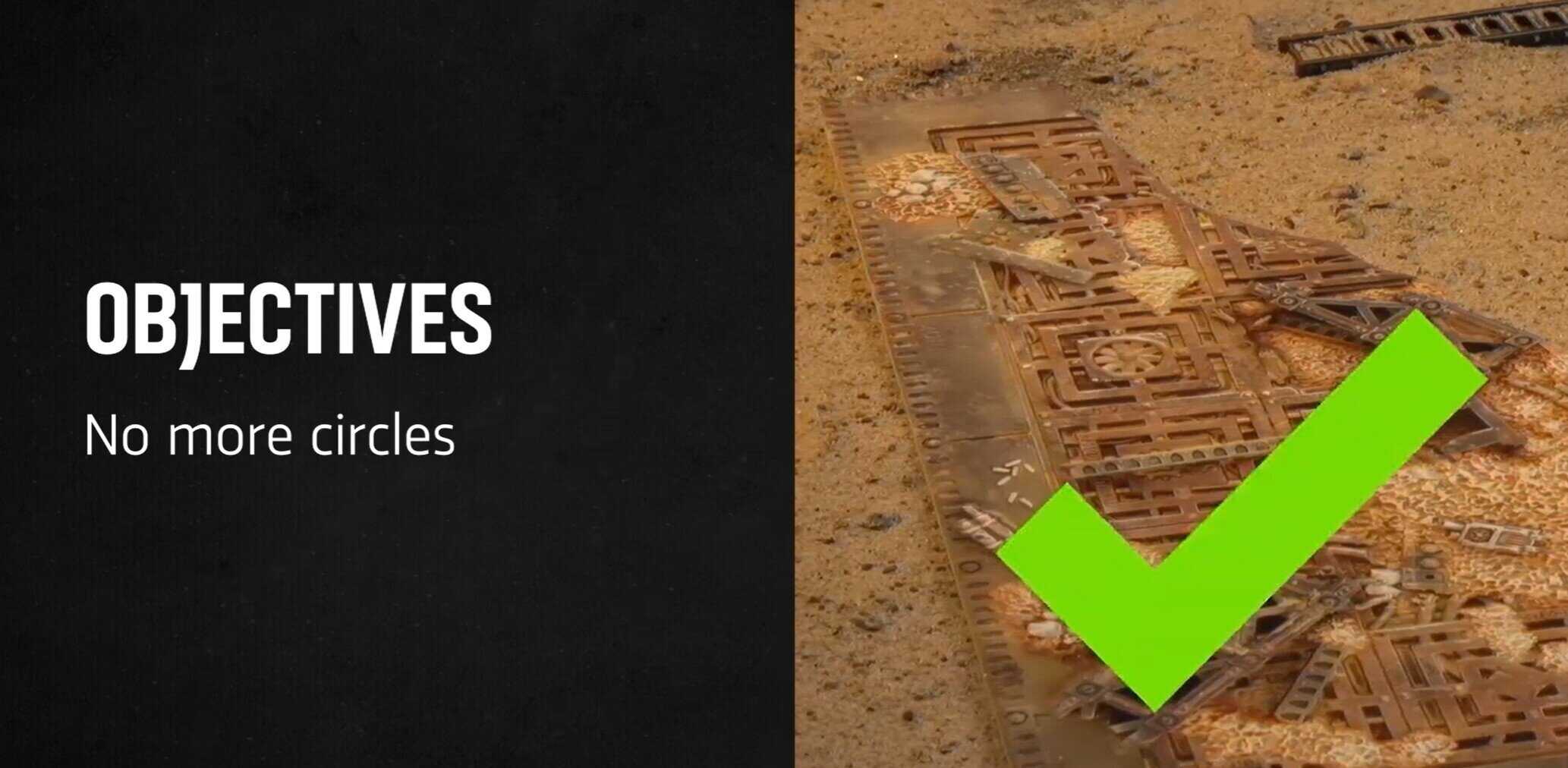 One of the weirdest, yet most immediately visible, changes is that the round objective markers are gone. That is right. No more circles. Instead, terrain footprints will determine control of key locations, relics, or fortifications.
How this will improve the Tabletop Experience
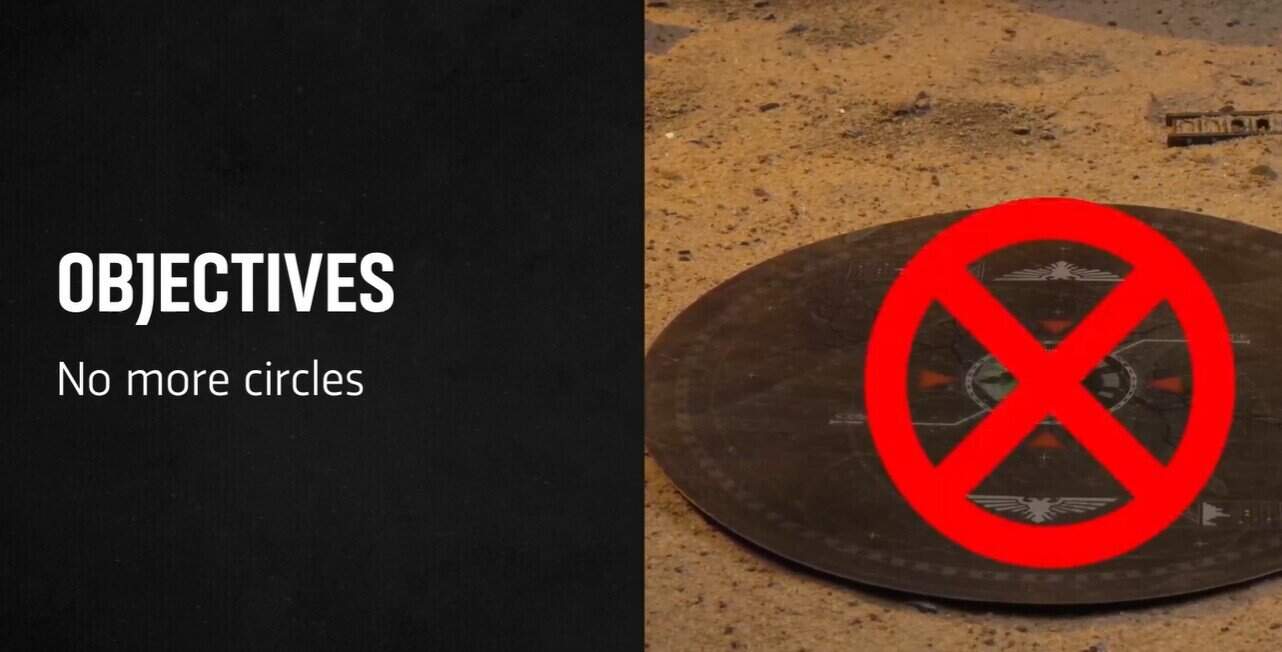 At first glance, this sounds like a small formatting change. It isn’t.
Objective circles have been one of those things players just accepted, even when they sometimes looked awkward on a beautifully built table. Swapping to terrain footprints could make objectives feel more natural, more immersive, and more connected to the battlefield itself.
Rather than pretending a random glowing disk in the middle of a ruined city is the whole story, the game may now anchor control around meaningful parts of the terrain.
How Objectives Work With Terrain in 11th Edition Now
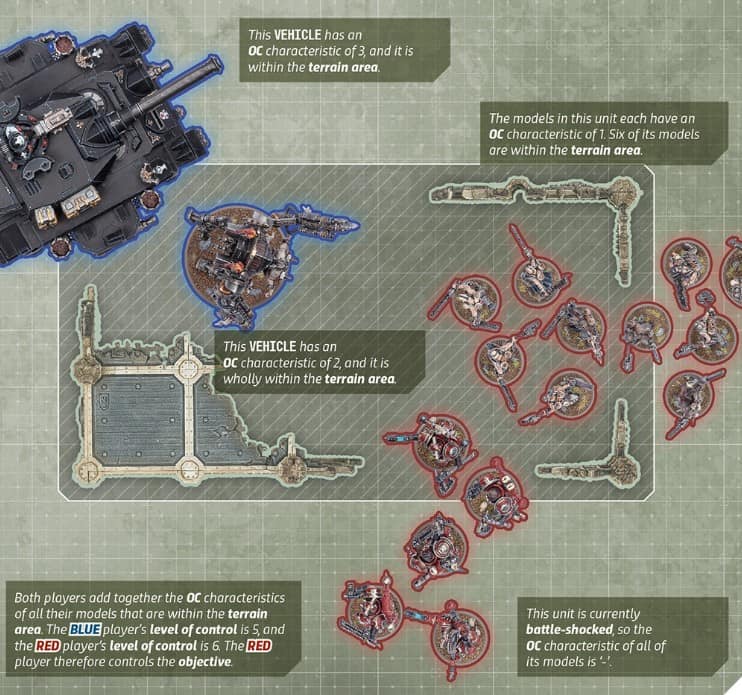 Terrain as objectives gives the whole game a lot more texture, since the units scoring points are often doing it from ruins, rubble, trees, or other features that actually help keep them alive.
Infantry, Beasts, and Swarms get a nice bonus here too, because if they skip shooting, they can lean on the Hidden rule (described below) and make themselves much harder to pick off at range.
Vehicles and monsters don’t get quite the same perks from terrain areas, but they can still use nearby cover while contesting those spots, and they’re better at moving through lighter terrain around objectives without getting bogged down. And from the looks of the picture, they just have to be touching the terrain footprint to score.
Terrain Rules & Staying Hidden: Warhammer 40k 11th Edition Rules Changes
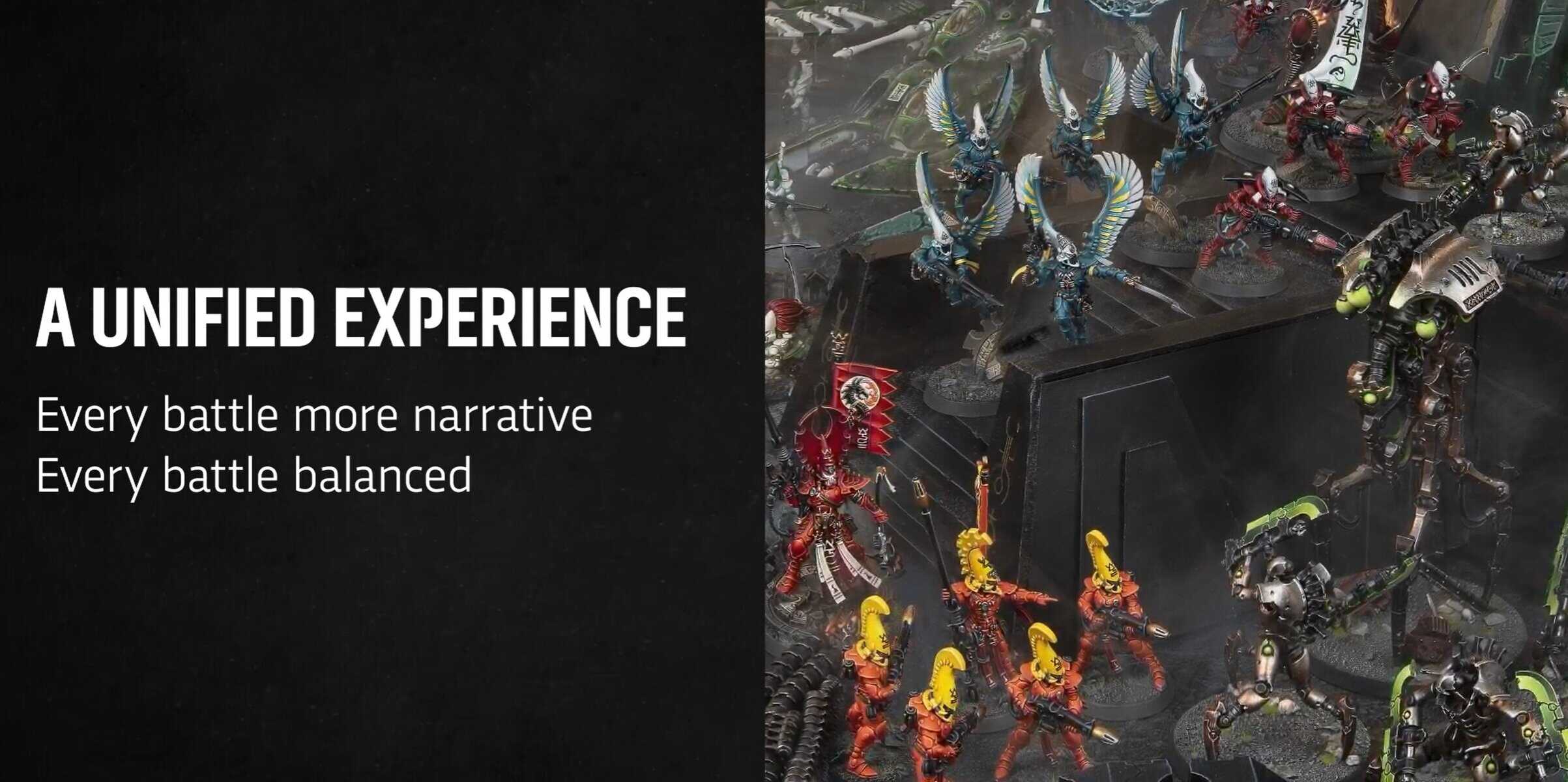 How terrain works has been recently expanded on by GW, and these Warhammer 40k 11th Edition rules changes pack a lot.
The default bonus for cover now affects Hit rolls, not saving throws, and units are generally much easier to hide than before. That’s a pretty major change to how shooting armies and defensive positioning could work in the new edition.
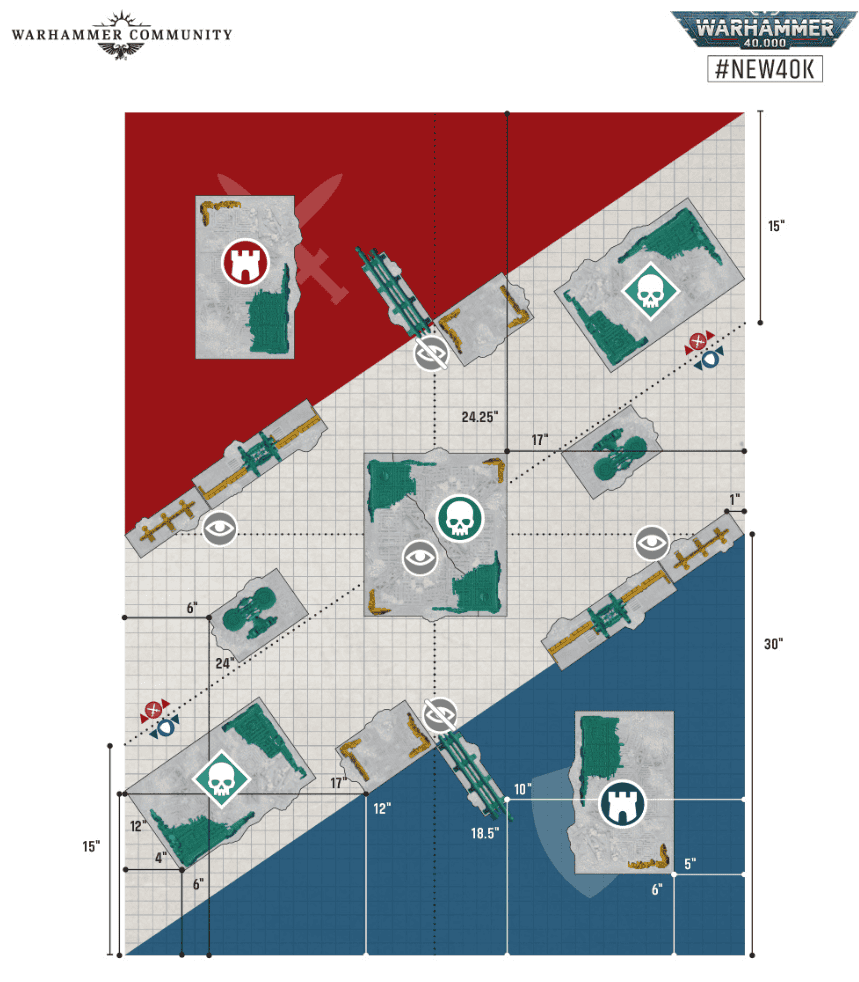 If these 11th Edition terrain rules pan out, the battlefield is about to matter as much as your list. Terrain footprints will be doing the heavy lifting (not just ruin shapes), objectives turning into actual terrain features you fight over, and more standardized layouts that could make games feel fairer across events.
GW showed off two deployment layout maps, and as you can see, the different terrain pieces serve as both the new objectives and the battlefield.
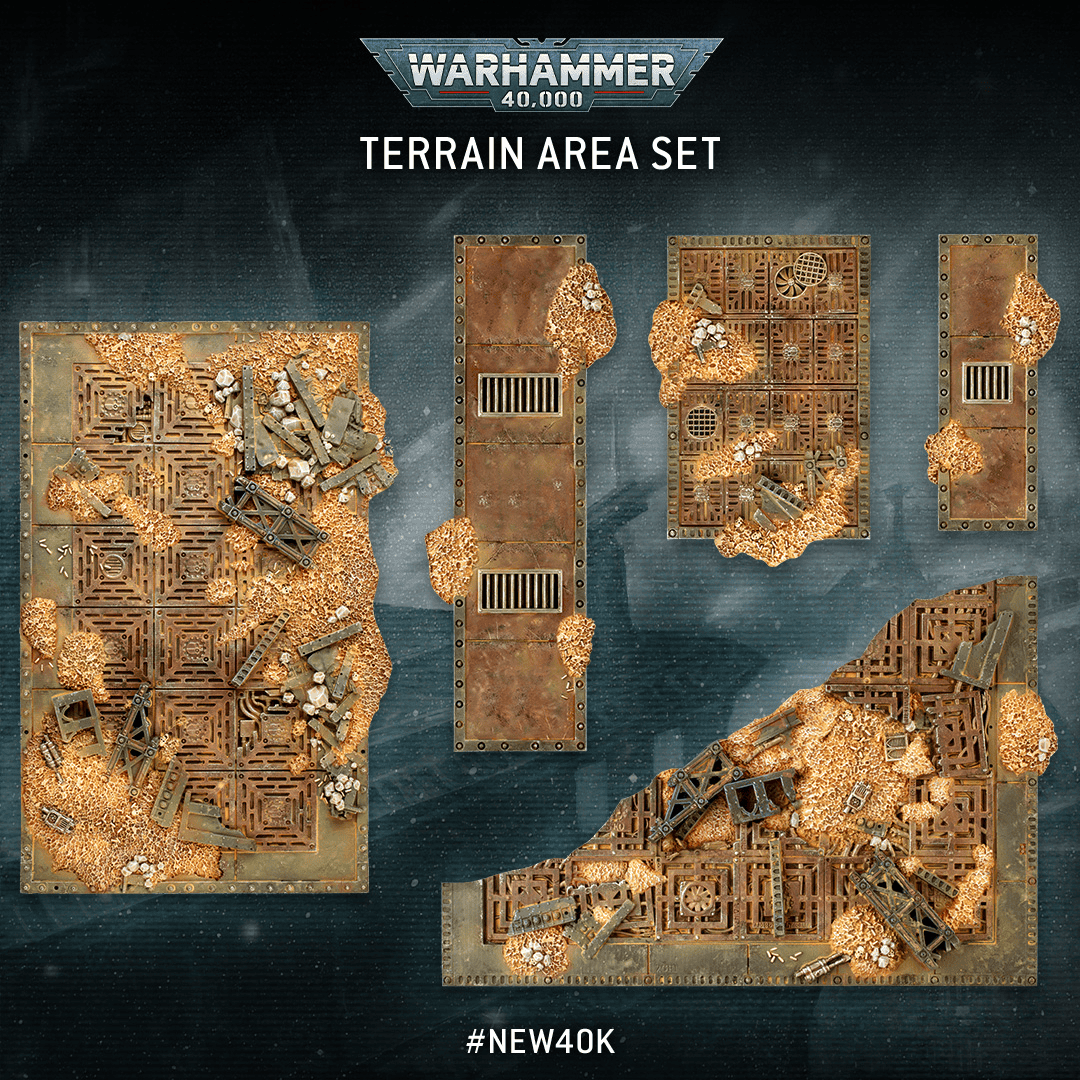
Terrain footprints take the wheel
The big shift is treating the (new) footprints as “rules”, with the walls and ruin bits more like the costume. Regardless, that means tables can look more varied without everyone arguing the same line-of-sight puzzle for the thousandth time.
If you need a set for your own table, here are the best 11th Edition terrain footprints to buy right now.
Here are the new dimensions and what terrain you’ll need:
- Four large rectangles – 7” x 11.5”
- Two large right-angle triangles – 8” x 11.5”
- Four medium rectangles – 6” x 4”
- Two long lines – 10” x 2.5”
- Four short lines – 6” x 2”
Compared to the old layout, that’s a lot more terrain to throw down:
- 6″x4″ – 4 count
- 12″x6″ – 6 count
- 10″x5″ – 2 count
Deployment and layouts get more “official.”
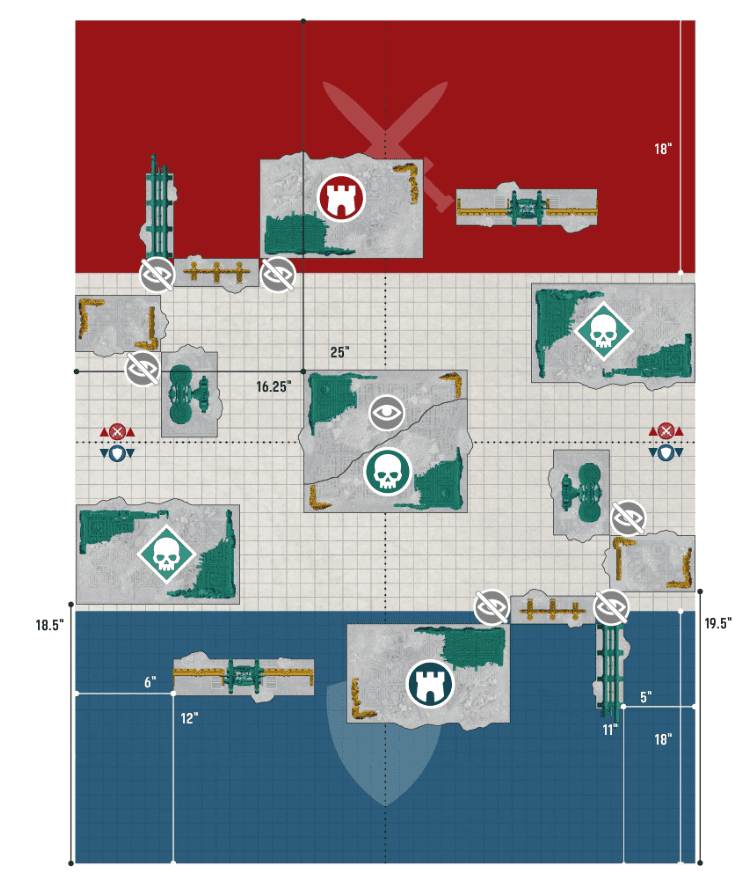 It’s official now that the new deployment maps bake in objective terrain placement, plus GW’s is pushing standardized competitive layouts (including varied footprint shapes) at all events. So if bigger tournament formats buy in, that could smooth out the wild “this table favors shooting, that one favors melee” swings when they happen.
The boring stuff stays put (good)
Quarterly balance updates and 44″x60″ boards sound like they’re sticking around. So you keep the familiar framework, but the battlefield itself starts doing a lot more work.
Staying Hidden Matters More Than Ever
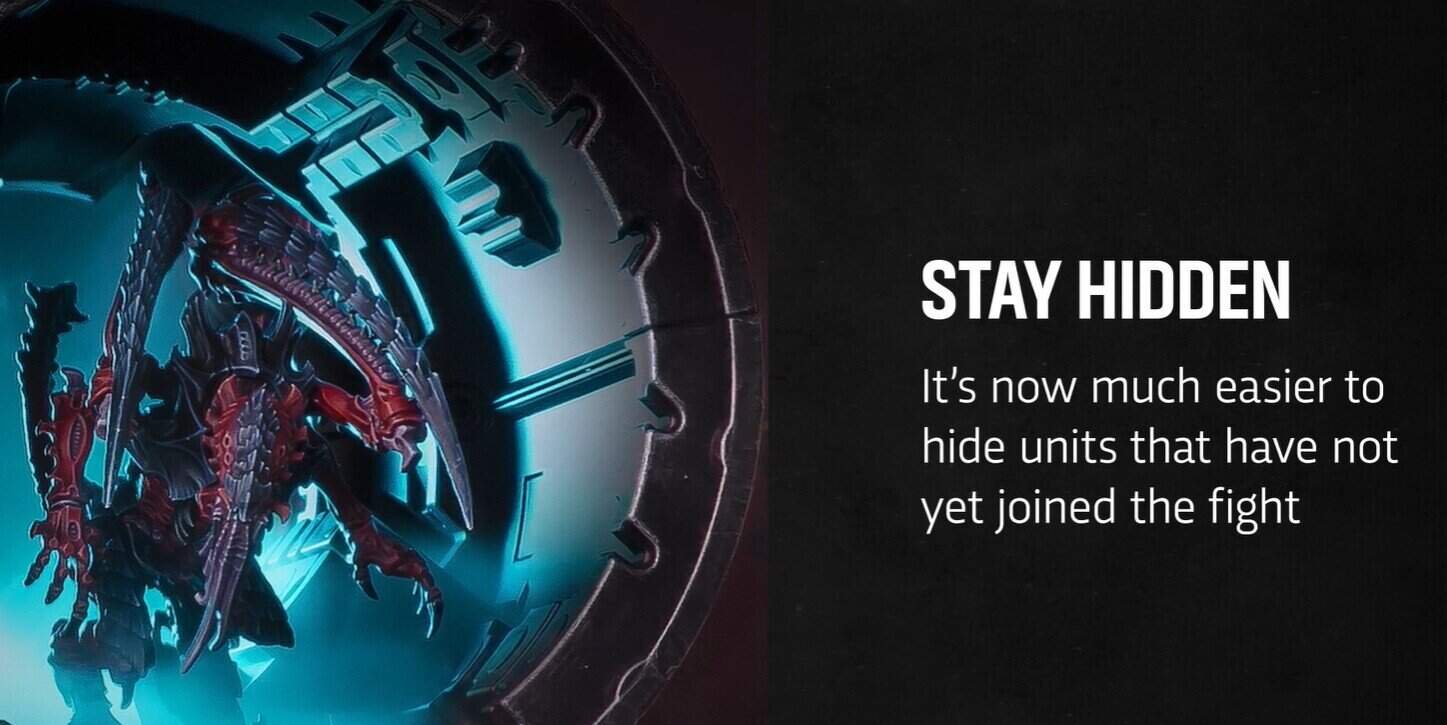 One of the sneakier Warhammer 40k 11th Edition rules changes here is how being hidden works on the table. Infantry can stay tucked away until they fire at another unit or an enemy gets within 15″, which should make movement, staging, and terrain use feel a lot more tactical.
 That’s great for armies that want to play cagey early, set up trades, or keep key units alive long enough to actually do something before getting blasted off the board.
Cover Affecting Hit Rolls Changes the Math
Shifting cover from saves to Hit rolls changes the feel of the game immediately.
Instead of making already tough units even harder to shift by piling onto their armor saves, cover now sounds like it interferes with the attacker’s ability to land shots cleanly in the first place.
That could help in a few ways:
- It may reduce some of the frustrating “I shot the thing, and it still ignored everything” moments.
- It could make battlefield positioning more meaningful.
- It may reward thoughtful use of terrain rather than just relying on raw defensive profiles.
For players who like tactical movement and using the board well, that is promising.
How You Actually Gain and Lose Cover Now
GW also spelled out who gets cover and how, and it’s more than just parking a couple of models behind a wall. Infantry, Beasts, and Swarms only get cover when the whole unit is inside the terrain feature.
Every other unit gets cover when every model is at least partially obscured by the terrain.
The catch is that one exposed model wrecks it for everyone. If a single Infantry model strays into the open where your opponent can see all of it, the squad loses cover. Same trap for a vehicle: park it dead center in a terrain piece with no wall actually blocking its hull, and it sits there in the open, getting no benefit at all.
Line of Sight and the New Solid Keyword
Terrain can now carry a Solid keyword, which is basically the old competitive rule where you can’t see through ruined windows; now it’s just official by GW. Any gap in a wall up to 3 inches tall counts as sealed, so you cannot trace a shot through it.
Once you get higher up in the ruins, you can start seeing through the windows to shoot.
The bigger swing is for models poking into terrain. In 10th Edition a model with a toe in the footprint could be seen, but could not see out. That’s gone now because in 11th, a model partly inside the terrain draws a line of sight normally, so it sees and gets seen the same way. Tall vehicles, monsters, and fast shooty units love this because they can creep up to a big central ruin and start firing through it instead of hiding behind it.
Movement Gets Cleaner: Free Pivots and Center-Point Measuring
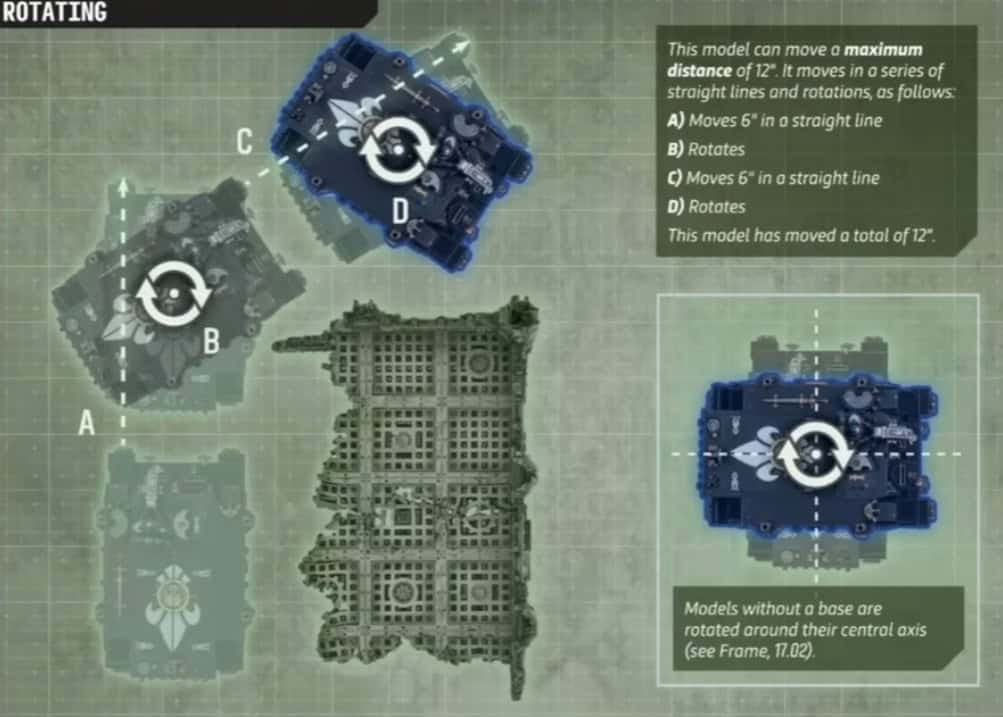
Two movement changes showed up in the livestream games that are easy to miss and are both super important. First, pivoting no longer costs you any movement, and every base type plays by the same rules now. To move, you pick the center of the model, move that center in straight lines, and spin the model around it as much as you want along the way.
That sounds minor until you remember how many oblong bases are in the game. Deploy a vehicle or a big oval-based model sideways along your line, then rotate it as you move, and you gain real board position for free. Long bases reach farther up the table, making it easier to touch objectives or slide into terrain for line of sight.
Now, they can’t do that quite as easily.
Coherency Loses the Two-by-Two Rule
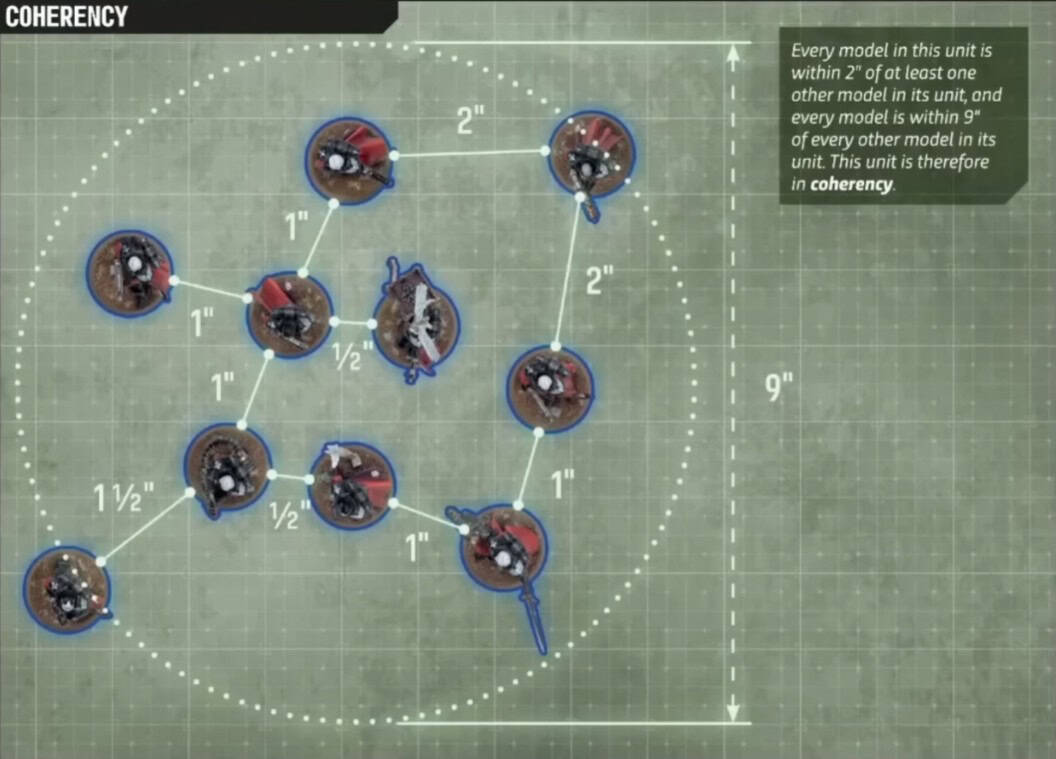
The old rule, where units of seven or more needed two models within 2 inches of each other, is gone. The new version is simpler: every model still has to be within 2 inches of one other model in the unit, but the whole squad also has to fit inside a 9-inch coherency bubble.
That kills the long conga-line slingshots from past editions while dropping the bookkeeping that made big units annoying to move.
11th Edition 40k Assault Rules: Charges + Fight Phases
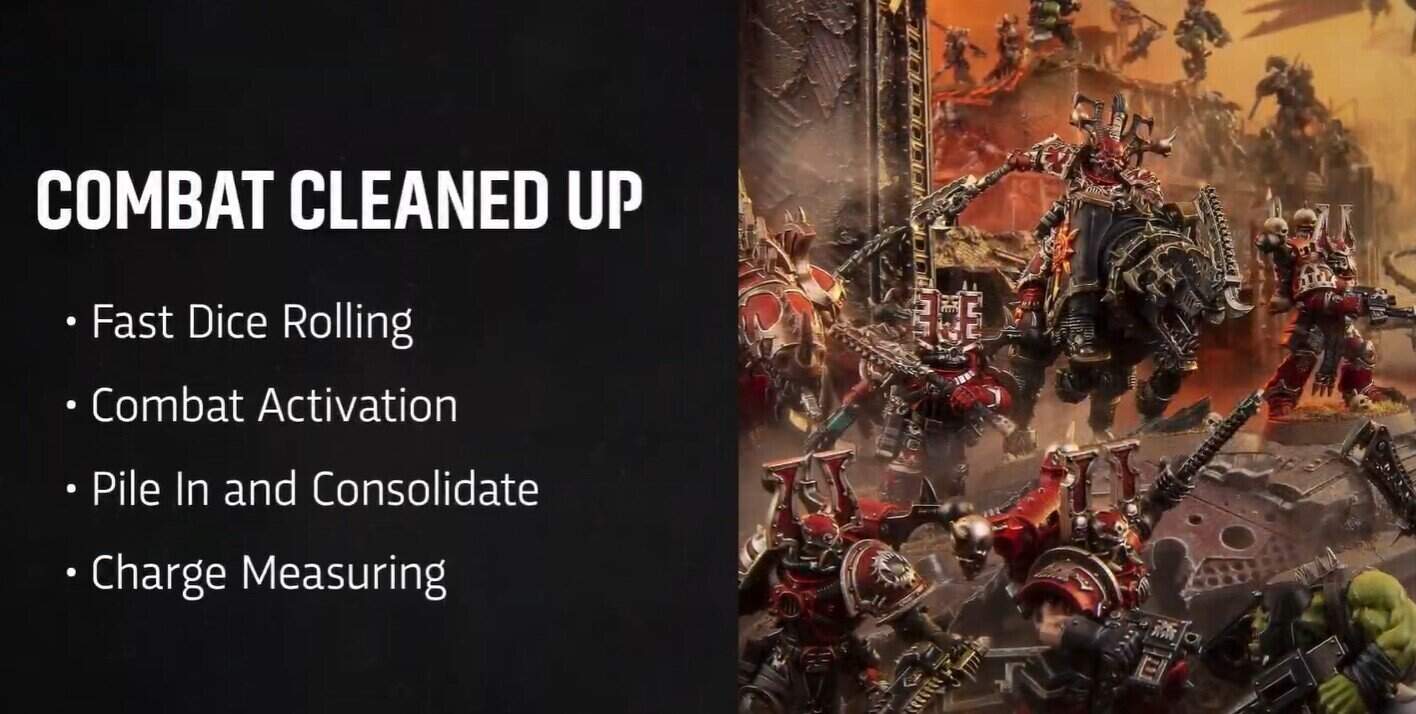
Melee in 11th has stopped being a geometry contest, and that shift alone will change how assault armies play. Engagement range jumps to 2″, which kills the 1.01″ wall-hugging trick overnight, and the charge sequence flips on its head so you roll first and pick targets after, meaning a bad angle doesn’t strand your key unit in the open.
Movement also gets the same treatment, because you can now push through an enemy unit’s engagement range mid-move as long as you don’t finish inside it.
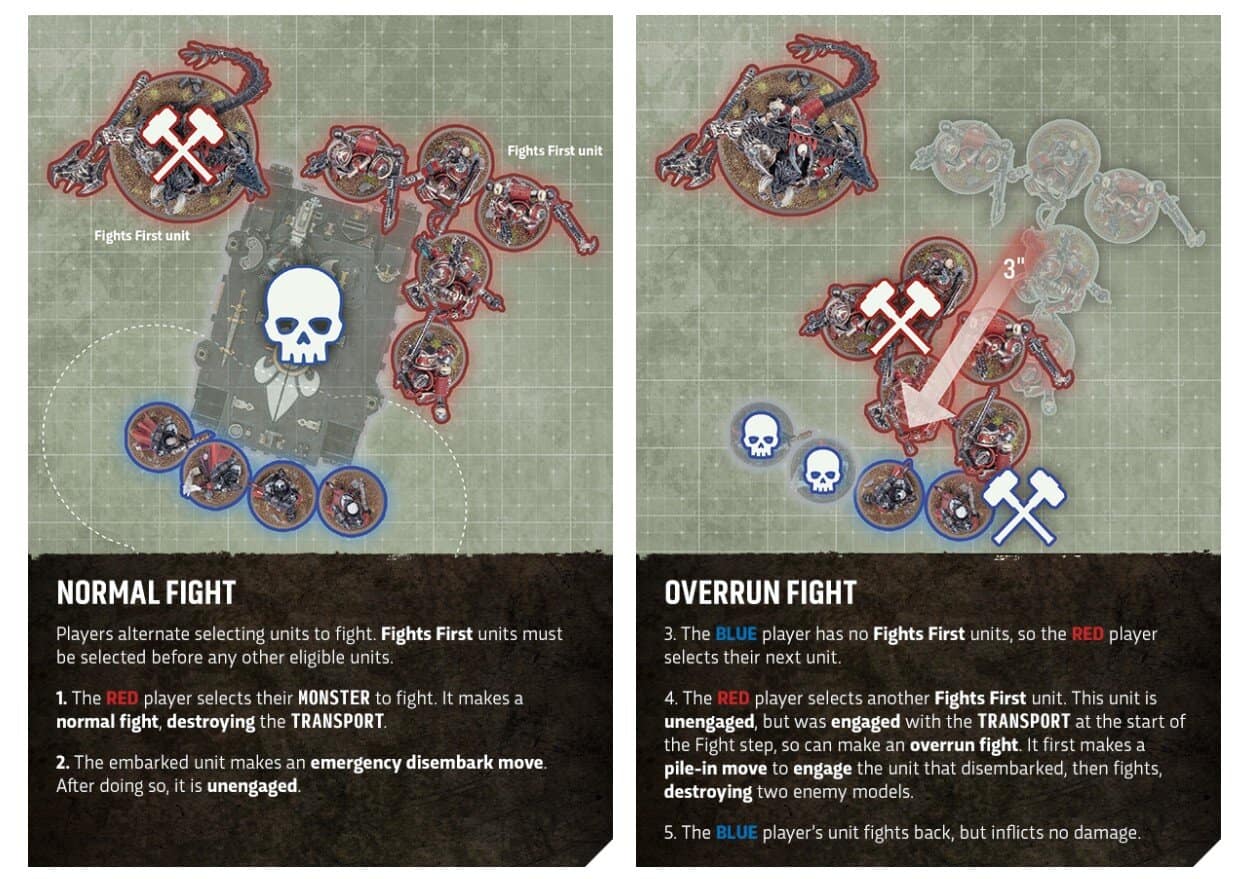
The Fight phase itself got tightened up, too, right where it used to grind. Now all Pile Ins are happening up front, and the player whose turn it is picks who swings first, even when both sides have Fights First.
That one change means your charger can actually land a blow now instead of getting sequenced into oblivion, and if the model you tagged dies before your unit activates, overrun fights let you Pile In again and hit something nearby, so eligible units aren’t shadowboxing at the end of the phase.

Lastly, Ingress moves like Deep Strike drops to 8″ instead of 9″, and units can bail from a transport that’s locked in combat, though they eat a Battleshock and can lose models on the way out.
For the full breakdown on every Charge and Fight phase change, and what it means for World Eaters, Orks, Tyranids, and anyone else who lives in melee, read the full 11th Edition assault rules guide here.
Charges, Pile-Ins, and Consolidations Get Looser
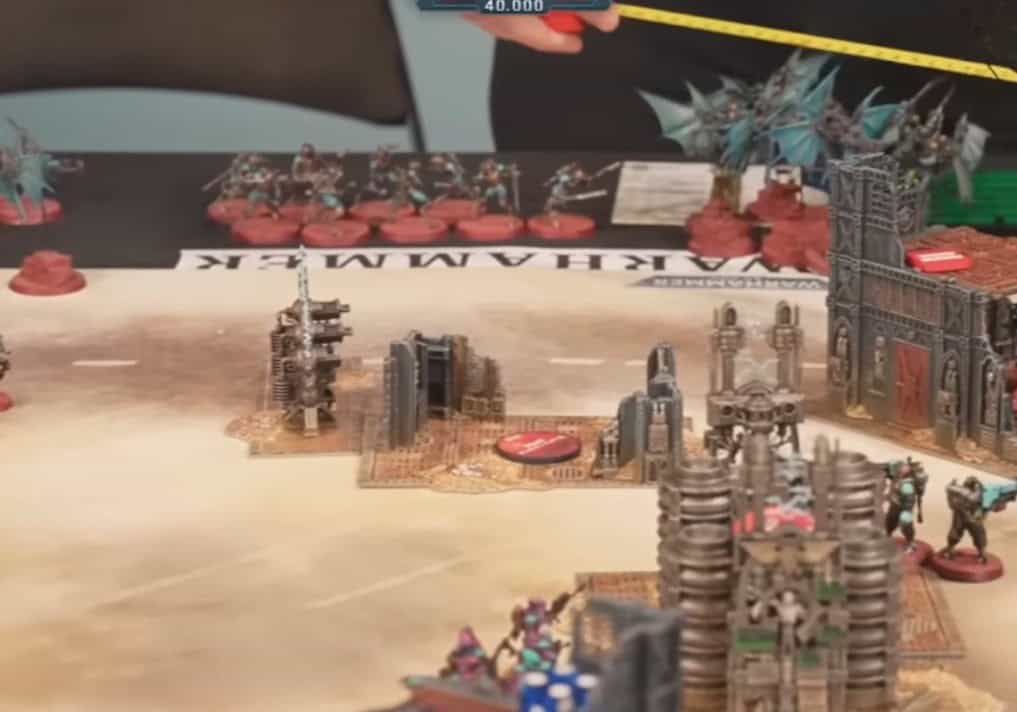
The livestream games also cleared up how loose combat movement gets. You no longer have to force models into base-to-base contact on a charge, pile-in, or consolidation. You just need to reach engagement range, and from there, your models can settle where they fit.
Just remember, GW did specifically say to make the charge, you have to roll high enough to get into base-to-base. It just seems like you don’t have to move the models all the way, now.
Consolidation around objectives is the sneaky-good part of all this. Since the center objective puck is gone, you only have to end the move on the objective’s terrain footprint. That means you can charge a unit sitting on an objective, wipe it, and then consolidate backward toward the rear edge of that terrain and still count as holding it.
Transports Lose the Generous Disembark
Disembarking also changes shape in 11th Edition. The old trick where you could place models 3 inches away from the transport, basically buying free threat range, is gone. Now models pile out as close as possible to the hull, forming a ring in base contact. You get about a base-width of movement out of it and nothing more, so expect people to use terrain and their own models to box out where a unit can even climb out.
Deadly Demise Goes Off After the Models Get Out
The trigger order on Deadly Demise flipped, too. In 10th Edition the explosion rolled before anyone disembarked, so passengers walked away clean. Now the models pile out first and then eat the Deadly Demise, which quietly guts tricks like moving the transport after rolling its demise to strand the unit. Not a huge deal day to day, but it’s good to know before you trust a wreck to keep your squad safe.
Attacks Now Resolve in Pools, and Saves Get Strange
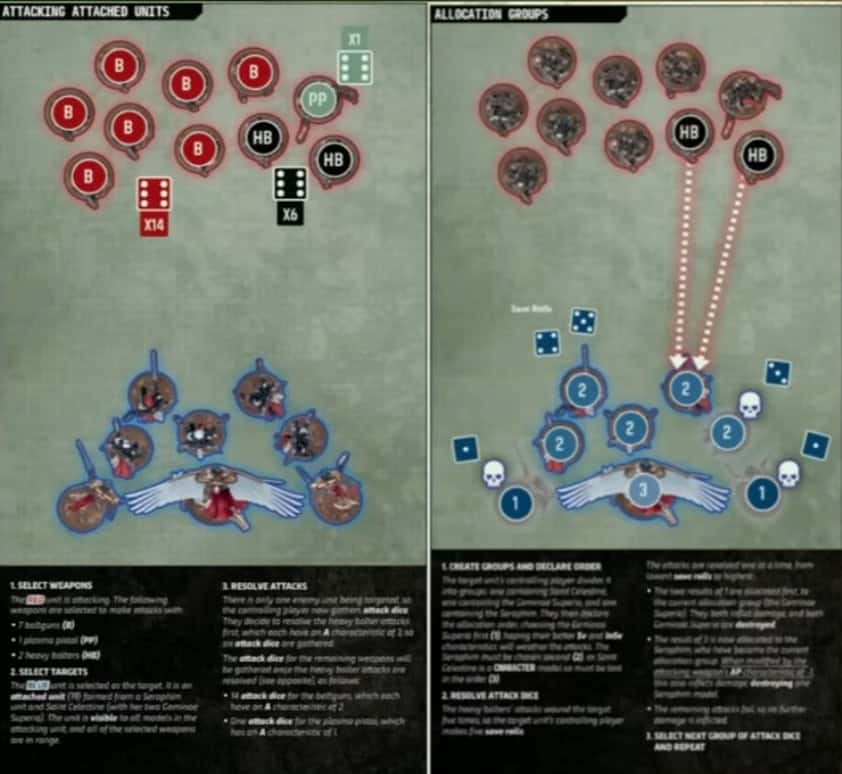
This might be the biggest single change between 10th and 11th Edition. Here’s how it works. Attacks no longer resolve one at a time. A unit gathers all the attacks from a single weapon type into a pool, and the attacking player picks which pool to resolve first.
Once the wounds are totaled, the defender takes over. You sort your unit into its defensive profiles, say plain power armor bodies, a Storm Shield model, and a Character, then you set the order they take saves.
Characters always go last, unless you have precision. You roll the saves as a batch and assign them from the lowest result upward, walking through your categories until models start dying.
Why Your Character Probably Lives
Because the low rolls get assigned first and Characters sit at the back of the line, a Character with an invulnerable save almost never eats a failed save while the rest of the squad is alive. Picture ten Guardsmen screening a Character with a 5+ invuln: the Guardsmen soak the 1s through 4s and drop, and the high rolls that are left land on the Character<,> who shrugs them off.
You can even park your non-invulnerable models early in the order on purpose, so your Storm Shield bodies tank the saves they were going to make anyway.
Precision Flips the Whole Thing
Precision used to just let you ping a Character. In 11th Edition, it hands the attacker the save order instead of the defender, and it breaks the Characters-go-last rule. So you can shove the enemy Character to the front of the line, feed them all the low rolls, and delete them before the bodyguards take a scratch.
If a unit has different defensive profiles inside it, Precision lets you choose not just who dies but the order they die in, which makes character sniping brutal. One last thing: if a unit is carrying both a Leader and a Support character, you order those two separately in the save step, as if they were their own categories.
10th vs 11th Edition At-a-Glance Rules Changes
Most of the 11th Edition changes are either keyword renames or behavioral flips you’ll feel the second the models hit the table. Honestly, the renames are mostly cosmetic, but the behavioral flips are where everything changes.
So here’s every update covered above, dropped into one side-by-side, so you can scan the new rules working in a single pass.
| Concept | 10th Edition | 11th Edition | Why It Matters |
| Tank Shock | Tank Shock | Crushing Impact | Same effect, just renamed. |
| Grenades | Grenades | Explosives | Same effect, just renamed. |
| Pistol Keyword | Pistol | Close-Quarters | Pistol stopped fitting once GW handed the keyword to non-pistol weapons. |
| Engagement Range | 1″ horizontal | 2″ horizontal | Kills the 1.01″ wall-hugging trick overnight. |
| Charge Sequence | Pick target, then roll | Roll, then pick target | A bad angle stops stranding your charger in the open. |
| Deep Strike Distance | 9″ | 8″ | Drops the 9″ charge from a prayer to a manageable reroll. |
| Cover | +1 to armor save | -1 to attacker’s hit roll | Cover finally matters, Invulns be damned. |
| Objectives | Round 40mm markers + 3″ control | Terrain footprint = objective | No more mousemats. Ruins and rubble are the objectives now. |
| Coherency (7+ Models) | Two models within 2″ | One model within 2″ + 9″ bubble | Kills the conga lines and drops the bookkeeping. |
| Stratagem Stacking | Multiple strats per unit per phase | One strat per unit per phase | End of the layer-cake death-star unit. |
| Pivoting | Costs movement | Free, around model’s center | Oblong bases pick up real board position for free. |
| Disembark Distance | Up to 3″ from hull | Base-to-base ring around hull | The free 3″ threat range is gone. |
| Deadly Demise Trigger | Before disembark | After disembark | Passengers eat the explosion now. |
| Hidden Detection | N/A | Cannot be targeted past 15″ unless you shoot | Cagey play and good movement finally get a real reward. |
| Leader / Bodyguard | Leader buff dies with the squad | Leader keeps abilities after squad dies | Characters keep earning their points the whole game. |
| Battle-Shock | Removed automatically | Must test in Command phase to shake | Proactive Battle-shock strats actually work now. |
| Save Resolution | Per-model saves, one at a time | Pooled saves, lowest rolls first, Characters last | Bodyguards eat the bad rolls. Characters live. |
| Precision | Pings a Character | Gives attacker save order, breaks Characters-go-last | Character sniping gets brutal. |
| Warhammer 40k 11th Edition Rules Changes At-a-Glance | |||
What These New 11th Edition Warhammer 40k Rules Changes Could Mean for Your Army
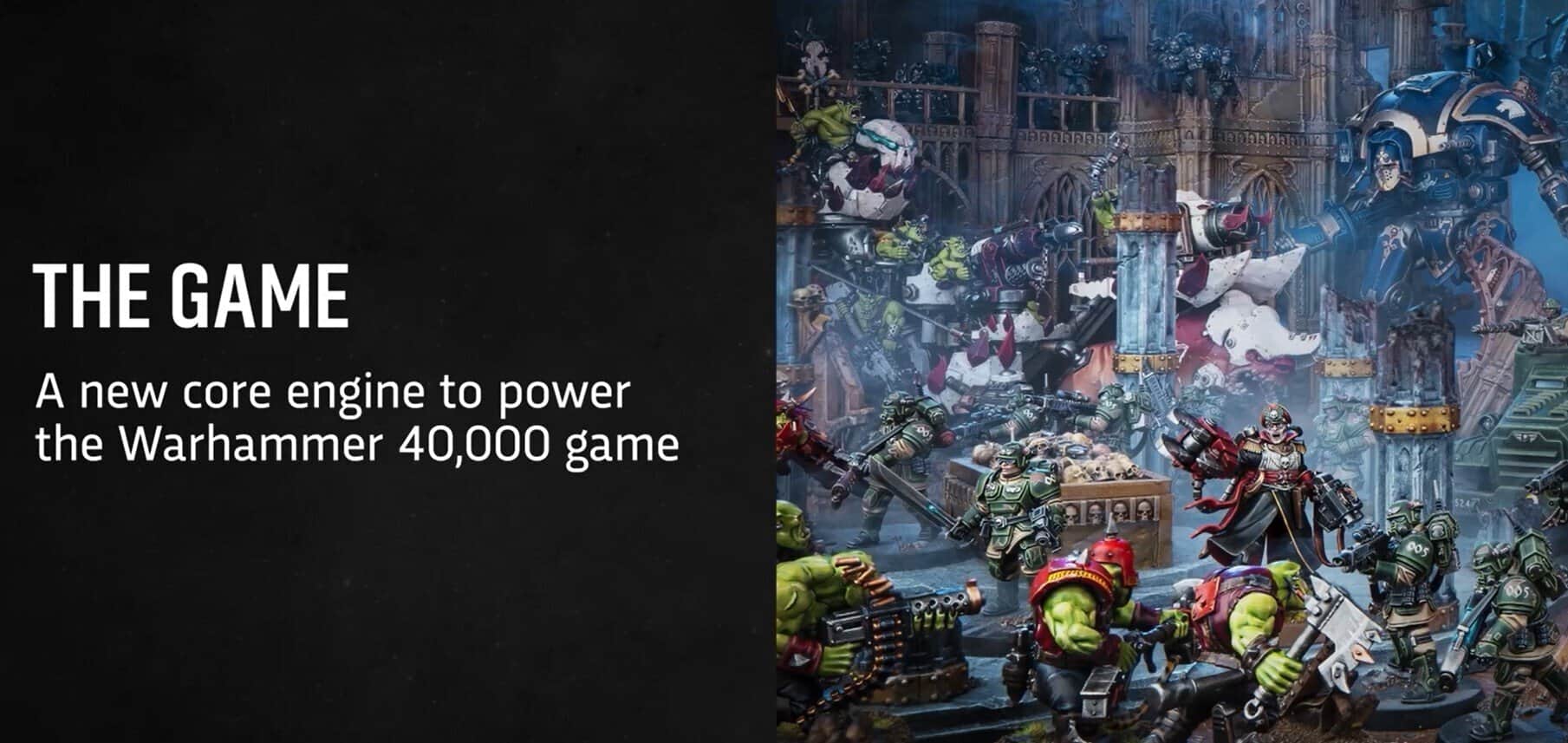 So what should players actually take away from these Warhammer 40k 11th Edition rules previews?
The biggest message is that Warhammer 40k 11th Edition rules are aiming for flexibility, battlefield interaction, and cleaner gameplay.
Your codex survives. Army building gets more room to breathe. Missions become more tied to army identity. Objectives are more terrain-based. Cover and hiding become more tactical. Combat gets streamlined.
That is a lot of pressure points getting adjusted at once.
Best-Case Scenario
If GW sticks the landing, 11th Edition could feel more thematic and dynamic without forcing players to throw out their current books and collections.
These Warhammer 40k 11th Edition rules previews would mean:
- more list creativity
- more missions that feel faction-appropriate
- less clunky terrain interaction
- fewer awkward fight-phase arguments
- more meaningful battlefield positioning
Worst-Case Scenario
The risk, as always, is balance.
Multiple detachment options, army-shaped missions, and major terrain changes all create room for strong ideas and terrible combos. So the full rules reveal is going to matter a lot more than the preview text.
Still, this early look at Warhammer 40k 11th Edition gives players a good reason to pay attention. These aren’t just cosmetic changes. Several of them could seriously reshape how games are built and played.
Warhammer 40k 11th Edition FAQ
What will change in Warhammer 40k 11th Edition?
11th Edition is a system tune-up, not a hard reset. Your current 10th Edition codex stays legal, but army building moves to a 1 to 3 point Detachment Points system, missions get generated by comparing each player’s Force Disposition, terrain footprints replace the round objective markers, cover swaps from a save buff to a hit debuff, hiding works out to 15″, and the Fight phase gets restructured around alternating activations and pooled saves. Honestly, that’s a lot of pressure points adjusted at once, but none of it tosses your books in the bin.
When did 11th Edition 40k come out?
It’s out now. 11th Edition came out on Saturday, June 20, 2026, in the Armageddon launch box, after pre-orders opened Saturday, June 6. The Core Rules have been a free download on Warhammer Community since June 1, 2026, so you don’t need the box to start learning the new edition.
What is the Cleave rule in Warhammer 40k 11th Edition?
Cleave is basically the melee version of Blast. Cleave X dishes out X bonus attacks for every 5 models in the target unit. So, Cleave 5, swinging into a 10-model unit, picks up 10 extra attacks. It scales hard against hordes and barely registers against single-model targets.
Will my 10th Edition codex still work in 11th Edition?
Yes. Every current 10th Edition codex stays legal at launch, including recent campaign supplements like Armageddon: Return of Yarrick. Each faction gets a PDF update at launch that adapts the codex rules to the new edition framework, and then a proper 11th Edition codex over the next three years.
How long will 11th Edition last?
If GW holds to the same cadence it’s run since 7th Edition launched in 2014, 11th Edition should run for three years, putting 12th Edition in summer 2029. Nothing official on that yet, but the pattern is pretty consistent.
Do I need the Armageddon launch box to play 11th Edition?
No. The Core Rules are free via the Warhammer 40,000 app and a downloadable PDF on Warhammer Community. The Armageddon box just bundles the Core Rules booklet, mission decks, the Operation Imperator lore book, and two starter armies for hobbyists who want everything in one package on day one.
How many new detachments come with 11th Edition?
GW confirmed 70 new detachments at launch, layered on top of every current codex detachment. So far, every revealed Faction Focus detachment costs 1 Detachment Point, which means a 2,000-point list can stack three of them.
What is a Force Disposition in 11th Edition?
Force Disposition is a thematic tag on every 11th Edition detachment: Take and Hold, Purge the Foe, Disruption, Reconnaissance, or Priority Assets. Comparing your Force Disposition against your opponent’s determines which Primary Mission you each play. So, unless you both pick the same one, you’ll each have different Primary objectives at the same table.
Final Thoughts on Warhammer 40k 11th Edition Rules Changes
 As far as the new Warhammer 40k 11th Edition rules previews go, the detachment update is probably the flashiest change, but the mission design, objective control, terrain rework, and combat cleanup might end up having the bigger effect once people start getting reps in.
Start looking at how your army wants to play, what terrain interaction might matter more, and how flexible mission scoring could reward your collection in new ways. Because if these previews are anything to go by, 11th Edition is not just asking what army you bring, it’s asking how you want that army to fight.
🔗 Related Reads:
- 40k 11th Edition Starter Set Details
- New 11th Edition Terrain Rules
- 40k Release Schedule Roadmap
- All the Chaos Rumors Heading Into 11th Edition
- Space Marine Rumors Roundup
- Latest Xenos Rumors for 40k
- New Combat Patrol Boxes
- Best Warhammer 40k Army List Builders