Which primer is best for miniatures and Warhammer models? We compare Citadel, P3, and Army Painter spray primers based on price, spray pattern, colors, and resin prep.
First off I just want to say never ever use that crap from Wal Mart.
Krylon is okay sometimes but that is about it. I have literally seen people bring in models to the store crying because they have melted due to janky primer. How that is even possible I have no idea, lol but I have seen it with my own eyes.
I’m only going to go over the big three primers, Citadel/ Games Workshop, Privateer Press/ P3, and Army Painter (the new kids on the block), mostly because that’s all I generally use. But believe me there is plenty to talk about between them, as they are very different.
Citadel Primer
Update, September 2026: This comparison was first published in November 2011, so the prices below are 2011 prices, not current ones. Formula P3 primers are now owned by Steamforged Games, which announced it had acquired the line from Privateer Press on June 3, 2024.
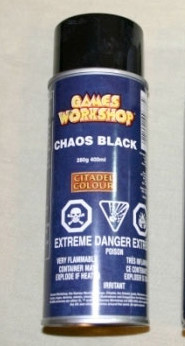 First off is Citadel Primer. I’ll be honest, this stuff isn’t cheap at a MSRP of $15. But it’s generally spot on as far as quality goes, and it’s formulated to be very forgiving for beginners who tend to glob on the paint.
Another cool feature is that it will attack and dissolve any bits of RTV rubber that may be on the model. Why is this important you ask? Well it’s almost impossible to paint over small bits of rubber than can become stuck in/on resin models from their molds during casting.
So if you’re going to shell out the cash to buy a nice Forge World model, you may want to use GW primer to make sure you get rid of any leftovers from the casting process.
Games Workshop used to also replace any models that were ruined because of faulty primer. I don’t know if they still do that, but its nice to have that kinda of insurance if they do.

The can produces a standard size spray pattern of primer, so generally you want to keep the nozzle about 10-12 inches away from the models your working on.
P3 Primer (Formula P3)

I use this stuff for most of my general work. It’s priced decently at $10, and comes in both black and white shades.
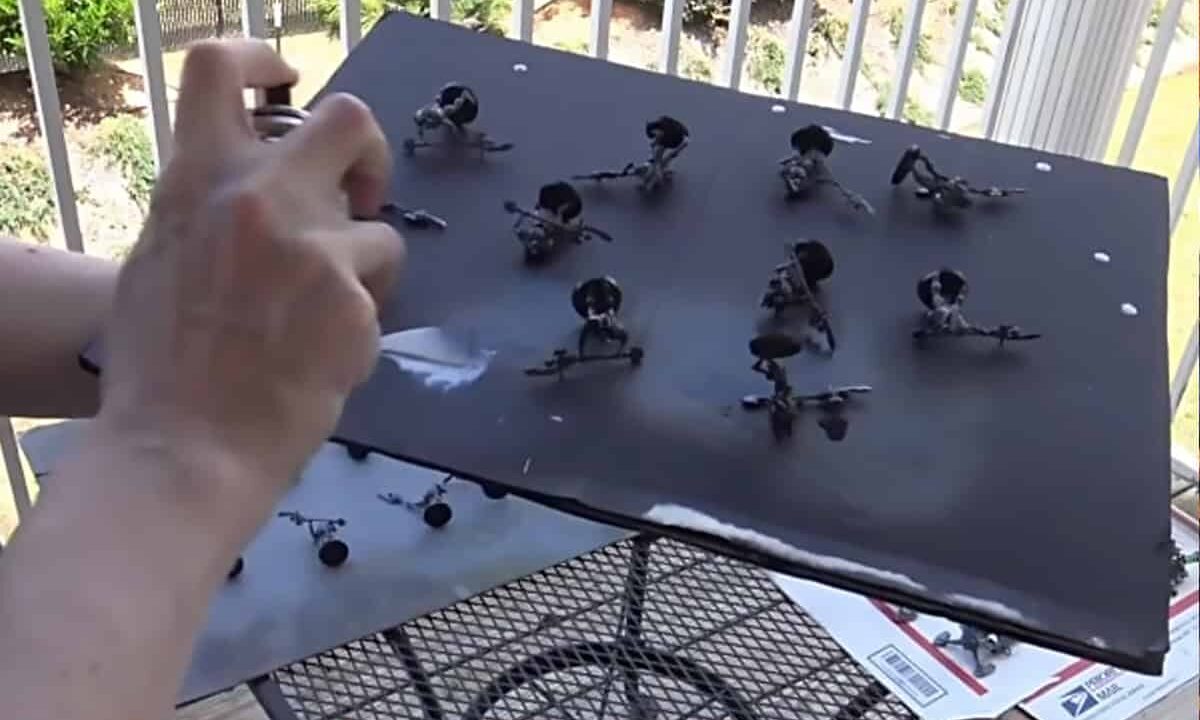
What I like about it is that it has a large spray pattern, so it’s much easier to cover the majority of your models when you use it.
I tried to show the approximate pattern below with the red lines, as compared to the normal spray you can see there already.

P3 Primer is also nice because it will get under wicked underhangs of weirdly positioned models, and vehicles way easier than with a normal can of spray primer because it’s special pattern. When I spray I generally keep the nozzle 10-12 inches away from the models I’m working with, just like the citadel stuff.
One bad thing about this primer however, is that does nothing about dissolving RTV Rubber like the citadel stuff.
Army Painter Colour Primers
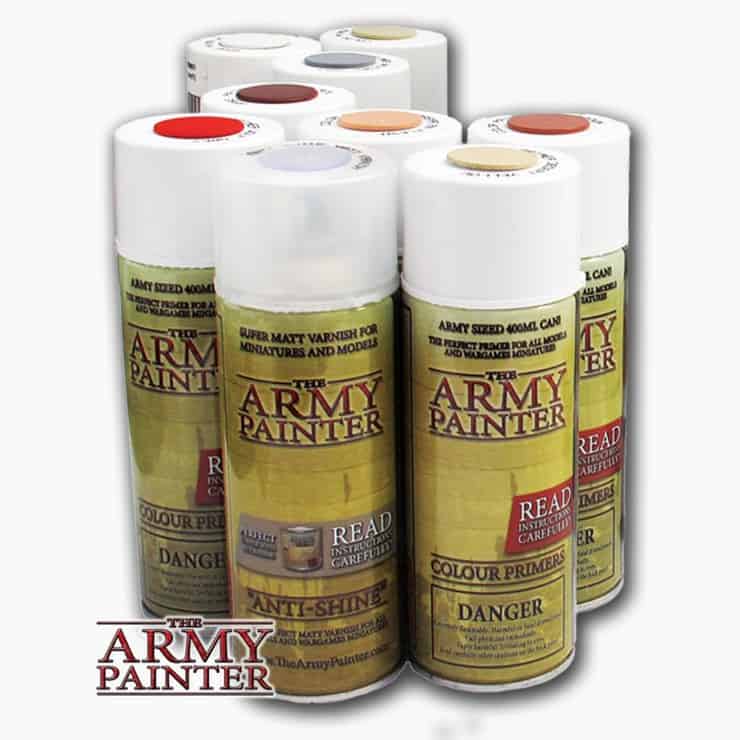
These guys are the relative new kids on the block, taking the old colored Citadel Spray idea and running with it (it’s even rumored that a lot of ex-Games Workshop guys work for them as well). Either way colored primers are a great idea because lets face it, not everyone can afford/ use an airbrush!
So they have quite the variety of color primers available, as well as the standard Black and White shades. This makes quick work of both primering and base-coating. The only problem is that its very hard to match that primer color with brush on paints, without mixing, so touch-ups are a semi pain.
They also have a whole system of dips, available for making painting even faster, and “getting more time to play”. I don’t use those myself, but I did help a friend paint his whole 2000 point army with them in only a weekend, lol. That was pretty remarkable!
I tend to just use the colored primers from Army Painter, as I prefer the P3 Black for all my general priming needs.
When I use this primer I generally get closer to the models, like about 8-10 inches. This stuff needs less distance to hit your models, and will fuzz up and trap air particles if you spray too far away.
So there you go, what primers I use and why. If you still want to know more about proper priming technique, check out my Hobby Basics: Priming 101 article from a few months ago. This will help you produce the best coat for your models, so be sure to check it out.
Frequently Asked Questions
Which primer is better for miniatures, white or black?
It depends on the colors you plan to use. The Army Painter’s own priming guide says white or lighter primers are useful when you want bright, vibrant colors, while black gives you a darker starting point and makes deep recesses more forgiving. For a mostly dark army, black saves work; for a bright scheme, start from white.
Is rustoleum primer ok for miniatures?
It can work, but it’s not made for miniatures. Rust-Oleum markets its Specialty Plastic Primer spray for items like plastic mailboxes and lawn chairs, and it tells you to test in a hidden area first because some plastics resist adhesion. Do the same on a spare sprue before you spray a finished model.
How long does 40k primer take to dry?
Plan on a few hours at minimum. The Army Painter’s guide to its Colour Primers says it is generally best to wait at least a few hours or overnight for primer to dry completely, and that drying time changes with temperature and humidity. Its priming guide recommends spraying at 15–27°C (60–80°F) and 40–60% humidity.
What is the difference between brush-on primer and spray primer for miniatures?
Speed. Warhammer TV’s painting team calls spray cans the best way to prime, because they get a base layer down quickly and easily. Brushing on primer or Base paint still works, but it takes extra thin coats and more effort; the trade-off is that you can prime indoors or when the weather will not cooperate with brush-on.
What primer do you use? Has anyone had any luck with the cheap-o Wal Mart stuff? -MBG